
We read your photo as:
State the observations made when Sulphur (IV) Oxide is bubbled through acidified potassium dichromate (VI), bromine water, nitric (V) acid, acidified potassium manganate (VII), and iron (III) chloride
ScanSolve AI Answer
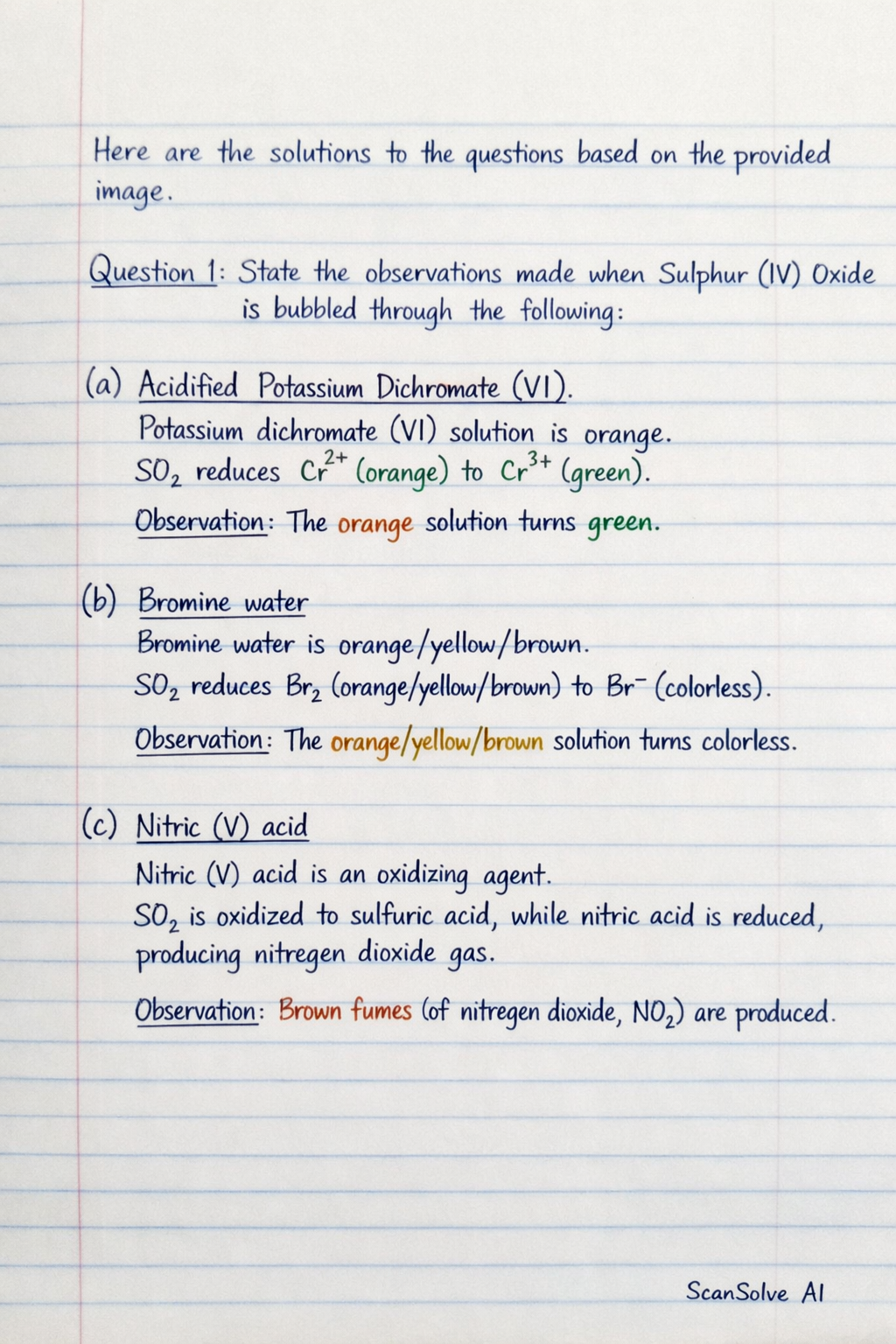
Here are the solutions to the questions based on the provided image.
Question 1: State the observations made when Sulphur (IV) Oxide is bubbled through the following:
Sulphur (IV) oxide () is a reducing agent. It will reduce the oxidizing agents listed below.
a) Acidified Potassium Dichromate (VI)
Potassium dichromate (VI) solution is orange. reduces (orange) to (green).
Observation: The orange solution turns green.
b) Bromine water
Bromine water is orange/yellow/brown. reduces (orange/yellow/brown) to (colorless).
Observation: The orange/yellow/brown solution turns colorless.
c) Nitric (V) acid
Nitric (V) acid is an oxidizing agent. is oxidized to sulfuric acid, while nitric acid is reduced, typically producing nitrogen dioxide gas.
Observation: Brown fumes (of nitrogen dioxide, ) are produced.
d) Acidified Potassium Manganate (VII)
Potassium manganate (VII) solution is purple. reduces (purple) to (colorless).
Observation: The purple solution turns colorless.
e) Iron (III) Chloride solution
Iron (III) chloride solution is yellow/brown. reduces (yellow/brown) to (pale green).
Observation: The yellow/brown solution turns pale green.
Question 2:
The question states: "Figure 1 is a flow chart which shows various reactions starting with hydrogen and nitrogen. Study it and answer the questions that follow."
Unfortunately, Figure 1 (the flowchart) is completely unreadable in the provided image. Therefore, I cannot answer any questions related to it.
Still stuck on this one?
Ask a follow-up, and the answer starts from this question.
More Chemistry Questions
Handwritten Step-by-Step Solution
Get this as a handwritten image on WhatsApp — like a tutor wrote it for you.
Try on WhatsApp