
We read your photo as:
When a burning candle is put into a gas jar of sulphur (IV) oxide gas, it goes off but a burning magnesium ribbon continues to burn. Explain these observations. Starting with copper metal, describe ho
ScanSolve AI Answer
Step-by-step solution
7 stepsHere are the solutions to the questions:
16) When a burning candle is put into a gas jar of sulphur (IV) oxide gas, it goes off but a burning magnesium ribbon continues to burn. Explain these observations.
- A burning candle goes off in sulphur (IV) oxide () gas because is a non-supporter of combustion. It does not provide oxygen for the candle to burn.
- A burning magnesium ribbon continues to burn in because magnesium is a very reactive metal and is a strong reducing agent. It reduces the sulphur (IV) oxide to sulphur, while magnesium itself gets oxidized to magnesium oxide. The reaction is: The heat from the burning magnesium is sufficient to sustain this reaction.
17) Starting with copper metal, describe how pure copper (II) carbonate can be prepared in the laboratory.
Convert copper metal to a soluble copper salt.
Heat copper metal in air to form copper (II) oxide:
Then, react copper (II) oxide with a dilute acid (e.g., nitric acid or sulfuric acid) to form a soluble copper salt:
(or )
Precipitate copper (II) carbonate.
Add a solution of a soluble carbonate (e.g., sodium carbonate or potassium carbonate) to the copper (II) nitrate (or sulfate) solution. Copper (II) carbonate is insoluble and will precipitate out.
Purify the copper (II) carbonate.
Filter the precipitate to separate it from the solution. Wash the precipitate with distilled water to remove any soluble impurities (like sodium nitrate). Finally, dry the pure copper (II) carbonate in an oven or desiccator.
18) a) State the observations that would be made when chlorine gas is bubbled through potassium bromide.
- The colorless potassium bromide solution would turn orange-brown (or yellow-brown) as bromine is displaced.
b) Write the ionic equation for the reaction in (a) above.
19) An element M has two isotopes. And. The relative atomic mass of the naturally occurring M is 63.5. Calculate the percentage abundance of each isotope.
This question is incomplete as the mass numbers of the two isotopes are not provided. To solve this, we need the mass numbers of the two isotopes.
Assuming the two isotopes are and (common for elements with average atomic mass around 63.5, like Copper):Set up equations for percentage abundance.
Let be the percentage abundance of .
Then, the percentage abundance of is .Use the formula for relative atomic mass.
Solve for .
Calculate the percentage abundance of each isotope.
Percentage abundance of .
Percentage abundance of .20) Distinguish between the terms deliquescent and efflorescent as used in chemistry.
- A substance is deliquescent if it absorbs moisture from the atmosphere and dissolves in it to form a solution. This process occurs when the vapor pressure of the saturated solution formed is less than the partial pressure of water vapor in the air.
- A substance is efflorescent if it loses its water of crystallization to the atmosphere when exposed to air, becoming a powder. This occurs when the vapor pressure of the hydrate is greater than the partial pressure of water vapor in the air.
Still stuck on this one?
Ask a follow-up, and the answer starts from this question.
More Chemistry Questions
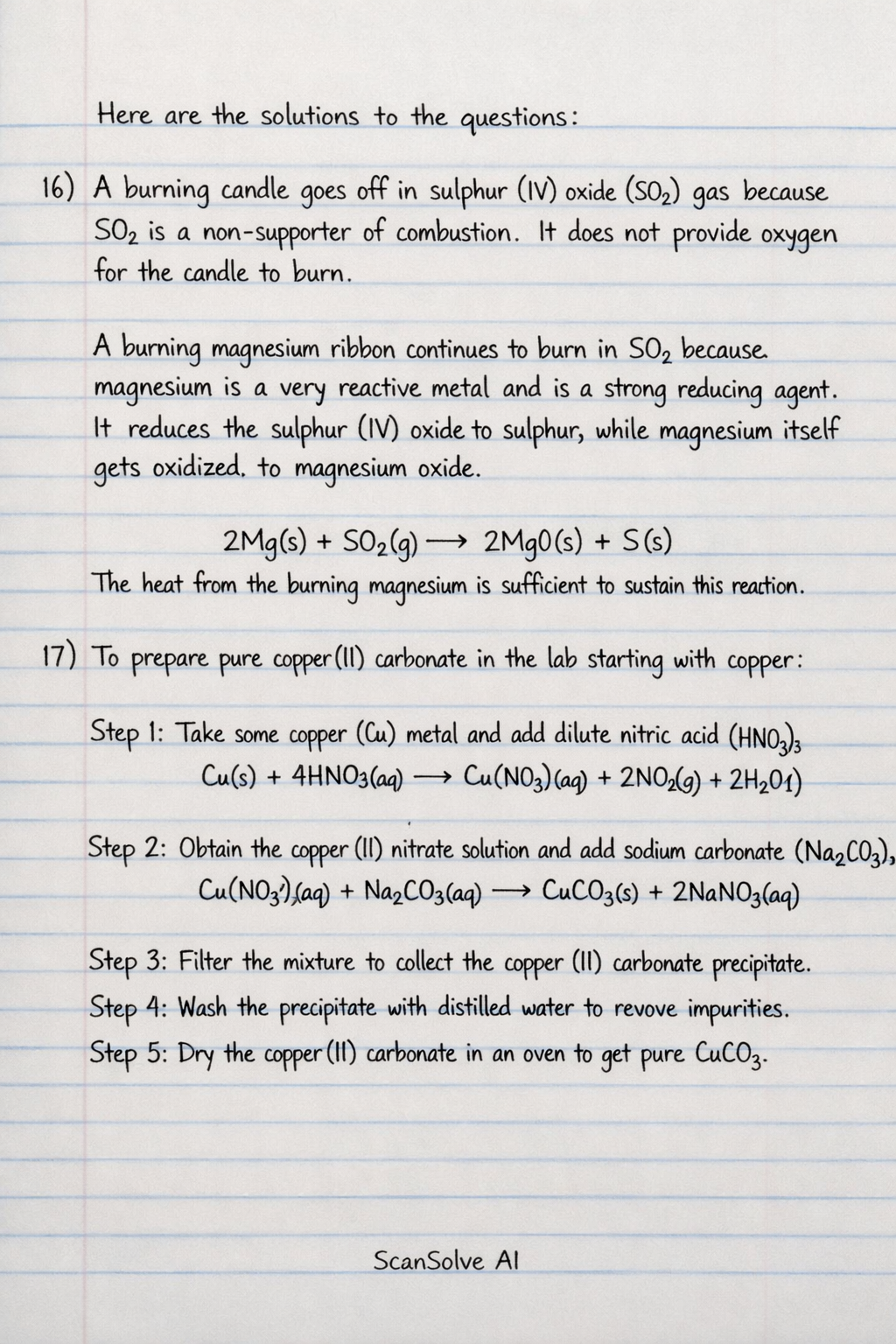
Handwritten Step-by-Step Solution
Get this as a handwritten image on WhatsApp — like a tutor wrote it for you.
Try on WhatsApp