

This chemistry question involves key chemical concepts and calculations. The detailed solution below walks through each step, from identifying the reaction type to computing the final answer.
ScanSolve AI Answer
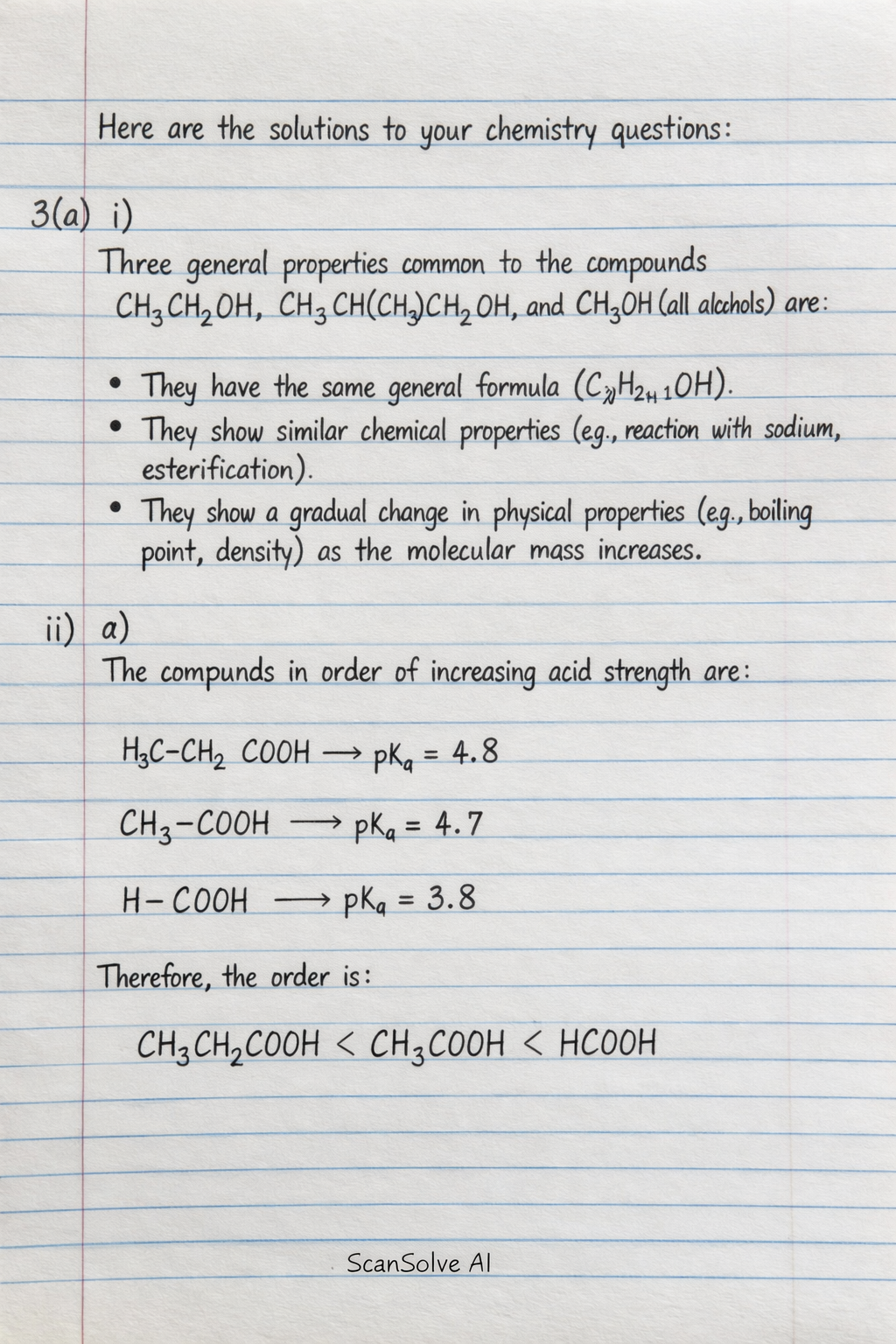
Here are the solutions to your chemistry questions: 3(a) i) Three general properties common to the compounds CH₃CH₂OH, CH₃CH(CH₃)CH₂OH, and CH₃OH (all alcohols) are: • They have the same general formula (C_nH_2n+1OH). • They show similar chemical properties (e.g., reaction with sodium, esterification). • They show a gradual change in physical properties (e.g., boiling point, density) as the molecular mass increases. ii) α) The compounds in order of increasing acid strength are: CH_3CH_2COOH < CH_3COOH < HCOOH β) The order of acid strength is determined by the stability of the conjugate base (carboxylate anion). Alkyl groups (CH_3, CH_3CH_2) are electron-donating. This electron-donating effect destabilizes the carboxylate anion by increasing the electron density on the negatively charged oxygen, making it less able to accommodate the negative charge. The stronger the electron-donating effect (i.e., the larger the alkyl group), the less stable the conjugate base, and thus the weaker the acid. Formic acid (HCOOH) has no alkyl group, so its conjugate base (HCOO^-) is the most stable, making HCOOH the strongest acid among the three. 3(b) i) Ionization energy is the minimum energy required to remove one mole of electrons from one mole of gaseous atoms in their ground state. ii) Four factors that determine the ionization energy values are: • Atomic radius: Smaller atoms have higher ionization energies because the valence electrons are closer to the nucleus and experience a stronger attraction. • Nuclear charge: A higher nuclear charge (more protons) leads to a stronger attraction for electrons, thus higher ionization energy. • Shielding effect: Inner electrons shield outer electrons from the full nuclear charge. A greater shielding effect reduces the effective nuclear charge, leading to lower ionization energy. • Electron configuration: Atoms with stable electron configurations (e.g., full or half-full subshells) have higher ionization energies because more energy is required to disrupt their stability. iii) Across a period, ionization energy generally increases. This is because, moving from left to right, the nuclear charge increases while the number of electron shells remains the same. This results in a stronger attraction between the nucleus and the valence electrons, and a decrease in atomic radius, making it harder to remove an electron. 3(c) Step 1: Write the balanced chemical equation for the reaction. Na_2CO_3(s) + 2HCl(aq) → 2NaCl(aq) + H_2O(l) + CO_2(g) Step 2: Determine the moles of CO_2 produced. From the balanced equation, 1 mole of Na_2CO_3 produces 1 mole of CO_2. Given 0.01 mol of Na_2CO_3, it will produce 0.01 mol of CO_2. Step 3: Calculate the number of molecules of CO_2. Number of molecules = moles × Avogadro's number (N_A) Number of molecules of CO_2 = 0.01 mol × 6.02 × 10^23 mol^-1 Number of molecules of CO_2 = 6.02 × 10^21 molecules 4(a) i) Classification of elements as metal or non-metal based on ionization energies: • Element A: Non-metal. The ionization energies increase gradually, with no very large jump, indicating that electrons are being removed from the same valence shell or that the element has many valence electrons. • Element B: Metal. There is a very large jump between the 1st (496 kJ mol⁻¹) and 2nd (4563 kJ mol⁻¹) ionization energies, indicating that it readily loses one electron to achieve a stable electron configuration, characteristic of a Group 1 metal. • Element C: Metal. There is a very large jump between the 2nd (1577 kJ mol⁻¹) and 3rd (3231 kJ mol⁻¹) ionization energies, indicating that it readily loses two electrons to achieve a stable electron configuration, characteristic of a Group 2 metal. • Element D: Metal. Similar to C, there is a very large jump between the 2nd (1451 kJ mol⁻¹) and 3rd (7733 kJ mol⁻¹) ionization energies, indicating it readily loses two electrons, characteristic of a Group 2 metal. ii) Explanation of classifications: • Metals typically have low first and second ionization energies because they tend to lose electrons to form positive ions. A significant jump in ionization energy occurs when an electron is removed from a stable, full inner electron shell, which requires much more energy. Elements B, C, and D show such jumps after losing 1 or 2 electrons, indicating they are metals. • Non-metals generally have higher ionization energies because they tend to gain electrons or share them. Their ionization energies increase more gradually as electrons are removed from the valence shell, and a large jump only occurs after all valence electrons have been removed. Element A shows this characteristic. 4(b) i) Suitable indicators for the titrations: α) CH_3COOH(aq) against KOH(aq) (Weak acid vs. Strong base): Phenolphthalein β) CH_3COOH(aq) against NH_3(aq) (Weak acid vs. Weak base): No suitable indicator γ) H_2SO_4(aq) against NH_3(aq) (Strong acid vs. Weak base): Methyl orange δ) HCl(aq) against NaOH(aq) (Strong acid vs. Strong base): Phenolphthalein (or Bromothymol blue, Methyl orange) ii) For the titration of a weak acid (CH_3COOH) against a weak base (NH_3), there is no sharp pH change at the equivalence point. The pH changes gradually over a wide range, making it impossible for a single indicator to accurately signal the equivalence point. 4(c) i) Tertiary alkanols resist oxidation because the carbon atom bearing the hydroxyl (-OH) group is bonded to three other carbon atoms and no hydrogen atoms. Oxidation typically involves the removal of a hydrogen atom from the carbon atom attached to the hydroxyl group. Since there are no such hydrogen atoms in tertiary alkanols, they cannot be easily oxidized. ii) α) The structural formula of the tertiary alkanol with the least number of carbon atoms (2-methylpropan-2-ol) is: c CH_3 \\ | \\ CH_3-C-OH \\ | \\ CH_3 β) The name of the structure drawn in (α) is 2-methylpropan-2-ol. 3 done, 2 left today. You're making progress.