
We read your photo as:
How many grams of Solid Aluminium Sulfide can be prepared by the reaction of 10.0 g of Aluminium and 15.0 g of Sulfur. How many grams of the non-limiting reactant are in excess.
ScanSolve AI Answer
Step-by-step solution
6 stepsWrite the balanced chemical equation.
Aluminum reacts with sulfur to form aluminum sulfide. Aluminum typically forms a ion and sulfur forms a ion, so the compound is .
Calculate the molar masses of the reactants and product.
- Molar mass of Al =
- Molar mass of S =
- Molar mass of
Convert the given masses of reactants to moles.
- Moles of Al =
- Moles of S =
Determine the limiting reactant.
To find the limiting reactant, divide the moles of each reactant by its stoichiometric coefficient from the balanced equation:
- For Al:
- For S: Since 0.1559 is less than 0.1853, Sulfur (S) is the limiting reactant, and Aluminum (Al) is the excess reactant.
Calculate the mass of solid Aluminum Sulfide () produced.
The amount of product is determined by the limiting reactant (Sulfur). From the balanced equation, 3 moles of S produce 1 mole of .
- Moles of produced =
- Mass of = Rounding to three significant figures, the mass of produced is .
Calculate the mass of the non-limiting reactant (Aluminum) in excess.
First, calculate the moles of Al consumed by the limiting reactant (S). From the balanced equation, 3 moles of S react with 2 moles of Al.
- Moles of Al consumed =
- Mass of Al consumed =
- Mass of Al in excess = Initial mass of Al - Mass of Al consumed
- Mass of Al in excess = Rounding to three significant figures, the mass of Aluminum in excess is .
Still stuck on this one?
Ask a follow-up, and the answer starts from this question.
More Chemistry Questions
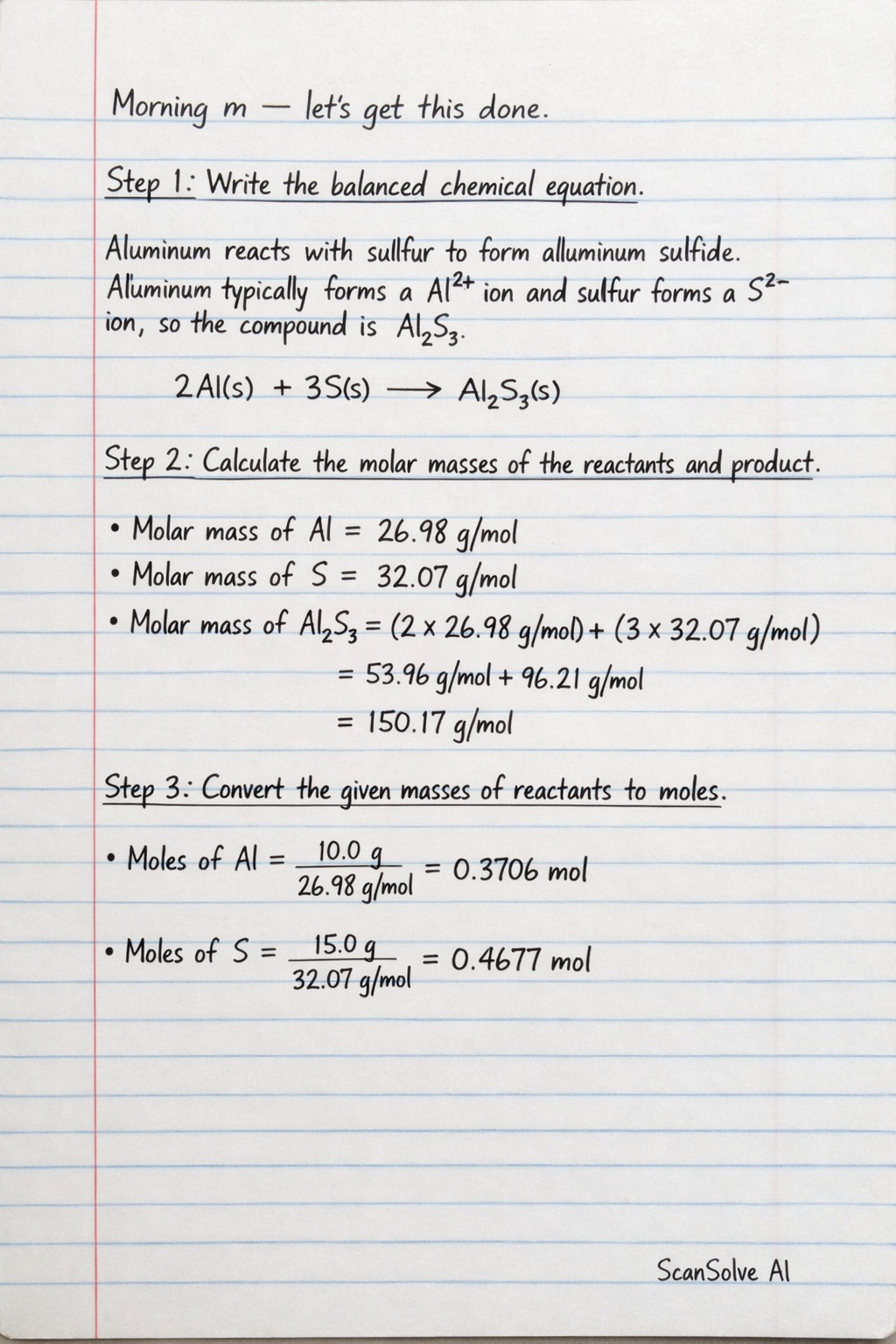
Handwritten Step-by-Step Solution
Get this as a handwritten image on WhatsApp — like a tutor wrote it for you.
Try on WhatsApp