
We read your photo as:
Figure 5 is a speed-time graph of an object. Given that the total distance travelled by the object is 7200m, calculate the acceleration in the first 40 seconds.
ScanSolve AI Answer
Step-by-step solution
7 stepsHere are the solutions to your questions.
18. Figure 5 is a speed-time graph of an object. Given that the total distance travelled by the object is 7200m, calculate the acceleration in the first 40 seconds.
Calculate the total distance travelled in terms of the maximum speed, .
The total distance travelled is the area under the speed-time graph. The graph forms a trapezium.
The parallel sides of the trapezium are the time intervals where the speed is non-zero.
Length of the first parallel side (top) = .
Length of the second parallel side (bottom) = .
The height of the trapezium is the maximum speed, .
The formula for the area of a trapezium is .Use the given total distance to find the maximum speed, .
We are given that the total distance travelled is .
Calculate the acceleration in the first 40 seconds.
Acceleration is the gradient of the speed-time graph. In the first 40 seconds, the object accelerates from rest () to a final speed of over a time interval of .
The formula for acceleration is .The acceleration in the first 40 seconds is .
19. Make the subject of the formula
Multiply both sides by 2 to eliminate the fraction.
Divide both sides by .
Rearrange the equation to isolate .
Add to both sides and subtract from both sides.
Take the square root of both sides to solve for .
The subject of the formula is .
Still stuck on this one?
Ask a follow-up, and the answer starts from this question.
More Physics Questions
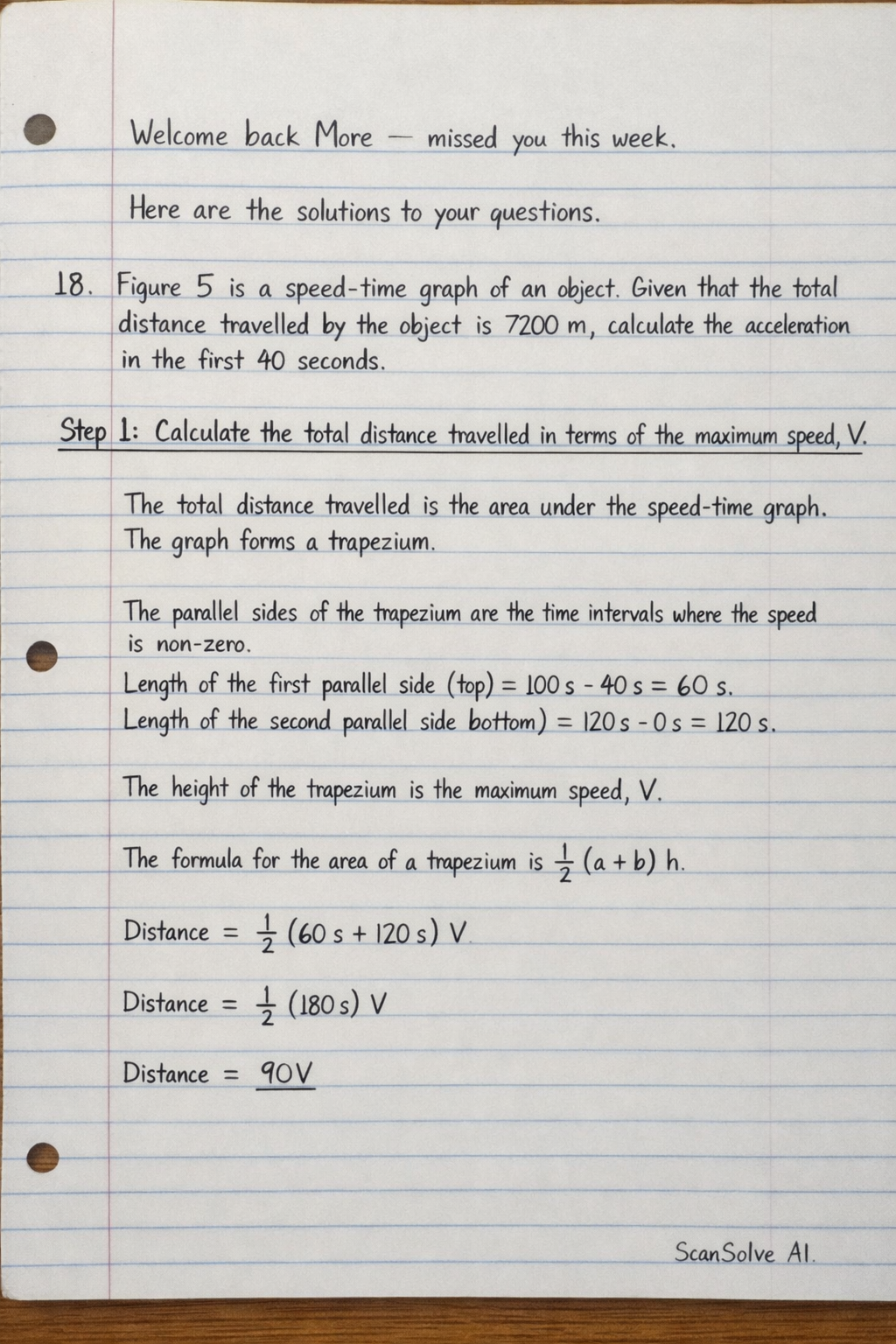
Handwritten Step-by-Step Solution
Get this as a handwritten image on WhatsApp — like a tutor wrote it for you.
Try on WhatsApp