
We read your photo as:
A velocity-time graph for a car shows acceleration for the first 2s, constant velocity for the next 4s, and deceleration for the final 2s. The maximum velocity reached is 8 m/s. Find the total distanc
ScanSolve AI Answer
Answers
2 partsStep-by-step solution
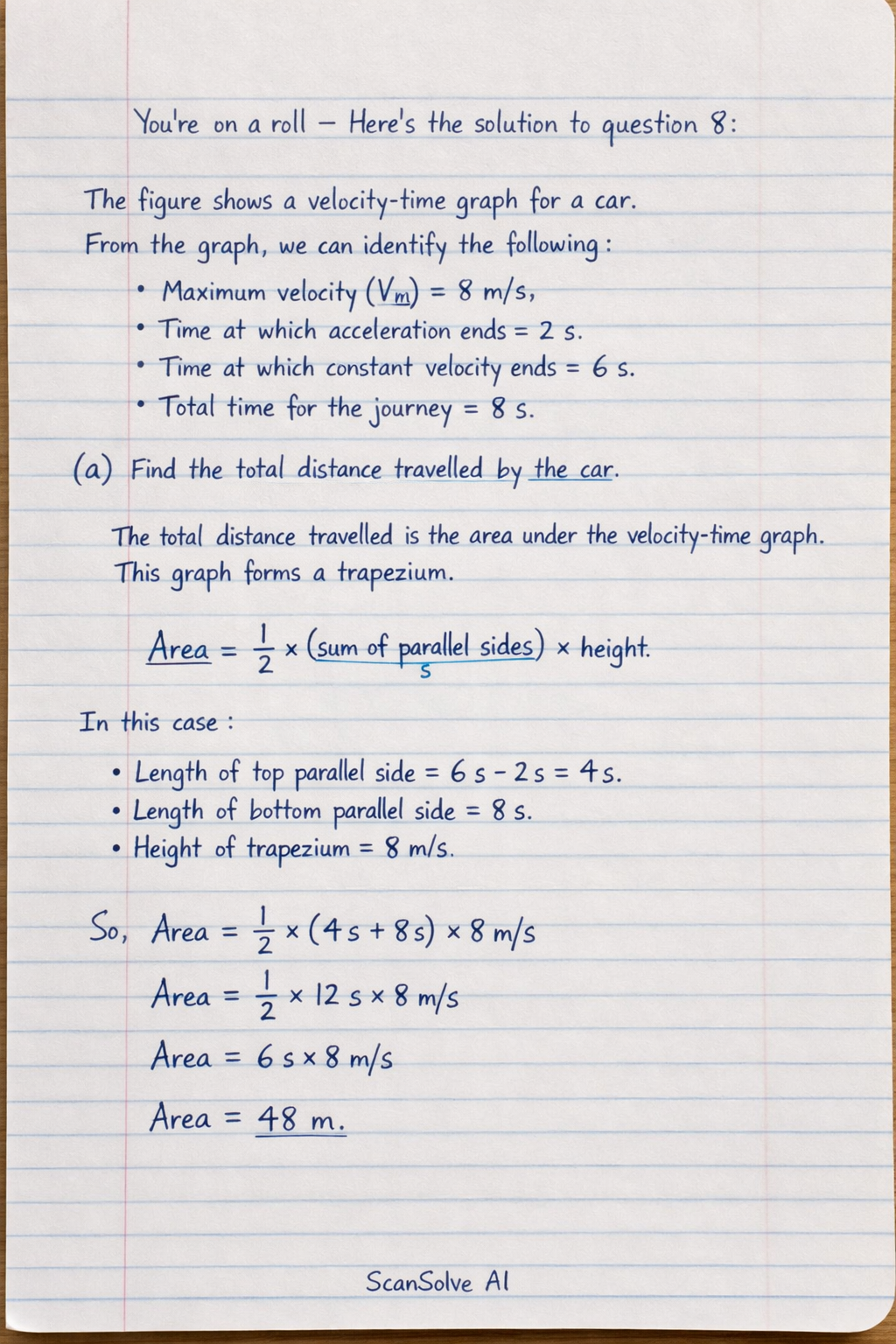
2 stepsHere's the solution to question 8:
The figure shows a velocity-time graph for a car.
From the graph, we can identify the following:
- Maximum velocity () = 8 m/s.
- Time at which acceleration ends and constant velocity begins = 2 s.
- Time at which constant velocity ends and deceleration begins = 6 s.
- Total time for the journey = 8 s.
Part a· 1 step
Find the total distance travelled by the car.
The total distance travelled is the area under the velocity-time graph. This graph forms a trapezium.
The area of a trapezium is given by the formula:
In this case:
- The length of the top parallel side (duration of constant velocity) = .
- The length of the bottom parallel side (total time) = .
- The height of the trapezium (maximum velocity) = .
Calculate the total distance.
The total distance travelled by the car is .
Part b
Calculate the deceleration of the car.
Deceleration occurs in the last phase of the journey, from s to s.
Deceleration is the negative of the acceleration, which is the gradient of the velocity-time graph during this period.
- Initial velocity () at s = 8 m/s.
- Final velocity () at s = 0 m/s.
- Time interval () = .
Calculate the deceleration.
The deceleration is the magnitude of this negative acceleration.
The deceleration of the car is .
Try one yourself
A new problem that tests the same skill.
Still stuck on this one?
Ask a follow-up, and the answer starts from this question.
More Physics Questions
Handwritten Step-by-Step Solution
Get this as a handwritten image on WhatsApp — like a tutor wrote it for you.
Try on WhatsApp