
We read your photo as:
Calculate the acceleration for each car.
ScanSolve AI Answer
Answer
Step-by-step solution
4 stepsCalculate the acceleration for each car.
The formula for constant acceleration starting from rest is .
For Car A:
Initial velocity
Final velocity
TimeFor Car B:
Initial velocity
Final velocity
TimeCalculate velocities at five instants of time for plotting.
We will calculate velocities at to cover the relevant time range up to .
The velocity for constant acceleration is . Since , .For Car A ():
- At ,
- At ,
- At ,
- For , Car A maintains its velocity of .
- At ,
- At ,
For Car B ():
- At ,
- At ,
- At ,
- At ,
- At ,
Describe the velocity-time graphs.
To plot the graphs on the same axes (time on x-axis, velocity on y-axis):
- Car A: The graph starts at . It is a straight line with a positive slope (representing constant acceleration) from to . After , the velocity remains constant at , so the graph becomes a horizontal line from to .
- Car B: The graph starts at . It is a straight line with a positive slope (representing constant acceleration) from to .
Calculate the displacement using the graph.
Displacement is the area under the velocity-time graph for the specified time intervals.
For Car A (interval to ):
The graph forms a triangle with base and height .The displacement for Car A is .
For Car B (interval to ):
The graph forms a triangle with base and height .
Try one yourself
A new problem that tests the same skill.
Still stuck on this one?
Ask a follow-up, and the answer starts from this question.
More Physics Questions
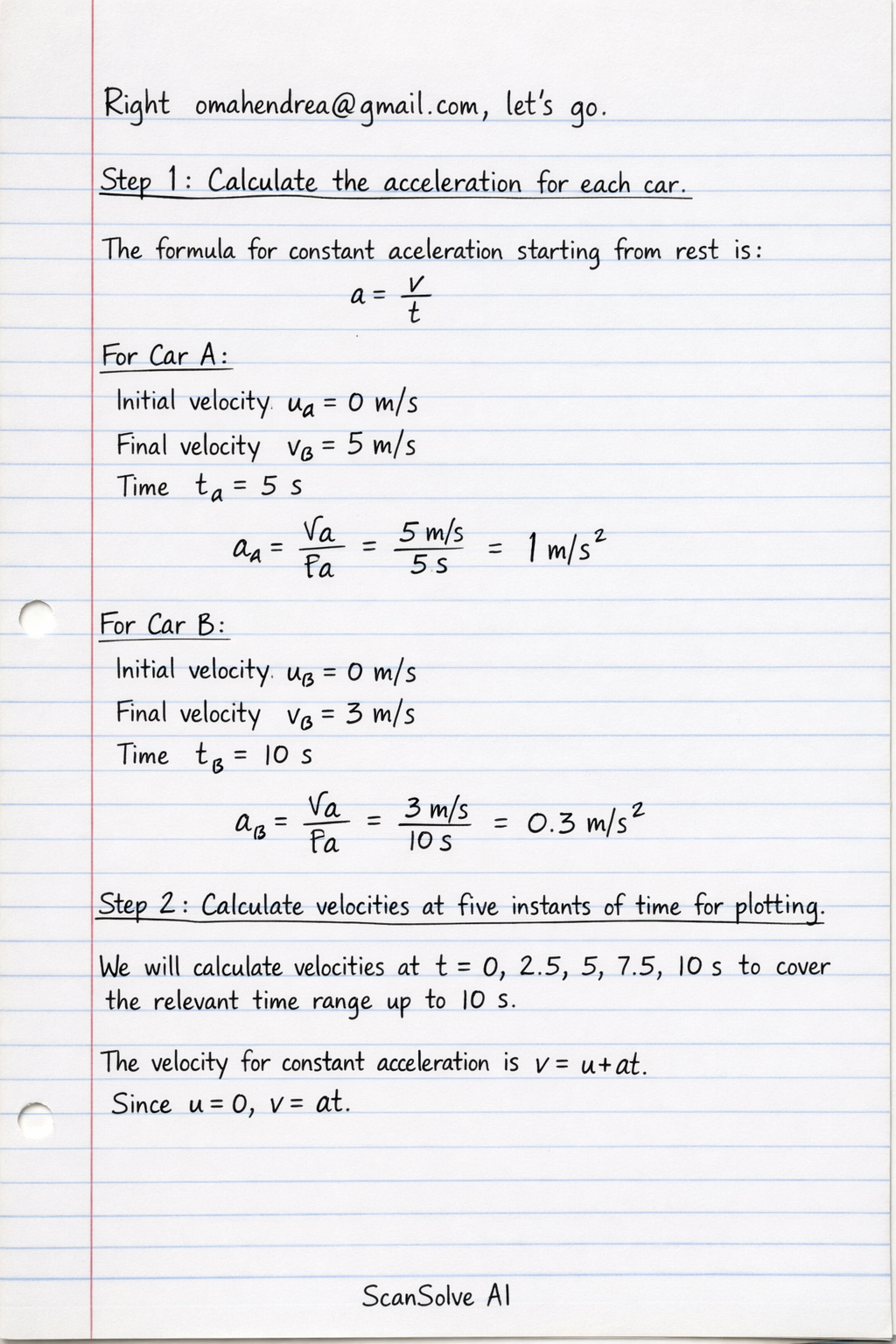
Handwritten Step-by-Step Solution
Get this as a handwritten image on WhatsApp — like a tutor wrote it for you.
Try on WhatsApp