
We read your photo as:
Which of the following forms of oxygen can exist freely in nature? A O, B O2, C O3
ScanSolve AI Answer
Answer
Step-by-step solution
3 stepsPart a· 1 step
OBJECTIVES
-
The form of oxygen that cannot exist freely in nature is atomic oxygen.
- A. O
-
Ions are not fundamental particles of an atom; they are atoms that have gained or lost electrons.
- B. Ions
-
Crystalline compounds have a regular, ordered structure, which results in a specific temperature at which all bonds break simultaneously.
- True
-
The regular arrangement of atoms in a crystal is known as a crystal lattice.
- C. Lattice
-
Step 1: Identify the given values and the formula for Hooke's Law. Given force and extension . Hooke's Law states , where is the spring constant.
Calculate the spring constant .
$$
k = \frac{F}{x} = \frac{20\, \text{N}}{2\, \text{m}} = 10\, \text{N/m}
$$
*   **A. 10 N/m**
Part b
THEORY
-
An atom consists of a central, dense nucleus containing positively charged protons and neutral neutrons. Negatively charged electrons orbit the nucleus in specific energy levels or shells. The number of protons determines the element.
-
• Cohesion is the attractive force between molecules of the same substance. For example, water molecules are cohesive, causing surface tension.
- Adhesion is the attractive force between molecules of different substances. For example, water adheres to glass, causing it to climb up a narrow tube (capillary action).
-
Young's Modulus (or modulus of elasticity) is a measure of the stiffness of an elastic material. It is defined as the ratio of tensile stress to tensile strain within the elastic limit of the material.
where is the applied force, is the cross-sectional area, is the extension, and is the original length.
-
Step 1: Calculate the spring constant () using the initial force and extension. Given initial force and initial extension . Using Hooke's Law, :
Calculate the new extension () when the applied force is .
Given new force $F_2 = 20\, \text{N}$. Using Hooke's Law, $F_2 = kx_2$: $$ x_2 = \frac{F_2}{k} = \frac{20\, \text{N}}{50\, \text{N/m}} = 0.4\, \text{m} $$Calculate the total length of the spring.
The natural length of the spring $L_0 = 0.5\, \text{m}$.
The new total length $L_2 = L_0 + x_2$:
$$
L_2 = 0.5\, \text{m} + 0.4\, \text{m} = 0.9\, \text{m}
$$
The length of the spring when the applied force is $20\, \text{N}$ will be $\boxed{\text{0.9 m}}$.
Try one yourself
A new problem that tests the same skill.
Still stuck on this one?
Ask a follow-up, and the answer starts from this question.
More Physics Questions
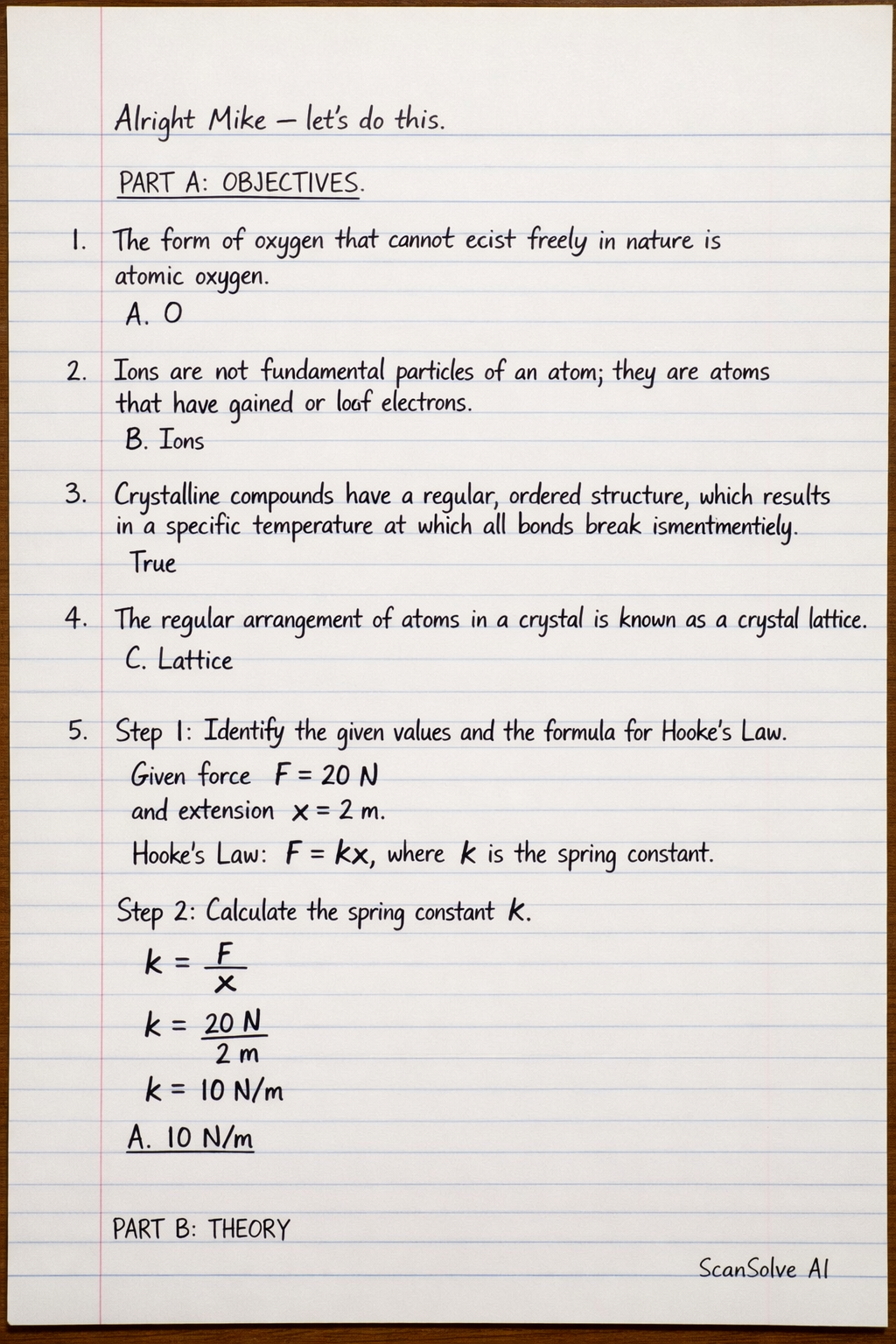
Handwritten Step-by-Step Solution
Get this as a handwritten image on WhatsApp — like a tutor wrote it for you.
Try on WhatsApp