
We read your photo as:
Calculate the acceleration for each of the three systems.
ScanSolve AI Answer
Answer
Step-by-step solution
4 stepsHere's how to determine the accelerations for each system:
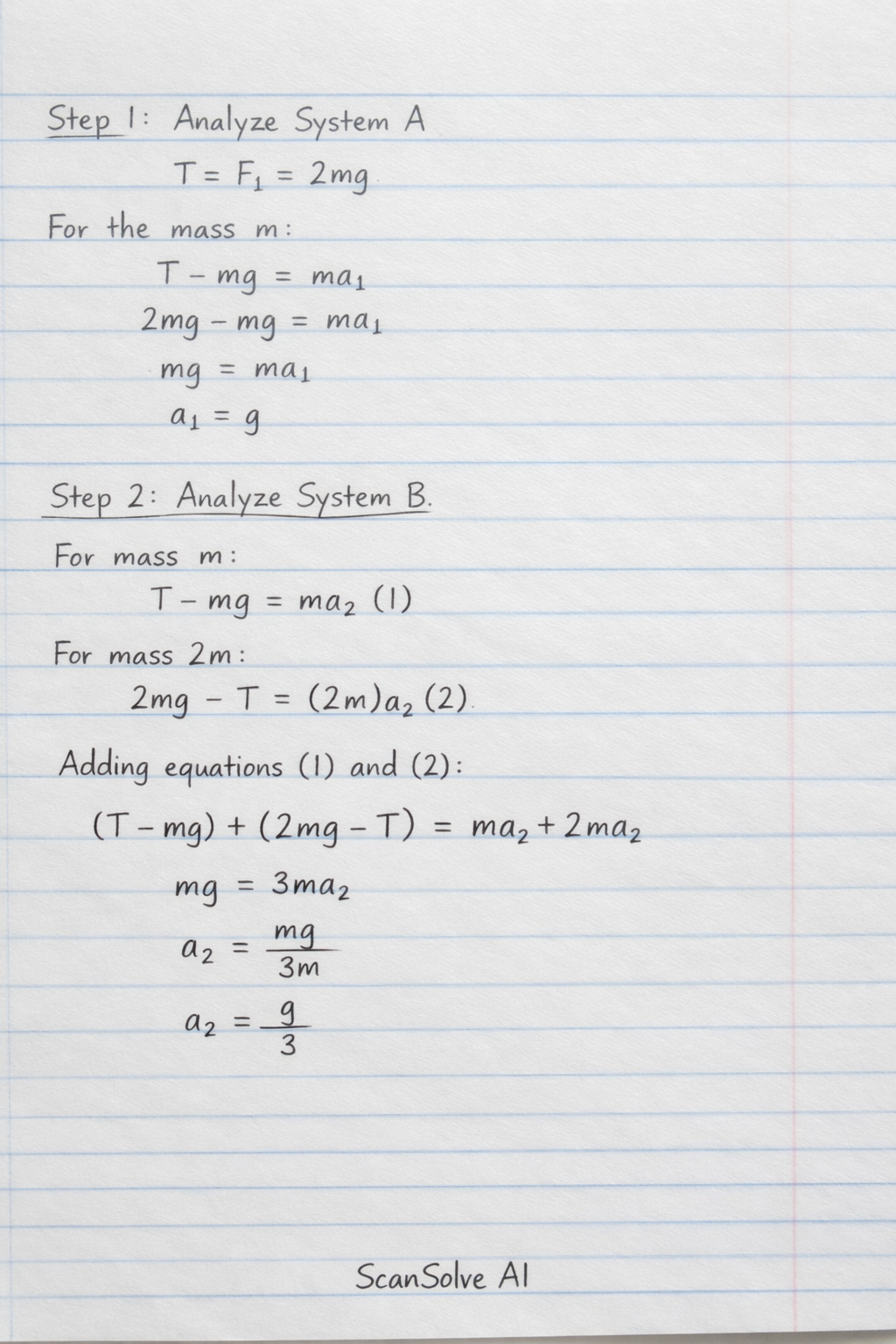
Analyze System A
In System A, a mass is attached to one end of a string, and a force is applied to the other end. Assuming an ideal pulley and string, the tension throughout the string is equal to the applied force.
For the mass , the forces acting are its weight downwards and the tension upwards. Applying Newton's second law ():
Analyze System B
In System B, a mass is on one side and a mass is on the other side. This is an Atwood machine. Let be the tension in the string and be the acceleration. We assume moves down and moves up.
For mass :For mass :
Adding equations (1) and (2):
Analyze System C
In System C, a mass is on the left, and a mass is on the right with an additional downward force . Let be the tension and be the acceleration. We assume the right side moves down and the left side moves up.
For the left mass :For the right mass , the total downward force is its weight plus the applied force . So, the total downward force is .
Adding equations (1) and (2):
Compare the accelerations
We have the accelerations:
Comparing these values:
Therefore, .This matches option (b).
The final answer is .
Try one yourself
A new problem that tests the same skill.
Still stuck on this one?
Ask a follow-up, and the answer starts from this question.
More Physics Questions
Handwritten Step-by-Step Solution
Get this as a handwritten image on WhatsApp — like a tutor wrote it for you.
Try on WhatsApp