
We read your photo as:
A satellite mass 80kg is in orbit around the earth at a distance 7.5R where R is the mean radius of the earth. If the gravitational field is 9.8N/kg at the earth surface and R = 6400km. a)Centripetal force acting on the satellite b) The period of the satellite of the orbit in hours.
ScanSolve AI Answer
Answers
2 partsStep-by-step solution
7 stepsHere's the solution to your problem:
We are given the following information:
- Mass of the satellite,
- Orbital radius from the center of the Earth, , where is the mean radius of the Earth.
- Gravitational field strength at the Earth's surface,
- Mean radius of the Earth,
First, let's convert and to meters:
The gravitational field strength at the Earth's surface is , where is the gravitational constant and is the mass of the Earth. From this, we can express .
Part a· 3 steps
Calculate the centripetal force acting on the satellite
Understand the force.
The centripetal force required to keep the satellite in orbit is provided by the gravitational force between the Earth and the satellite.
So, the centripetal force is equal to the gravitational force .Substitute and the given values.
Substitute into the formula:
Now, substitute the numerical values:
Calculate the force.
Rounding to two significant figures:
Part b
Calculate the period of the satellite's orbit in hours
Use the formula for the orbital period.
The period of a satellite in orbit is given by Kepler's Third Law:
Substitute and the given values.
Substitute :
Now, substitute the numerical values:
Calculate the period in seconds.
Convert the period from seconds to hours.
There are 3600 seconds in an hour.
Rounding to two significant figures:
Try one yourself
A new problem that tests the same skill.
Still stuck on this one?
Ask a follow-up, and the answer starts from this question.
More Physics Questions
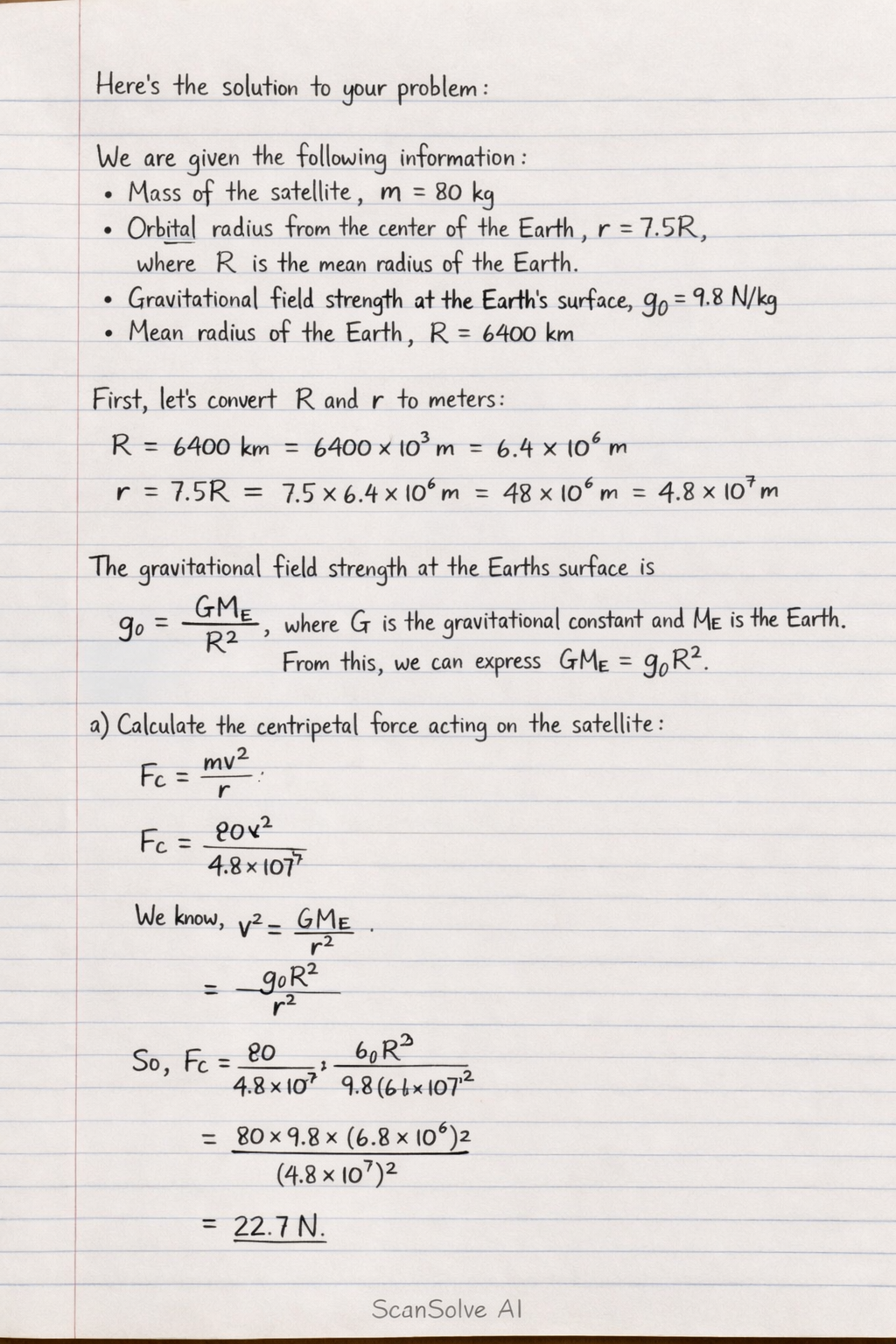
Handwritten Step-by-Step Solution
Get this as a handwritten image on WhatsApp — like a tutor wrote it for you.
Try on WhatsApp