
![A satellite of mass, M revolves around a planet of mass, m in an orbit of radius, R with velocity, V. Show that its period, T is related to the orbital radius, R by the equation T2 = 39.44R3 / Gm [π = 3.14]](/_next/image?url=https%3A%2F%2Fohijasnjvprzodcmxltt.supabase.co%2Fstorage%2Fv1%2Fobject%2Fpublic%2Fwhatsapp-images%2F1780323934610-915584d3edab4cce.png&w=3840&q=75)
This physics problem tests your understanding of fundamental physical laws and their applications. The step-by-step solution below breaks down the problem using relevant equations and physical reasoning.
ScanSolve AI Answer
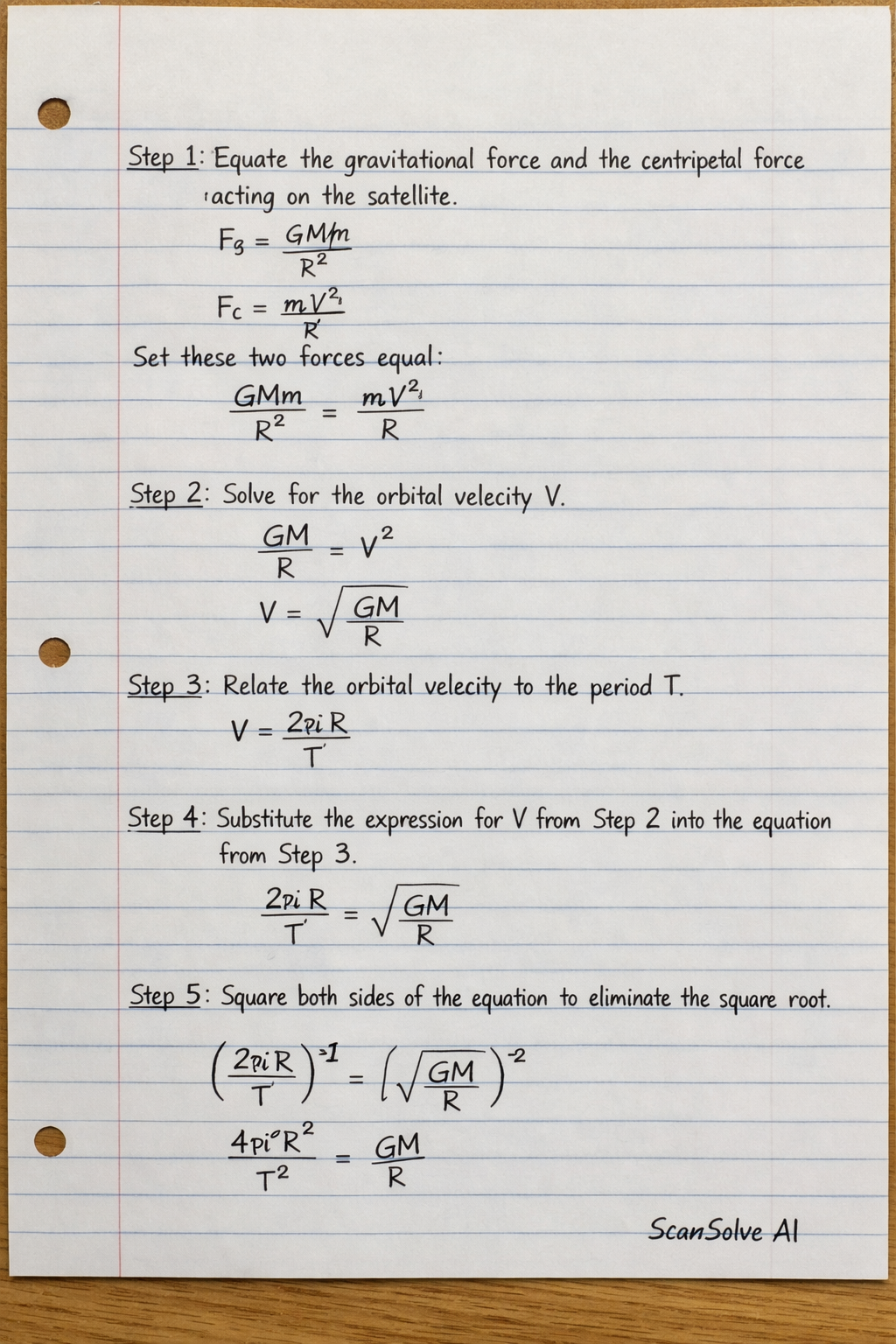
Step 1: Equate the gravitational force and the centripetal force acting on the satellite. The gravitational force between the planet (mass M) and the satellite (mass m) is given by: F_g = (GMm)/(R^2) The centripetal force required to keep the satellite in orbit is: F_c = (mV^2)/(R) Setting these two forces equal: (GMm)/(R^2) = (mV^2)/(R) Step 2: Solve for the orbital velocity V. Cancel m from both sides and multiply by R: (GM)/(R) = V^2 V = sqrt((GM)/(R)) Step 3: Relate the orbital velocity to the period T. The satellite travels a distance equal to the circumference of its orbit (2 R) in one period T. V = (2 R)/(T) Step 4: Substitute the expression for V from Step 2 into the equation from Step 3. (2 R)/(T) = sqrt((GM)/(R)) Step 5: Square both sides of the equation to eliminate the square root. ((2 R)/(T))^2 = (sqrt((GM)/(R)))^2 (4^2 R^2)/(T^2) = (GM)/(R) Step 6: Rearrange the equation to solve for T^2. Multiply both sides by T^2 and by R, and divide by GM: T^2 = (4^2 R^2 · R)/(GM) T^2 = (4^2 R^3)/(GM) Step 7: Substitute the given value of = 3.14. Calculate 4^2: 4^2 = 4 × (3.14)^2 4^2 = 4 × 9.8596 4^2 = 39.4384 Step 8: Substitute this value back into the equation for T^2. T^2 = (39.4384 R^3)/(GM) Rounding 39.4384 to two decimal places gives 39.44. Therefore, we have shown that: T^2 = (39.44 R^3)/(GM) Send me the next one 📸