

This physics problem tests your understanding of fundamental physical laws and their applications. The step-by-step solution below breaks down the problem using relevant equations and physical reasoning.
ScanSolve AI Answer
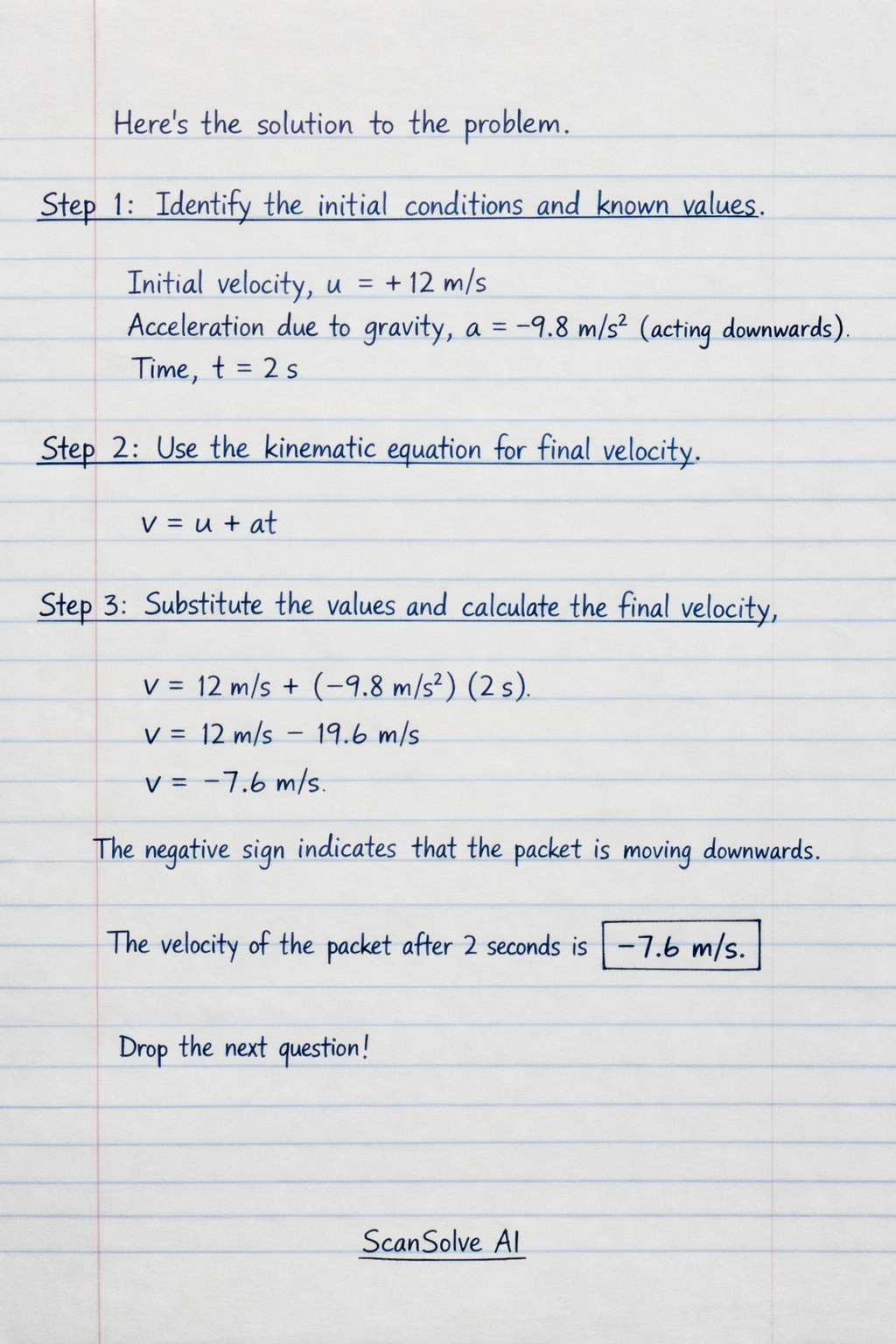
Here's the solution to the problem. Step 1: Identify the initial conditions and known values. When the packet is dropped, its initial velocity is the same as the balloon's velocity. We'll take the upward direction as positive. Initial velocity, u = +12 m/s Acceleration due to gravity, a = -9.8 m/s^2 (acting downwards) Time, t = 2 s Step 2: Use the kinematic equation for final velocity. The formula relating initial velocity, acceleration, time, and final velocity is: v = u + at Step 3: Substitute the values and calculate the final velocity. v = 12 m/s + (-9.8 m/s^2)(2 s) v = 12 m/s - 19.6 m/s v = -7.6 m/s The negative sign indicates that the packet is moving downwards. The velocity of the packet after 2 seconds is -7.6 m/s. Drop the next question!