
We read your photo as:
From 18 m height above the ground a ball is dropped from rest. The height above the ground at which the magnitude of velocity equal to the magnitude of acceleration due to gravity is ______ m. (Take g
Physics
ScanSolve AI Answer
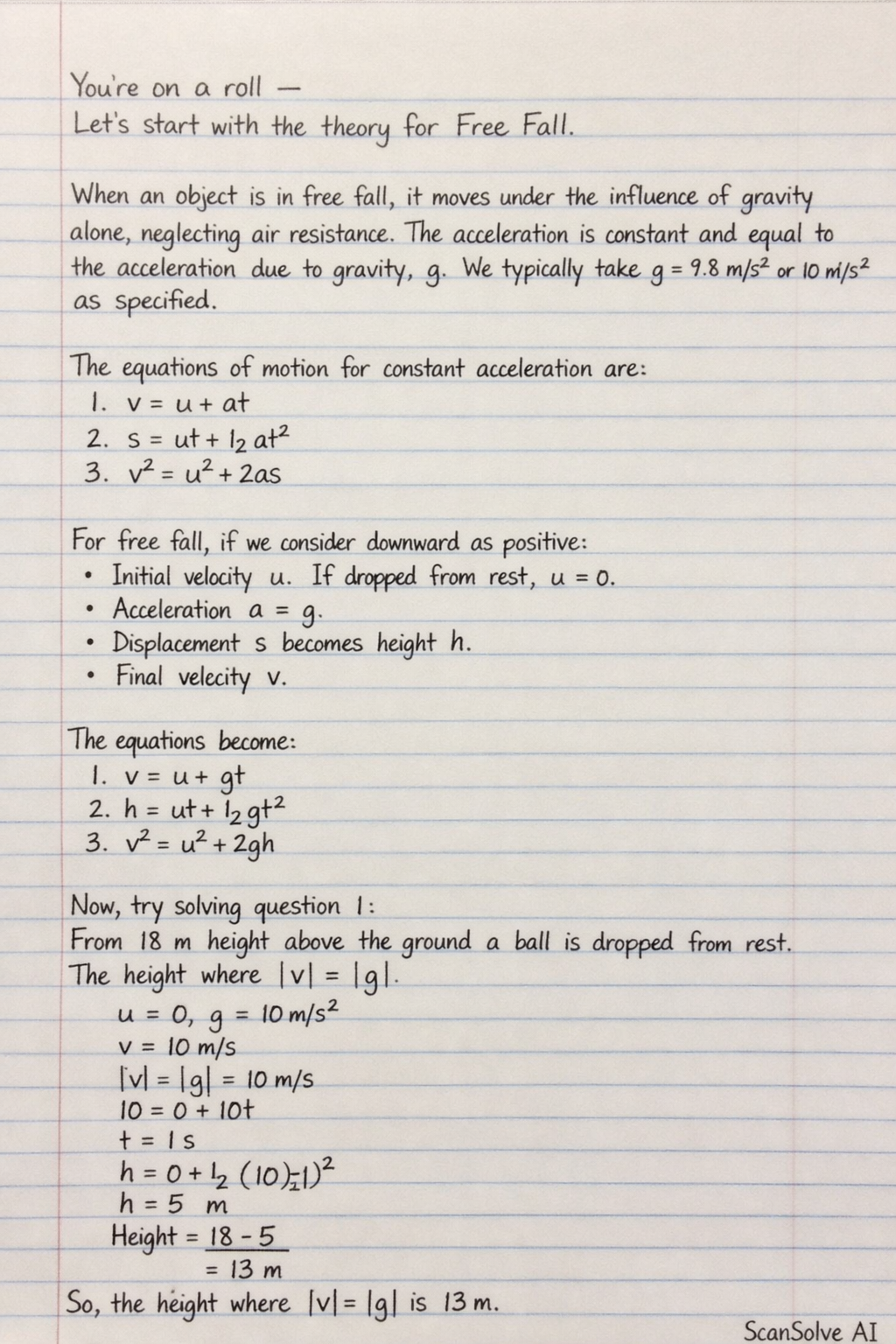
Let's start with the theory for Free Fall.
When an object is in free fall, it moves under the influence of gravity alone, neglecting air resistance. The acceleration is constant and equal to the acceleration due to gravity, . We typically take or as specified.
The equations of motion for constant acceleration are:
For free fall, if we consider downward as positive:
- Initial velocity . If dropped from rest, .
- Acceleration .
- Displacement becomes height .
- Final velocity .
The equations become:
Now, try solving question 1:
- From height above the ground a ball is dropped from rest. The height above the ground at which the magnitude of velocity equal to the magnitude of acceleration (in the same set of units) due to gravity is ______ . (Take and neglect the air resistance)
Was this helpful?
Still stuck on this one?
Ask a follow-up, and the answer starts from this question.
Got a different question?Ask your own question
More Physics Questions
QA ball is dropped from a height. What is the height of the building if it takes 4 seconds to reach…QA ball of mass 400 gm is dropped from tower of height 90 m. Find: i) Time to reach the ground. ii)…QA stone falls from a height of 19.6 m. How long does it take to reach the ground? If a ball is…QA ball is dropped from rest and falls 30 m to reach point B. Ignoring air resistance, what is the…QA ball is released from rest and falls under gravity. Calculate its velocity at point B and the…
Browse by topic:Mechanics
Handwritten Step-by-Step Solution
Get this as a handwritten image on WhatsApp — like a tutor wrote it for you.
Try on WhatsApp