
We read your photo as:
A stone is thrown vertically upwards from a point that is 12 m above the sea. It then falls into the sea below after 3.4 s. Air resistance is negligible. At which speed was the stone released when it was thrown?
ScanSolve AI Answer
Answer
Step-by-step solution
7 stepsHere are the solutions to the problems from the image:
10. A stone is thrown vertically upwards from a point that is 12 m above the sea. It then falls into the sea below after 3.4 s. Air resistance is negligible. At which speed was the stone released when it was thrown?
We can use the kinematic equation for constant acceleration: .
Let's define upwards as the positive direction.
Given:
- Displacement (final position is 12 m below the initial position)
- Time
- Acceleration due to gravity (acting downwards)
Substitute the known values into the kinematic equation.
Calculate the term involving acceleration and time.
Rearrange the equation to solve for .
Calculate the initial velocity .
Comparing this to the given options, the closest value is 13 m/s.
The correct option is C.11. A combined heat and power (CHP) station generates electrical power and useful heat. The diagram shows the input and output powers for a CHP station. What is the efficiency of the CHP station for producing useful power?
Calculate the total useful power output.
Total useful power = Useful heating power + Useful electrical power
Calculate the total input power.
Total input power = Total useful power + Wasted power
Calculate the efficiency.
Efficiency is defined as .
The closest option is 81%.
The correct option is D.12. Which statement about the principle of conservation of energy is correct?
The principle of conservation of energy states that energy cannot be created or destroyed, but it can be transformed from one form to another. In a closed system, the total amount of energy remains constant.
- A: Energy conversion helps to conserve energy sources. (This relates to resource management, not the fundamental principle).
- B: Energy is conserved only in systems with an efficiency of 100%. (Energy is always conserved, but useful energy output might be less than input due to energy dissipation, often as heat).
- C: The supply of energy is limited so energy should be conserved. (This is about energy conservation in terms of resource usage, not the physical law).
- D: The total amount of energy in a closed system is constant. (This is the correct definition of the principle of conservation of energy). The correct option is D.
13. A rocket is fired upwards. As it accelerates upwards after leaving the launch pad, which forms of energy are changing?
As the rocket accelerates upwards:
- Its speed increases, so its kinetic energy increases.
- Its height increases, so its gravitational potential energy increases.
- It is burning fuel to produce thrust, so the chemical energy stored in the fuel is being converted into other forms of energy. Therefore, chemical energy, gravitational potential energy, and kinetic energy are all changing. The correct option is A.
Try one yourself
A new problem that tests the same skill.
Still stuck on this one?
Ask a follow-up, and the answer starts from this question.
More Physics Questions
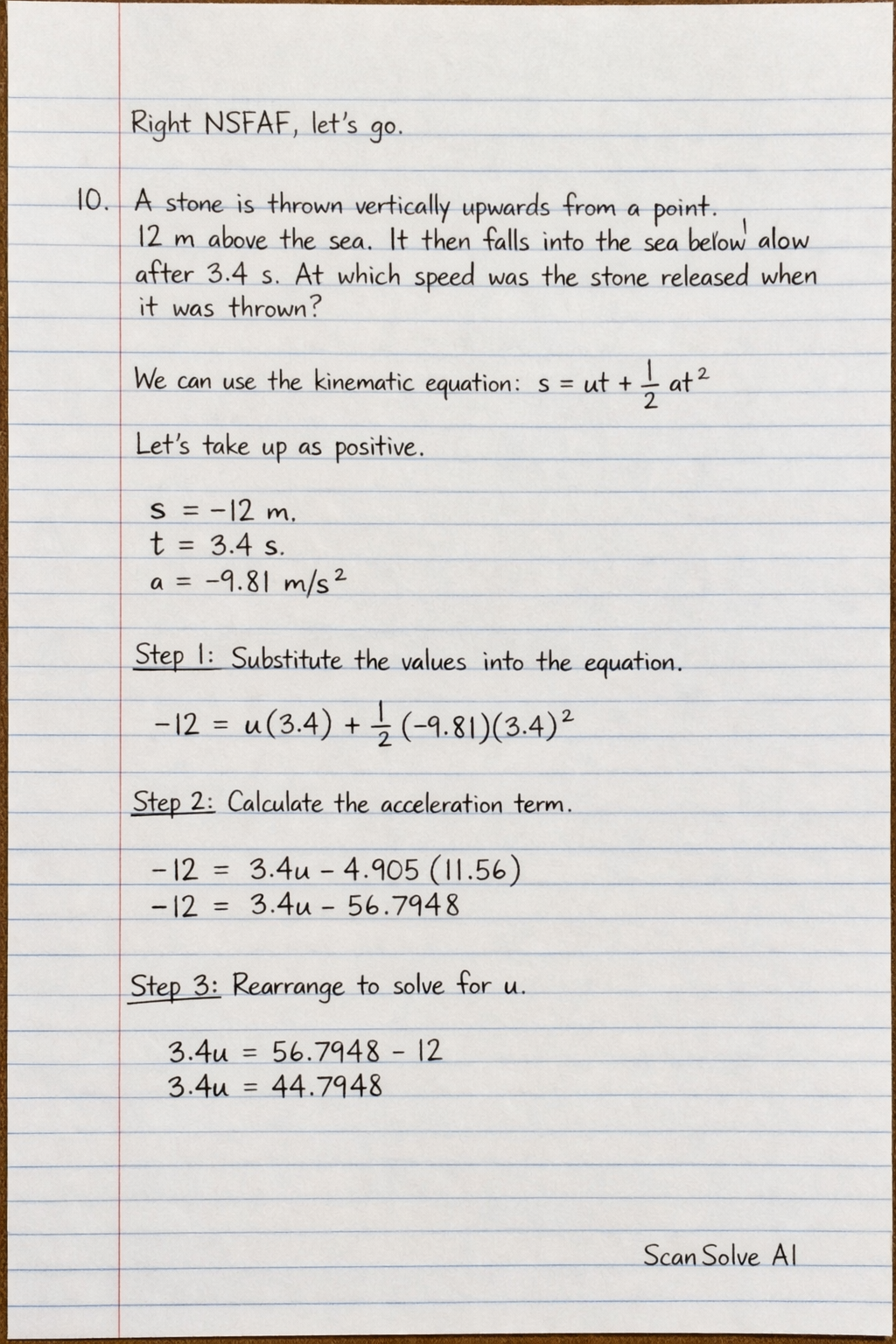
Handwritten Step-by-Step Solution
Get this as a handwritten image on WhatsApp — like a tutor wrote it for you.
Try on WhatsApp