
We read your photo as:
A stone of mass 0.50 kg is dropped from a height of 20 m above the ground. Calculate its speed just before it hits the ground. (g = 10 m s -2, air resistance is negligible.)
ScanSolve AI Answer
Answer
Step-by-step solution
6 stepsIdentify the given values for the stone's motion.
The stone is dropped, so its initial velocity .
The height .
The acceleration due to gravity .
We need to find the final speed .Use the kinematic equation that relates initial velocity, final velocity, acceleration, and displacement.
Since air resistance is negligible, we can use the equation:
Substitute the values into the equation and solve for .
The speed of the stone just before it hits the ground is .
- Step 1: Identify the given values for the lens problem. The object distance . The focal length of the converging lens . We need to find the image distance .
Use the lens formula.
The lens formula is given by:
Rearrange the formula to solve for .
Substitute the given values into the formula and calculate .
To subtract the fractions, find a common denominator, which is 30 cm.
The position of the image formed is . Since is positive, the image is real and formed on the opposite side of the lens from the object.
Try one yourself
A new problem that tests the same skill.
Still stuck on this one?
Ask a follow-up, and the answer starts from this question.
More Physics Questions
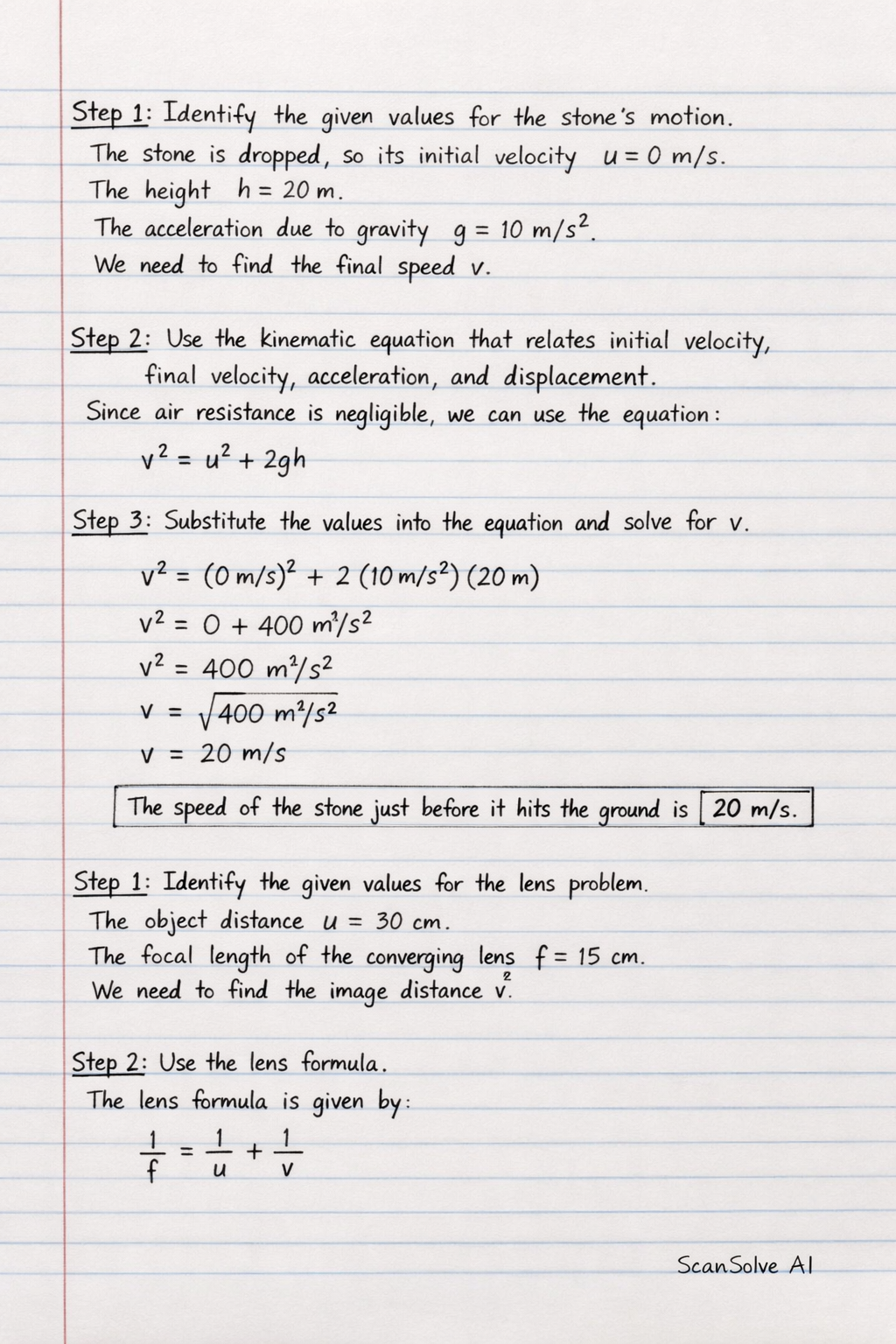
Handwritten Step-by-Step Solution
Get this as a handwritten image on WhatsApp — like a tutor wrote it for you.
Try on WhatsApp