
We read your photo as:
Calculate the acceleration of the particle in the first 10 seconds the value of t if it travelled 50 meters from 20th seconds the average speed for the whole journey
ScanSolve AI Answer
Step-by-step solution
7 steps- Calculate the acceleration of the particle in the first 10 seconds.
Identify the initial and final velocities and the time interval from the graph.
From s to s:
Initial velocity, m/s
Final velocity, m/s
Time interval, sUse the formula for acceleration.
Acceleration
The acceleration of the particle in the first 10 seconds is .
- The value of t if it travelled 50 meters from 20th seconds.
Identify the shape and dimensions of the graph segment from s to s.
This segment is a triangle.
Initial velocity at s is 10 m/s.
Final velocity at s is 0 m/s.
The base of the triangle is s.
The height of the triangle is 10 m/s.
The distance travelled is the area under this segment, which is given as 50 m.Set up the equation for the area of the triangle and solve for .
Area of triangle =
Divide both sides by 5:
Add 20 to both sides:
The value of is .
- The average speed for the whole journey.
Calculate the total distance travelled.
This is the total area under the graph from s to s.
The journey consists of three parts:- Part 1 (0 to 10 s): A trapezium. Area
- Part 2 (10 to 20 s): A rectangle. Area
- Part 3 (20 to 30 s): A triangle. The distance for this part is given as 50 m in question 2. Area m
Total distance = Area + Area + Area
Determine the total time taken for the journey.
Total time = s (from question 2).
Calculate the average speed.
Average speed =
The average speed for the whole journey is .
Still stuck on this one?
Ask a follow-up, and the answer starts from this question.
More Physics Questions
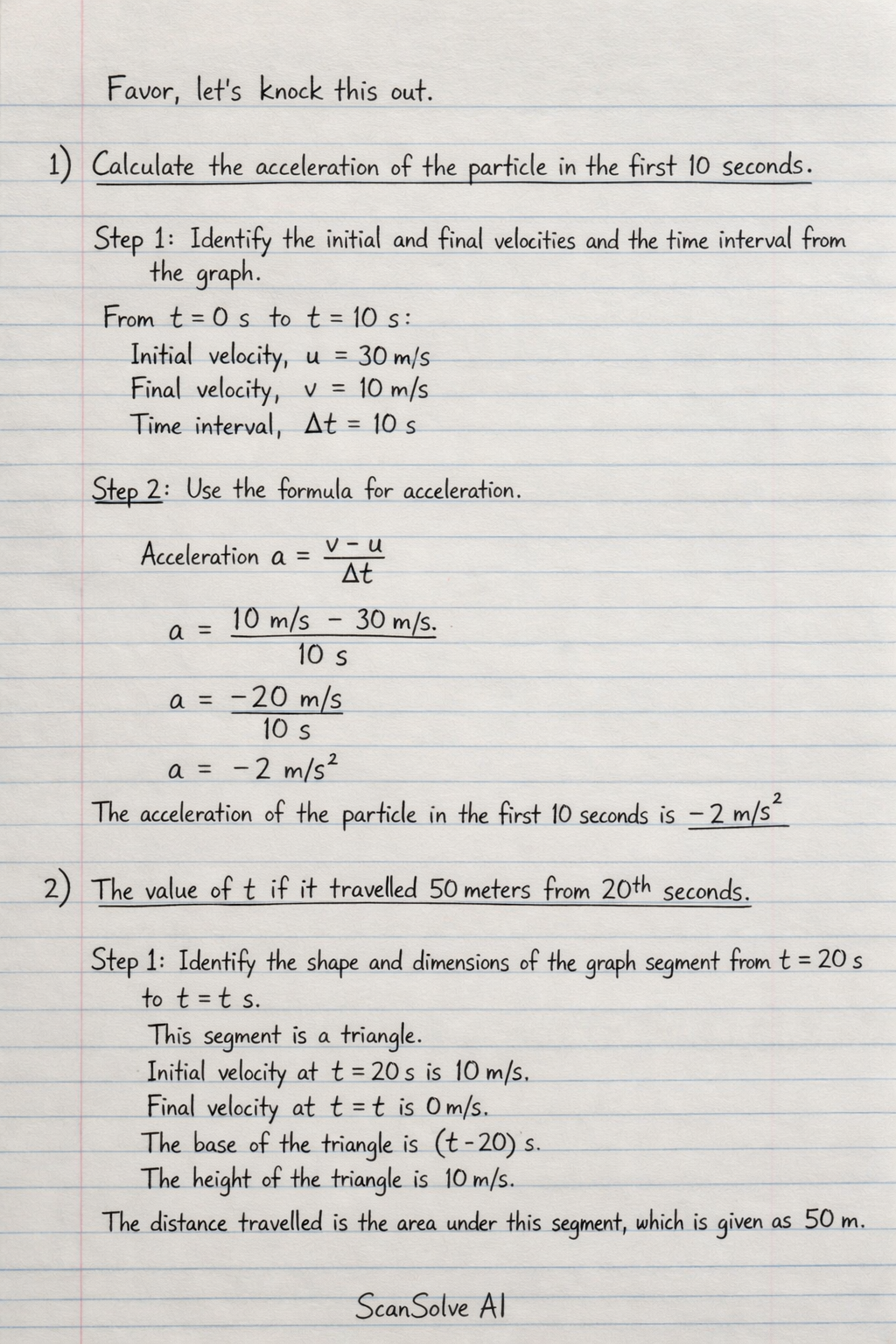
Handwritten Step-by-Step Solution
Get this as a handwritten image on WhatsApp — like a tutor wrote it for you.
Try on WhatsApp