
We read your photo as:
Question 3 [5 marks] Find the total distance travelled, the distance travelled in the first 40 seconds, the acceleration when t = 25.
ScanSolve AI Answer
Answers
3 partsStep-by-step solution
9 stepsHere's how to solve the problem using the provided velocity-time graph.
Part a· 4 steps
The total distance travelled
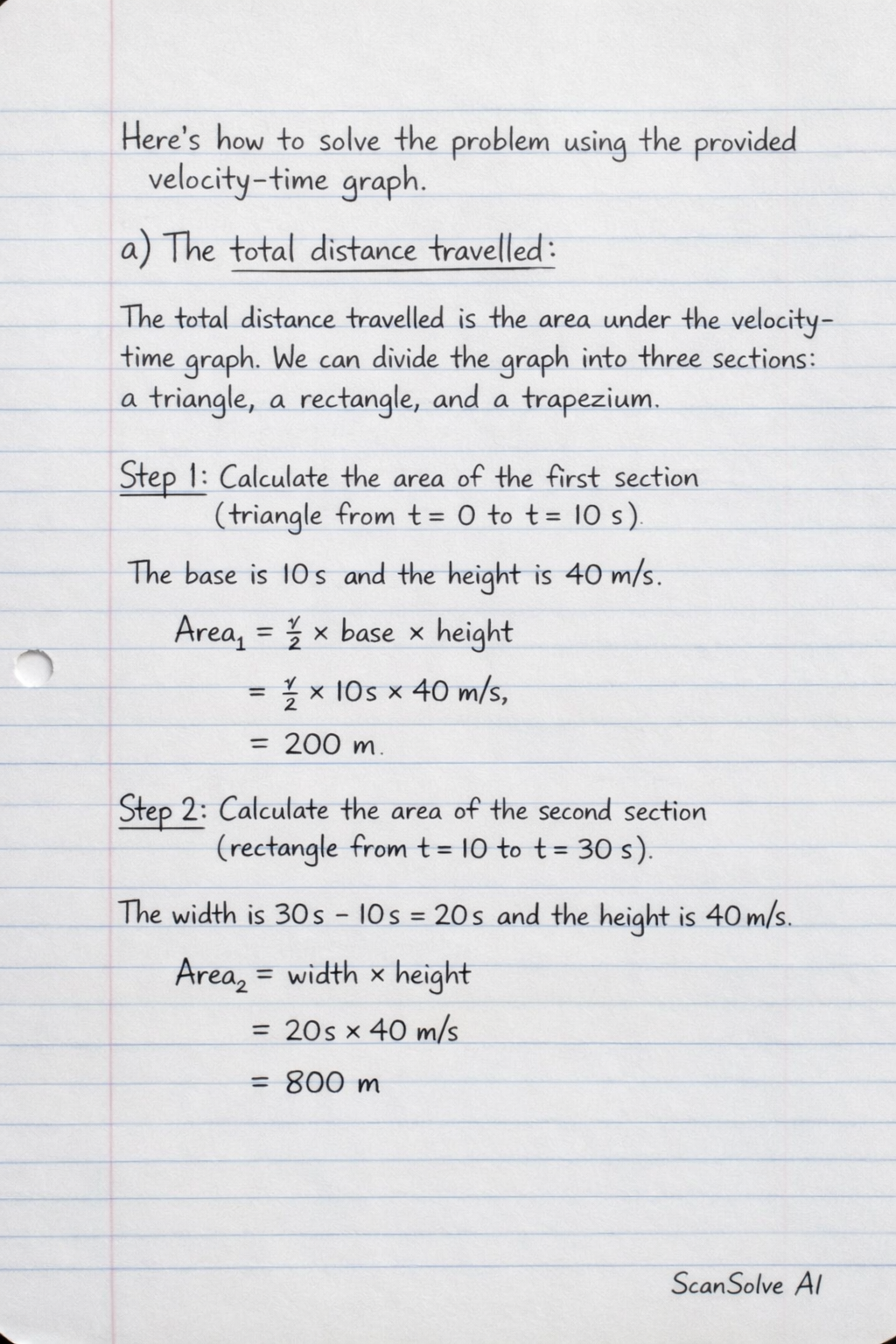
The total distance travelled is the area under the velocity-time graph. We can divide the graph into three sections: a triangle, a rectangle, and a trapezium.
Calculate the area of the first section (triangle from to s).
The base is and the height is .
Calculate the area of the second section (rectangle from to s).
The width is and the height is .
Calculate the area of the third section (trapezium from to s).
The parallel sides are (at ) and (at ). The height (time interval) is .
Calculate the total distance.
The total distance travelled is .
Part b
The distance travelled in the first 40 seconds
This is the area under the graph from to s. This includes the first two sections and part of the third section.
Determine the velocity at s.
The acceleration between s and s is constant.
Using , where at (which corresponds to s), and s (which corresponds to s):
Calculate the area of the third part up to s (trapezium from to s).
The parallel sides are (at ) and (at ). The height (time interval) is .
Calculate the total distance in the first 40 seconds.
The distance travelled in the first 40 seconds is .
Part c
The acceleration when
Acceleration is the gradient (slope) of the velocity-time graph.
Identify the segment of the graph at s.
At s, the graph is a horizontal line segment between s and s.
Calculate the gradient of this segment.
In this segment, the velocity is constant at . A horizontal line has a gradient of zero.
The acceleration when s is .
Try one yourself
A new problem that tests the same skill.
Still stuck on this one?
Ask a follow-up, and the answer starts from this question.
More Mathematics Questions
Handwritten Step-by-Step Solution
Get this as a handwritten image on WhatsApp — like a tutor wrote it for you.
Try on WhatsApp