
We read your photo as:
Given: P(A)=0,4 ; P(B)=0,5 and P(A and B)=0,25. Determine the: P(not B), P(A or B), P(not A and B).
ScanSolve AI Answer
Step-by-step solution
20 stepsHere's the solution to Question 3:
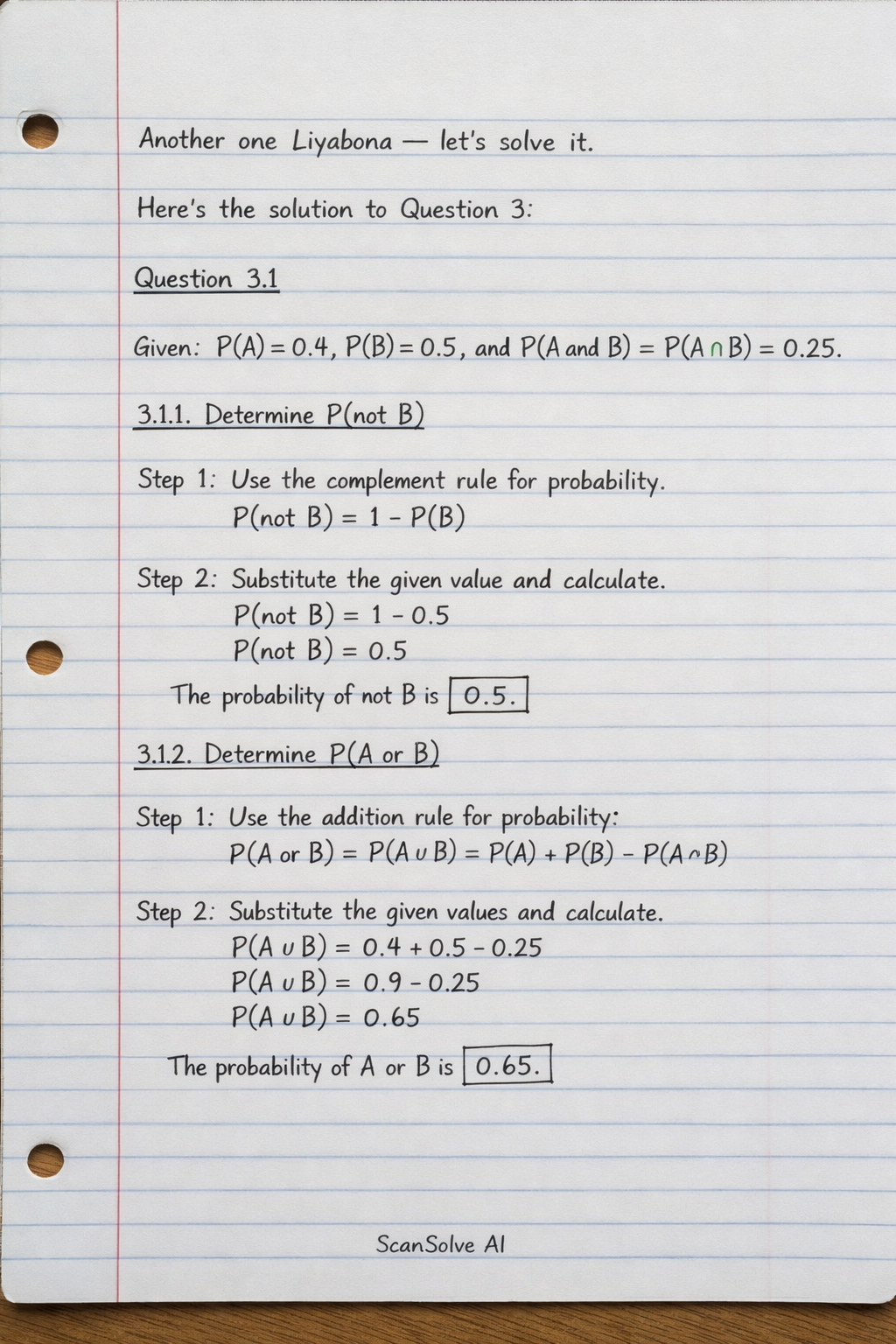
Question 3.1
Given: , , and .
3.1.1 Determine
Use the complement rule for probability.
Substitute the given value and calculate.
The probability of not B is .
3.1.2 Determine
Use the addition rule for probability.
Substitute the given values and calculate.
The probability of A or B is .
3.1.3 Determine
This represents the probability that event B occurs but event A does not ().
Substitute the given values and calculate.
The probability of not A and B is .
Question 3.2
Given: Total learners = 70.
Learners taking Economics (E) = 32.
Learners taking Mathematics (M) = 43.
Learners taking neither subject = 15.
Learners taking both subjects = .3.2.1 Show that .
Set up an equation using the total number of learners.
The total number of learners is the sum of those taking only E, only M, both, and neither.
Substitute the values into the equation.
Simplify and solve for .
Thus, it is shown that .
3.2.2 Draw a Venn diagram to illustrate the above information.
Calculate the number of learners in each section.
- Only Economics:
- Only Mathematics:
- Both Economics and Mathematics:
- Neither: 15
Draw the Venn diagram.
(Imagine a rectangle representing the universal set of 70 learners. Inside, draw two overlapping circles. Label one circle 'E' for Economics and the other 'M' for Mathematics.)
- In the section of circle E that does not overlap with M, write '12'.
- In the section of circle M that does not overlap with E, write '23'.
- In the overlapping section (intersection), write '20'.
- Outside both circles but inside the rectangle, write '15'. (Sum check: )
3.2.3 Determine the probability of a learner taking:
Total learners = 70.a) Economics and Mathematics.
Identify the number of learners taking both subjects.
Calculate the probability.
The probability of taking Economics and Mathematics is .
b) at least ONE of the two subjects.
Identify the number of learners taking at least one subject.
This is the total learners minus those taking neither.
Calculate the probability.
The probability of taking at least one subject is .
c) taking EXACTLY ONE subject.
Identify the number of learners taking exactly one subject (only E or only M).
Calculate the probability.
The probability of taking exactly one subject is .
3.2.4 Determine the number of learners that take Physical Sciences.
Let P be the event of taking Physical Sciences.
Given: "The probability that a Mathematics learner is also a Physical Sciences learner is 79%."
This is a conditional probability: .
We know .Use the conditional probability formula to find the number of learners taking both Physical Sciences and Mathematics.
Solve for .
Since the number of learners must be an integer, round to the nearest whole number.
Note: The question asks for "the number of learners that take Physical Sciences" (). From the given information, we can only directly calculate the number of learners who take both Physical Sciences and Mathematics (). To determine uniquely, we would need additional information (e.g., the number of learners taking only Physical Sciences). However, in the context of such problems, it is often implied that the question is asking for the number of learners in the intersection, or that all Physical Sciences learners also take Mathematics. Assuming this common interpretation, we provide the number of learners taking both.
The number of learners that take Physical Sciences (and Mathematics) is .
Still stuck on this one?
Ask a follow-up, and the answer starts from this question.
More Mathematics Questions
Handwritten Step-by-Step Solution
Get this as a handwritten image on WhatsApp — like a tutor wrote it for you.
Try on WhatsApp