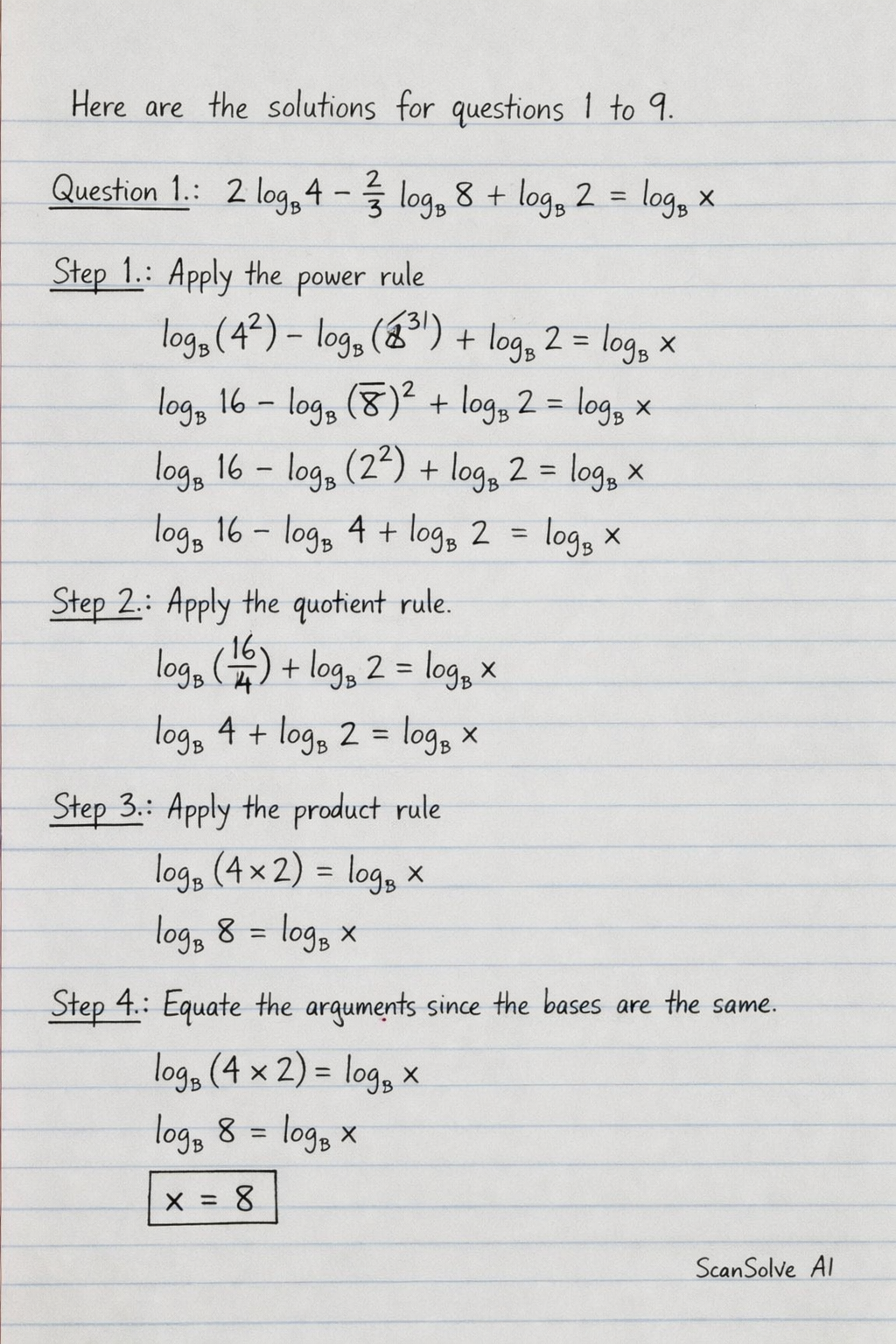
Question 1:2logb4−32logb8+logb2=logbx
Step 1: Apply the power rule clogba=logb(ac) to the first two terms.
logb(42)−logb(832)+logb2=logbxlogb16−logb(38)2+logb2=logbxlogb16−logb(22)+logb2=logbxlogb16−logb4+logb2=logbx
Step 2: Apply the quotient rule logbM−logbN=logb(NM) to the first two terms.
logb(416)+logb2=logbxlogb4+logb2=logbx
Step 3: Apply the product rule logbM+logbN=logb(M×N) to the left side.
logb(4×2)=logbxlogb8=logbx
Step 4: Equate the arguments since the bases are the same.
x=8
Question 2:2logb3+logb5−logb9=logbx
Step 1: Apply the power rule clogba=logb(ac) to the first term.
logb(32)+logb5−logb9=logbxlogb9+logb5−logb9=logbx
Step 2: Combine terms.
(logb9−logb9)+logb5=logbx0+logb5=logbxlogb5=logbx
Step 3: Equate the arguments.
x=5
Question 3:logb16−logb2+logb4=logbx
Step 1: Apply the quotient rule logbM−logbN=logb(NM) to the first two terms.
logb(216)+logb4=logbxlogb8+logb4=logbx
Step 2: Apply the product rule logbM+logbN=logb(M×N) to the left side.
logb(8×4)=logbxlogb32=logbx
Step 3: Equate the arguments.
x=32
Question 4:logb25+logb4−logb10=logbx
Step 1: Apply the product rule logbM+logbN=logb(M×N) to the first two terms.
logb(25×4)−logb10=logbxlogb100−logb10=logbx
Step 2: Apply the quotient rule logbM−logbN=logb(NM) to the left side.
logb(10100)=logbxlogb10=logbx
Step 3: Equate the arguments.
x=10
Question 5:logb12−logb3+logb2=logbx
Step 1: Apply the quotient rule logbM−logbN=logb(NM) to the first two terms.
logb(312)+logb2=logbxlogb4+logb2=logbx
Step 2: Apply the product rule logbM+logbN=logb(M×N) to the left side.
logb(4×2)=logbxlogb8=logbx
Step 3: Equate the arguments.
x=8
Question 6:logb100−logb5+logb2=logbx
Step 1: Apply the quotient rule logbM−logbN=logb(NM) to the first two terms.
logb(5100)+logb2=logbxlogb20+logb2=logbx
Step 2: Apply the product rule logbM+logbN=logb(M×N) to the left side.
logb(20×2)=logbxlogb40=logbx
Step 3: Equate the arguments.
x=40
Question 7:logb18+logb2−logb4=logbx
Step 1: Apply the product rule logbM+logbN=logb(M×N) to the first two terms.
logb(18×2)−logb4=logbxlogb36−logb4=logbx
Step 2: Apply the quotient rule logbM−logbN=logb(NM) to the left side.
logb(436)=logbxlogb9=logbx
Step 3: Equate the arguments.
x=9
Question 8:logb24−logb3+logb5=logbx
Step 1: Apply the quotient rule logbM−logbN=logb(NM) to the first two terms.
logb(324)+logb5=logbxlogb8+logb5=logbx
Step 2: Apply the product rule logbM+logbN=logb(M×N) to the left side.
logb(8×5)=logbxlogb40=logbx
Step 3: Equate the arguments.
x=40
Question 9:logb15+logb2−logb6=logbx
Step 1: Apply the product rule logbM+logbN=logb(M×N) to the first two terms.
logb(15×2)−logb6=logbxlogb30−logb6=logbx
Step 2: Apply the quotient rule logbM−logbN=logb(NM) to the left side.
logb(630)=logbxlogb5=logbx
Step 3: Equate the arguments.
x=5
3 done, 2 left today. You're making progress.
Was this helpful?
Need help with your own homework?
Get instant step-by-step solutions to any question. Free to start.
This mathematics problem involves applying core mathematical principles and formulas. Below you will find a complete step-by-step solution with detailed explanations for each step, helping you understand not just the answer but the method behind it.
ScanSolve AI Answer
Here are the solutions for questions 1 to 9. Question 1: 2 _b 4 - (2)/(3) _b 8 + _b 2 = _b x Step 1: Apply the power rule c _b a = _b (a^c) to the first two terms. _b (4^2) - _b (8^(2)/(3)) + _b 2 = _b x _b 16 - _b ([3]8)^2 + _b 2 = _b x _b 16 - _b (2^2) + _b 2 = _b x _b 16 - _b 4 + _b 2 = _b x Step 2: Apply the quotient rule _b M - _b N = _b ((M)/(N)) to the first two terms. _b ((16)/(4)) + _b 2 = _b x _b 4 + _b 2 = _b x Step 3: Apply the product rule _b M + _b N = _b (M × N) to the left side. _b (4 × 2) = _b x _b 8 = _b x Step 4: Equate the arguments since the bases are the same. x = 8 Question 2: 2 _b 3 + _b 5 - _b 9 = _b x Step 1: Apply the power rule c _b a = _b (a^c) to the first term. _b (3^2) + _b 5 - _b 9 = _b x _b 9 + _b 5 - _b 9 = _b x Step 2: Combine terms. (_b 9 - _b 9) + _b 5 = _b x 0 + _b 5 = _b x _b 5 = _b x Step 3: Equate the arguments. x = 5 Question 3: _b 16 - _b 2 + _b 4 = _b x Step 1: Apply the quotient rule _b M - _b N = _b ((M)/(N)) to the first two terms. _b ((16)/(2)) + _b 4 = _b x _b 8 + _b 4 = _b x Step 2: Apply the product rule _b M + _b N = _b (M × N) to the left side. _b (8 × 4) = _b x _b 32 = _b x Step 3: Equate the arguments. x = 32 Question 4: _b 25 + _b 4 - _b 10 = _b x Step 1: Apply the product rule _b M + _b N = _b (M × N) to the first two terms. _b (25 × 4) - _b 10 = _b x _b 100 - _b 10 = _b x Step 2: Apply the quotient rule _b M - _b N = _b ((M)/(N)) to the left side. _b ((100)/(10)) = _b x _b 10 = _b x Step 3: Equate the arguments. x = 10 Question 5: _b 12 - _b 3 + _b 2 = _b x Step 1: Apply the quotient rule _b M - _b N = _b ((M)/(N)) to the first two terms. _b ((12)/(3)) + _b 2 = _b x _b 4 + _b 2 = _b x Step 2: Apply the product rule _b M + _b N = _b (M × N) to the left side. _b (4 × 2) = _b x _b 8 = _b x Step 3: Equate the arguments. x = 8 Question 6: _b 100 - _b 5 + _b 2 = _b x Step 1: Apply the quotient rule _b M - _b N = _b ((M)/(N)) to the first two terms. _b ((100)/(5)) + _b 2 = _b x _b 20 + _b 2 = _b x Step 2: Apply the product rule _b M + _b N = _b (M × N) to the left side. _b (20 × 2) = _b x _b 40 = _b x Step 3: Equate the arguments. x = 40 Question 7: _b 18 + _b 2 - _b 4 = _b x Step 1: Apply the product rule _b M + _b N = _b (M × N) to the first two terms. _b (18 × 2) - _b 4 = _b x _b 36 - _b 4 = _b x Step 2: Apply the quotient rule _b M - _b N = _b ((M)/(N)) to the left side. _b ((36)/(4)) = _b x _b 9 = _b x Step 3: Equate the arguments. x = 9 Question 8: _b 24 - _b 3 + _b 5 = _b x Step 1: Apply the quotient rule _b M - _b N = _b ((M)/(N)) to the first two terms. _b ((24)/(3)) + _b 5 = _b x _b 8 + _b 5 = _b x Step 2: Apply the product rule _b M + _b N = _b (M × N) to the left side. _b (8 × 5) = _b x _b 40 = _b x Step 3: Equate the arguments. x = 40 Question 9: _b 15 + _b 2 - _b 6 = _b x Step 1: Apply the product rule _b M + _b N = _b (M × N) to the first two terms. _b (15 × 2) - _b 6 = _b x _b 30 - _b 6 = _b x Step 2: Apply the quotient rule _b M - _b N = _b ((M)/(N)) to the left side. _b ((30)/(6)) = _b x _b 5 = _b x Step 3: Equate the arguments. x = 5 3 done, 2 left today. You're making progress.