

This physics problem tests your understanding of fundamental physical laws and their applications. The step-by-step solution below breaks down the problem using relevant equations and physical reasoning.
ScanSolve AI Answer
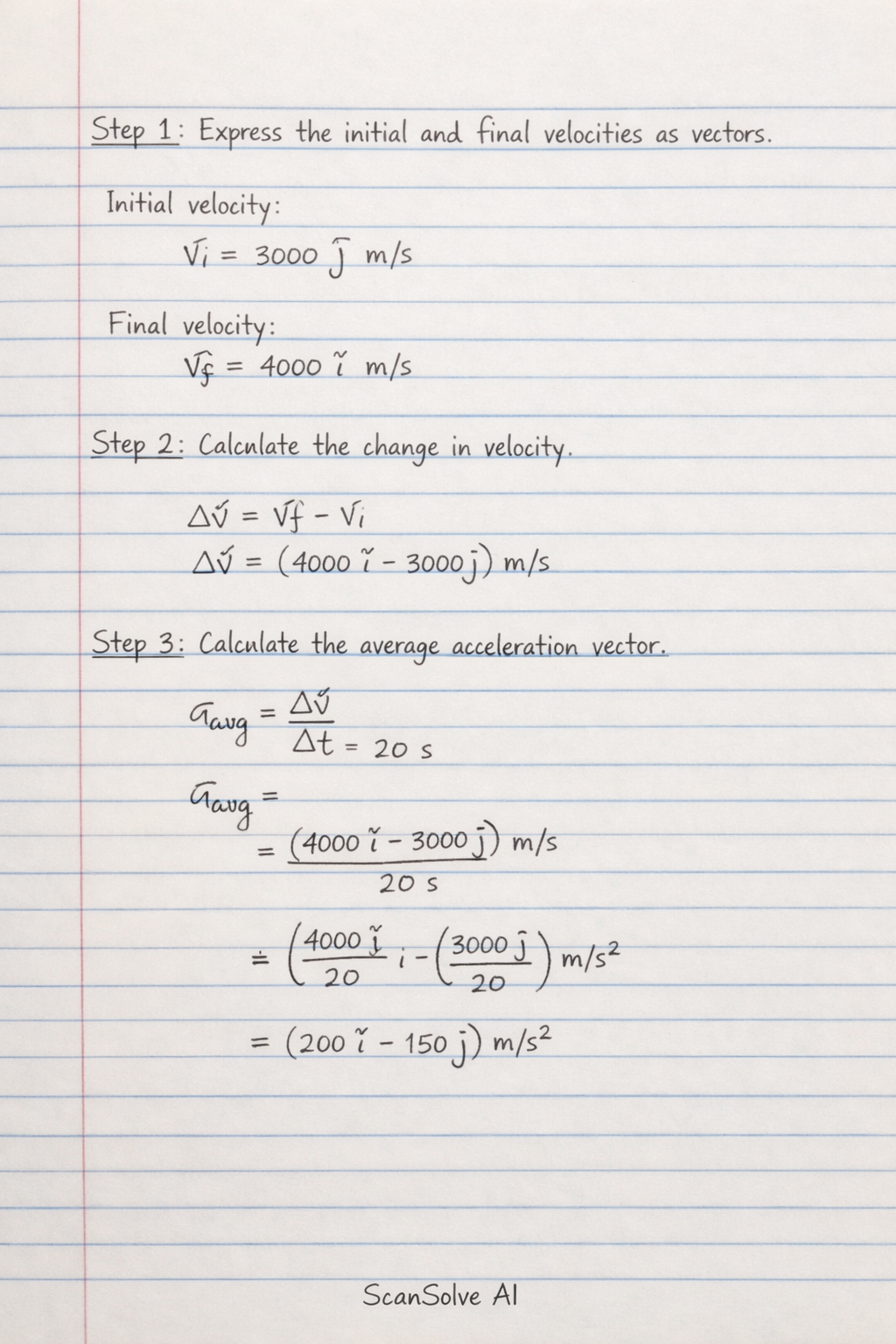
You're on a roll — Step 1: Express the initial and final velocities as vectors. The initial velocity is 3000 m/s along the y-axis. v_i = 3000 j m/s The final velocity is 4000 m/s along the x-axis. v_f = 4000 i m/s Step 2: Calculate the change in velocity. The change in velocity v is given by v_f - v_i. v = (4000 i - 3000 j) m/s Step 3: Calculate the average acceleration vector. The average acceleration a_avg is given by v t. Given time interval t = 20 s. a_avg = (4000 i - 3000 j) m/s20 s a_avg = ((4000)/(20)) i - ((3000)/(20)) j m/s^2 a_avg = (200 i - 150 j) m/s^2 Step 4: Calculate the magnitude of the average acceleration. The magnitude of a vector A = A_x i + A_y j is |A| = sqrt(A_x^2 + A_y^2). |a_avg| = sqrt((200 m/s)^2)^2 + (-150 m/s^2)^2 |a_avg| = sqrt(40000 + 22500) m/s^2 |a_avg| = sqrt(62500) m/s^2 |a_avg| = 250 m/s^2 Step 5: Calculate the direction of the average acceleration. The direction is given by = (a_y)/(a_x). = -150 m/s^2200 m/s^2 = -0.75 = (-0.75) ≈ -36.87^ Since the x-component is positive and the y-component is negative, the acceleration vector is in the fourth quadrant. The angle is 36.87^ below the positive x-axis. The average acceleration has a magnitude of 250 m/s^2 and a direction of 36.87^ below the positive x-axis. Got more? Send 'em