We read your photo as:

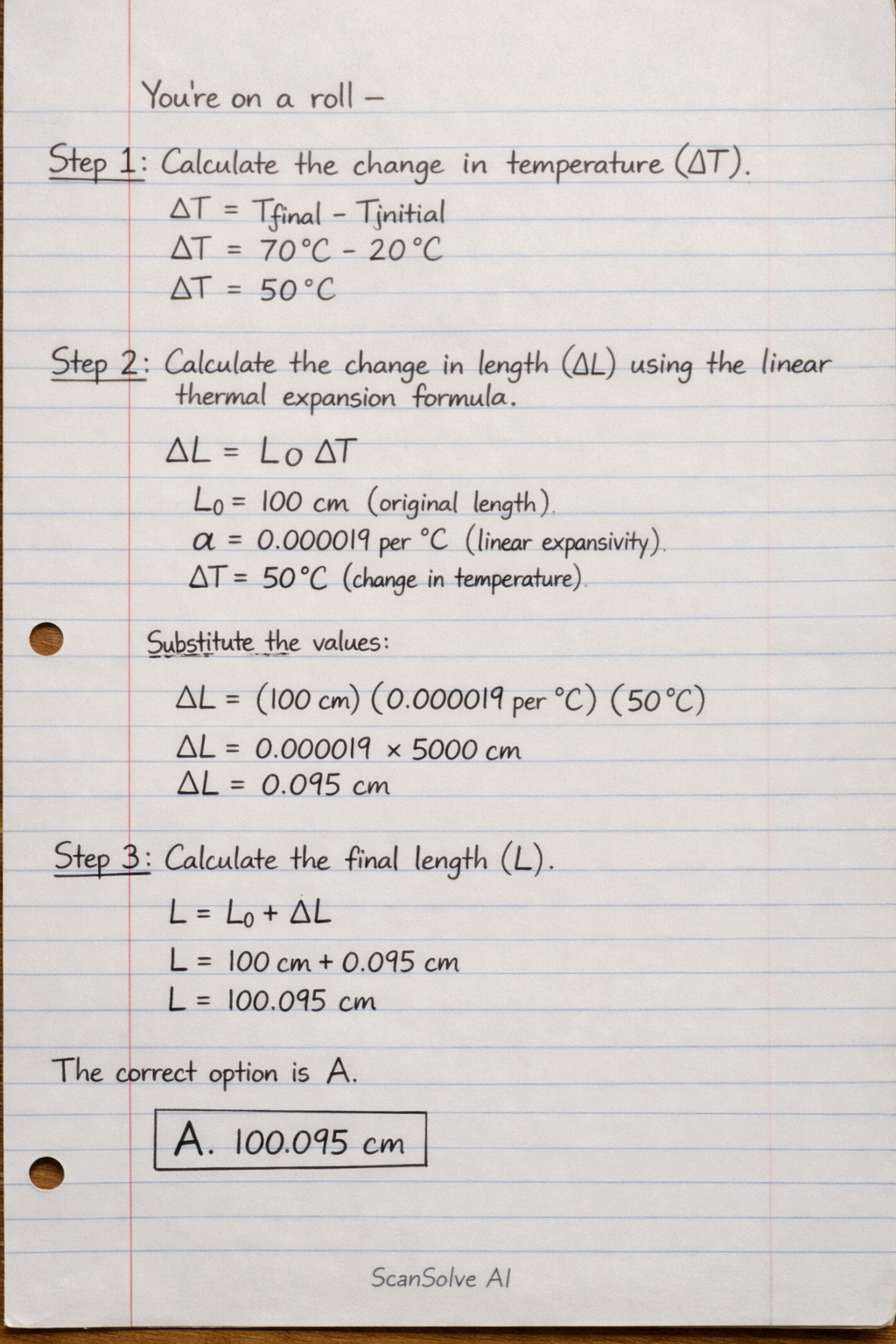
Calculate the change in temperature ( T).

Geography

ScanSolve AI Answer

Answer

A

Step-by-step solution

6 steps
  1. Calculate the change in temperature (ΔT\Delta T).

    ΔT=Tfinal−Tinitial\Delta T = T_{final} - T_{initial} ΔT=70∘C−20∘C\Delta T = 70 ^\circ\text{C} - 20 ^\circ\text{C} ΔT=50∘C\Delta T = 50 ^\circ\text{C}
  2. Calculate the change in length (ΔL\Delta L) using the linear thermal expansion formula.

    ΔL=L0αΔT\Delta L = L_0 \alpha \Delta T

    Where:

    • L0=100 cmL_0 = 100 \text{ cm} (original length)
    • α=0.000019 per ∘C\alpha = 0.000019 \text{ per } ^\circ\text{C} (linear expansivity)
    • ΔT=50∘C\Delta T = 50 ^\circ\text{C} (change in temperature)

    Substitute the values:

    ΔL=(100 cm)×(0.000019 per ∘C)×(50∘C)\Delta L = (100 \text{ cm}) \times (0.000019 \text{ per } ^\circ\text{C}) \times (50 ^\circ\text{C}) ΔL=0.000019×5000 cm\Delta L = 0.000019 \times 5000 \text{ cm} ΔL=0.095 cm\Delta L = 0.095 \text{ cm}
  3. Calculate the final length (LL).

    L=L0+ΔLL = L_0 + \Delta L L=100 cm+0.095 cmL = 100 \text{ cm} + 0.095 \text{ cm} L=100.095 cmL = 100.095 \text{ cm}

    The correct option is A.

    A. 100.095 cm\boxed{\text{A. } 100.095 \text{ cm}}

    Absolute zero temperature is defined as the lowest possible temperature, where all molecular motion ceases. This corresponds to 0 K0 \text{ K} or approximately −273∘C-273 ^\circ\text{C}.

    The correct option is B.

    B. −273∘C\boxed{\text{B. } -273 ^\circ\text{C}}

    Boyle's Law states that for a fixed mass of gas at constant temperature, the pressure of the gas is inversely proportional to its volume. This can be expressed as P∝1VP \propto \frac{1}{V} or PV=constantPV = \text{constant}.

    The correct option is B.

    B. Inversely proportional to volume\boxed{\text{B. Inversely proportional to volume}}

    The temperature at which water vapour in the air just saturates is called the dew point. At this temperature, the air can no longer hold all of the water vapour, and condensation begins to occur.

    The correct option is C.

    C. Dew point\boxed{\text{C. Dew point}}
  4. Convert temperatures from Celsius to Kelvin.

    Charles's Law requires temperatures to be in Kelvin.

    T1=27∘C+273=300 KT_1 = 27 ^\circ\text{C} + 273 = 300 \text{ K} T2=127∘C+273=400 KT_2 = 127 ^\circ\text{C} + 273 = 400 \text{ K}
  5. Apply Charles's Law.

    Charles's Law states that for a fixed mass of gas at constant pressure, the volume is directly proportional to its absolute temperature:

    V1T1=V2T2\frac{V_1}{T_1} = \frac{V_2}{T_2}

    Given:

    • V1=200 cm3V_1 = 200 \text{ cm}^3
    • T1=300 KT_1 = 300 \text{ K}
    • T2=400 KT_2 = 400 \text{ K}
  6. Calculate the final volume (V2V_2).

    Rearrange the formula to solve for V2V_2:

    V2=V1×T2T1V_2 = V_1 \times \frac{T_2}{T_1}

    Substitute the values:

    V2=200 cm3×400 K300 KV_2 = 200 \text{ cm}^3 \times \frac{400 \text{ K}}{300 \text{ K}} V2=200 cm3×43V_2 = 200 \text{ cm}^3 \times \frac{4}{3} V2=8003 cm3V_2 = \frac{800}{3} \text{ cm}^3 V2≈266.67 cm3V_2 \approx 266.67 \text{ cm}^3

    The correct option is B.

    B. 266.7 cm3\boxed{\text{B. } 266.7 \text{ cm}^3}

    For an isotropic solid, the relationship between volume expansivity (γ\gamma) and linear expansivity (α\alpha) is given by γ=3α\gamma = 3\alpha.
    Given that the volume expansivity is yy and the linear expansivity is aa, then:

    y=3ay = 3a

    The correct option is C.

    C. y=3a\boxed{\text{C. } y = 3a}
Was this helpful?

Try one yourself

A new problem that tests the same skill.

Still stuck on this one?

Ask a follow-up, and the answer starts from this question.

Got a different question?Ask your own question
Handwritten step-by-step solution preview

Handwritten Step-by-Step Solution

Get this as a handwritten image on WhatsApp — like a tutor wrote it for you.

Try on WhatsApp