
We read your photo as:
Classify erosional features by agent of erosion (wind, waves, running water) and describe equatorial rainforest characteristics.
ScanSolve AI Answer
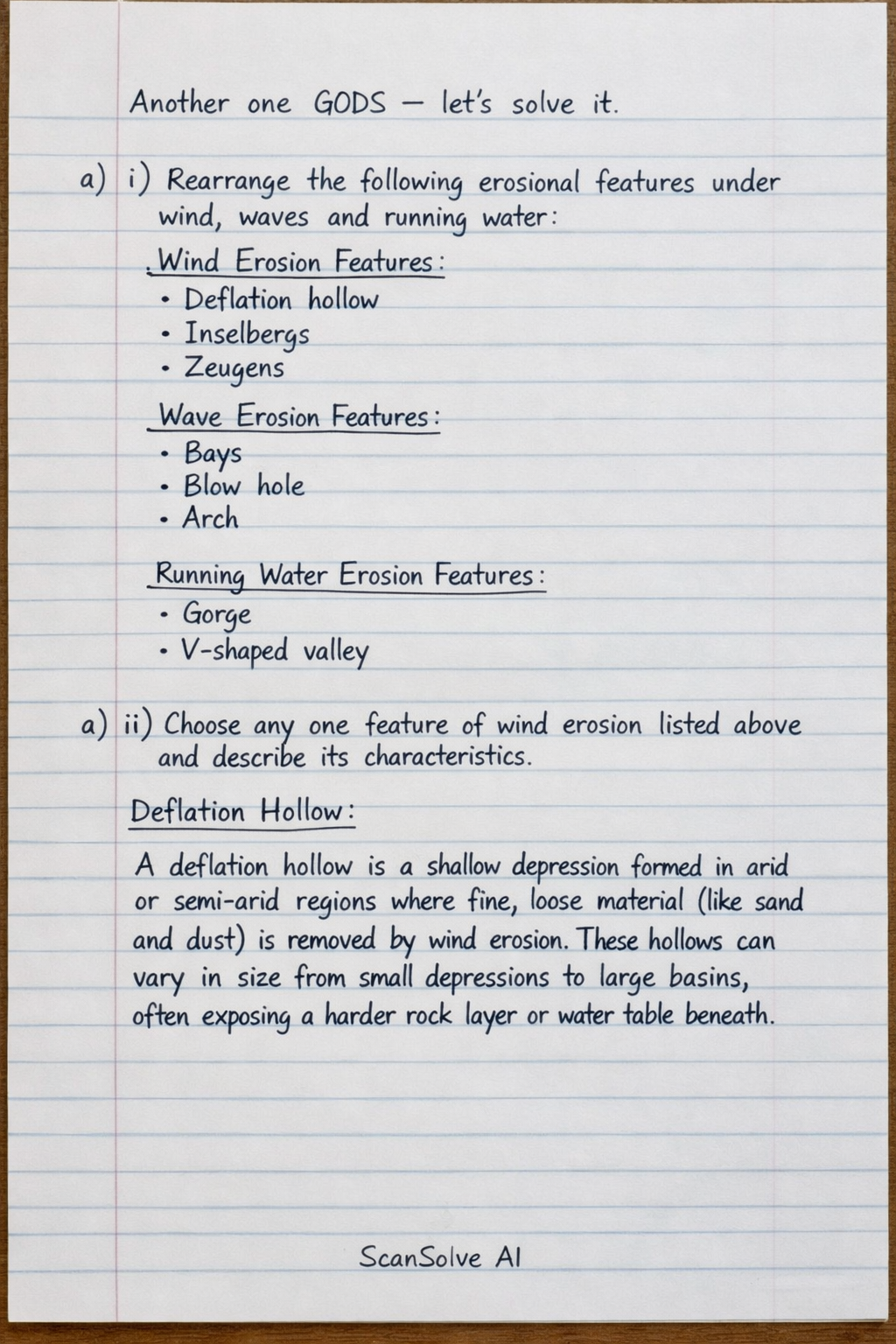
a) i) Rearrange the following erosional features under wind, waves and running water (Deflation hollow, gorge, bays, inselbergs, V-shaped valley, blow hole, zeugens and arch)
- Wind Erosion Features:
- Deflation hollow
- Inselbergs
- Zeugens
- Wave Erosion Features:
- Bays
- Blow hole
- Arch
- Running Water Erosion Features:
- Gorge
- V-shaped valley
a) ii) Choose any one feature of wind erosion listed above and describe its characteristics.
Deflation Hollow:
A deflation hollow is a shallow depression formed in arid or semi-arid regions where fine, loose material (like sand and dust) is removed by wind erosion. These hollows can vary in size from small depressions to large basins, often exposing a harder rock layer or water table beneath.
b) "High temperature, heavy rainfall, broad leaves, Tall trees" are climatic and vegetation characteristics of a vegetation type"
b) i) State the vegetation type described above?
The vegetation type described is Equatorial Rainforest (also known as Tropical Rainforest).
b) ii) Name two areas where it is found
- Amazon Basin (South America)
- Congo Basin (Central Africa)
- Southeast Asia (e.g., Indonesia, Malaysia)
c) i) Briefly define the following:
- Food chain: A food chain describes a linear sequence of organisms where energy is transferred from one trophic level to the next, starting with producers and moving through consumers.
- Food web: A food web is a complex network of interconnected food chains within an ecosystem, showing multiple feeding relationships and energy pathways among various organisms.
c) ii) Give two reasons why natural vegetation is disappearing very fast in the world today
- Deforestation for agriculture: Large areas of forests are cleared to create land for farming, livestock grazing, and plantations.
- Urbanization and infrastructure development: Expansion of cities, construction of roads, dams, and other infrastructure leads to the destruction of natural habitats.
- Logging and timber extraction: Commercial logging for wood products removes vast tracts of forests.
- Mining activities: Surface mining operations destroy vegetation and alter landscapes.
d) Outline two:
d) i) Impact of volcanicity on the environment
- Atmospheric pollution: Volcanic eruptions release gases like sulfur dioxide, carbon dioxide, and ash into the atmosphere, which can lead to acid rain, respiratory problems, and temporary climate cooling.
- Fertile soils: Volcanic ash and weathered lava can enrich soils with minerals, making them highly fertile for agriculture in the long term.
- Habitat destruction: Lava flows, ash falls, and pyroclastic flows can destroy existing ecosystems, vegetation, and animal habitats.
d) ii) Methods to conserve the soils
- Contour ploughing: Ploughing along the contours of a slope rather than up and down helps reduce water runoff and soil erosion.
- Terracing: Constructing level platforms or steps on hillsides to create flat areas for farming, which reduces erosion and retains water.
- Afforestation/Reforestation: Planting trees helps bind the soil with their roots, preventing erosion by wind and water.
- Crop rotation: Alternating different crops in the same field over successive seasons helps maintain soil fertility and structure.
d) iii) Measures to mitigate the effects of Earthquakes
- Building codes and earthquake-resistant construction: Implementing strict building codes that require structures to be designed and built to withstand seismic forces, using materials and techniques that absorb earthquake energy.
- Early warning systems: Developing and deploying systems that detect initial seismic waves and provide a few seconds to minutes of warning before stronger shaking arrives, allowing for protective actions.
- Land-use planning: Avoiding construction of critical infrastructure and large settlements in areas highly prone to seismic activity or on unstable ground.
Still stuck on this one?
Ask a follow-up, and the answer starts from this question.
More Geography Questions
Handwritten Step-by-Step Solution
Get this as a handwritten image on WhatsApp — like a tutor wrote it for you.
Try on WhatsApp