
We read your photo as:
Explain the concepts of natural environment and environmental degradation, the importance of the natural environment, and ways to protect it.
ScanSolve AI Answer
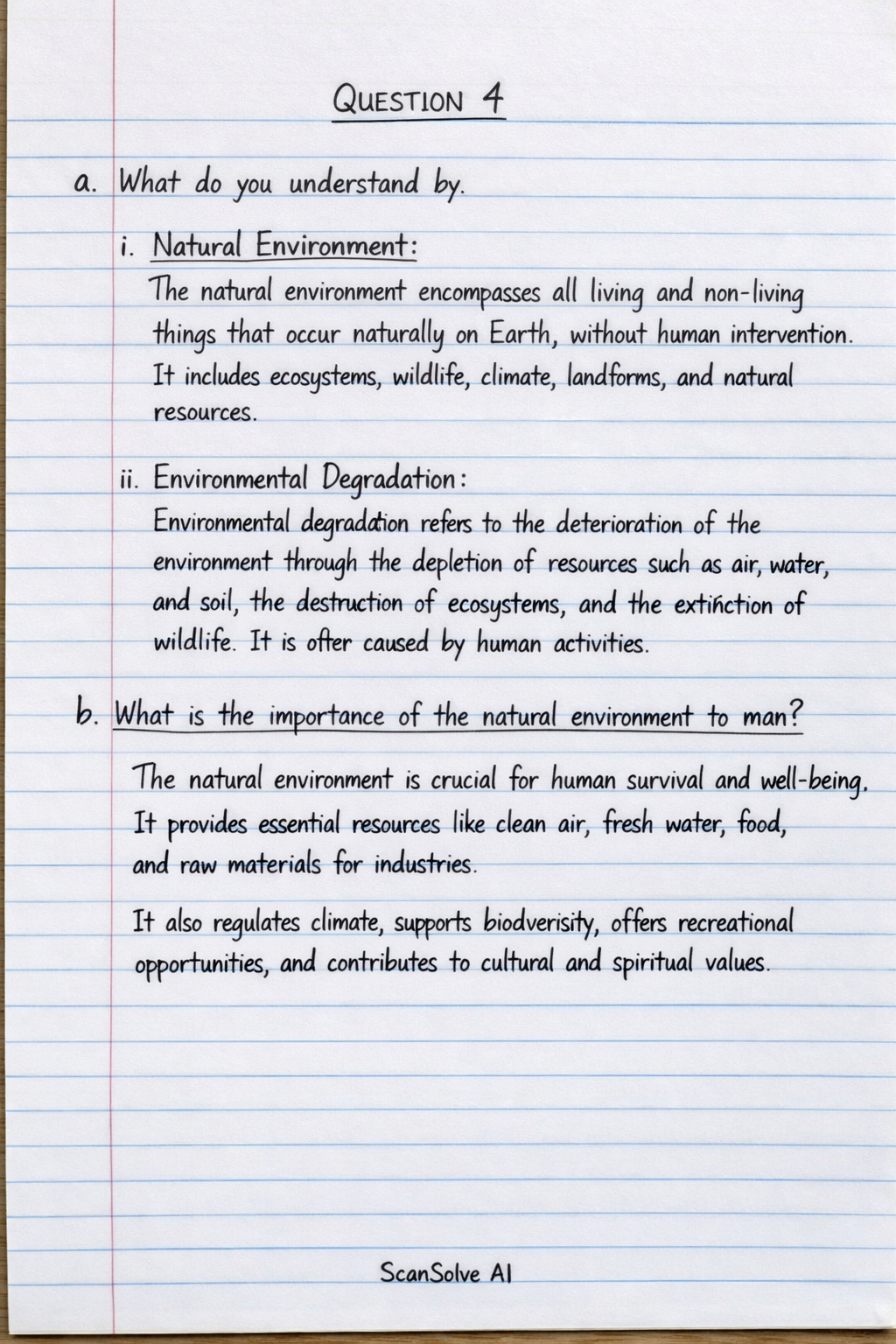
QUESTION 4
a. What do you understand by
- i. Natural Environment: The natural environment encompasses all living and non-living things that occur naturally on Earth, without human intervention. It includes ecosystems, wildlife, climate, landforms, and natural resources.
- ii. Environmental Degradation: Environmental degradation refers to the deterioration of the environment through the depletion of resources such as air, water, and soil; the destruction of ecosystems; and the extinction of wildlife. It is often caused by human activities.
b. What is the importance of the natural environment to man?
The natural environment is crucial for human survival and well-being. It provides essential resources like clean air, fresh water, food, and raw materials for industries. It also regulates climate, supports biodiversity, offers recreational opportunities, and contributes to cultural and spiritual values.
c. Outline ways in which man can protect and preserve the natural environment.
- Reduce, Reuse, Recycle: Minimizing waste generation and promoting the circular economy.
- Sustainable Resource Management: Using natural resources like forests and water in a way that meets present needs without compromising future generations.
- Pollution Control: Implementing measures to reduce air, water, and soil pollution from industrial, agricultural, and domestic sources.
- Conservation of Biodiversity: Protecting endangered species and their habitats through national parks, wildlife reserves, and anti-poaching laws.
- Promote Renewable Energy: Shifting from fossil fuels to cleaner energy sources like solar, wind, and hydro power to reduce greenhouse gas emissions.
- Environmental Education: Raising awareness among the public about environmental issues and the importance of conservation.
QUESTION 5
a. What are the Principles of Democracy?
- Rule of Law: All citizens, including those in power, are subject to and accountable under the law.
- Popular Sovereignty: The ultimate authority rests with the people, who exercise it through elected representatives.
- Equality: All citizens are equal before the law and have equal opportunities.
- Individual Rights and Freedoms: Fundamental rights such as freedom of speech, assembly, and religion are protected.
- Free and Fair Elections: Citizens have the right to choose their representatives through regular, competitive, and transparent elections.
- Accountability and Transparency: Government officials are accountable to the public, and government actions are open to scrutiny.
b. State some of the factors that promote national integration in Cameroon.
- Bilingualism: The official status of both English and French helps bridge linguistic divides.
- National Symbols: Shared national flag, anthem, and motto foster a sense of common identity.
- National Institutions: Unified government structures, military, and educational systems promote cohesion.
- Inter-regional Marriages: Marriages between individuals from different regions help blend cultures and reduce ethnic tensions.
- Sports and Culture: National sports teams and cultural festivals bring people together and create shared experiences.
- Infrastructure Development: Roads and communication networks connect different regions, facilitating interaction and trade.
c. Outline some of the obstacles to national integration.
- Ethno-regionalism: Strong loyalty to one's ethnic group or region over the nation.
- Linguistic Divide: Despite bilingualism, tensions can arise between Anglophone and Francophone communities.
- Political Marginalization: Perceptions of unequal representation or distribution of power among different groups.
- Economic Disparities: Uneven development and resource allocation across regions can fuel resentment.
- Corruption: Undermines trust in national institutions and creates a sense of injustice.
- Historical Grievances: Unresolved issues from the past, particularly concerning the Anglophone question.
QUESTION 7
a. What do you understand by
- i. Economic growth: Economic growth refers to the increase in the production of goods and services in an economy over a period, typically measured by the percentage change in real Gross Domestic Product (GDP). It primarily focuses on quantitative expansion.
- ii. Economic development: Economic development is a broader concept that encompasses not only economic growth but also improvements in the quality of life, living standards, education, health, and overall well-being of a nation's population. It is a qualitative and quantitative process.
- iii. Tax evasion: Tax evasion is the illegal act of deliberately misrepresenting one's financial affairs to the tax authorities to reduce or avoid tax obligations. This includes under-reporting income, overstating deductions, or hiding assets.
b. Explain consequences of tax evasion in an economy.
Tax evasion leads to a significant reduction in government revenue, which limits the state's ability to fund essential public services like infrastructure, education, and healthcare. It creates an unfair burden on honest taxpayers, distorts economic competition, and can lead to increased budget deficits or higher taxes for compliant citizens.
c. What reasons may economic growth not lead to economic development?
- Unequal Distribution of Wealth: Economic growth might benefit only a small segment of the population, leading to increased income inequality rather than widespread improvement in living standards.
- Lack of Investment in Human Capital: Growth might not translate into development if there's insufficient investment in education, healthcare, and skill development for the general population.
- Environmental Degradation: Rapid economic growth, if not sustainable, can lead to severe environmental damage, negatively impacting public health and future productivity.
- Corruption and Poor Governance: Funds generated by economic growth may be siphoned off or mismanaged, preventing them from being used for developmental projects.
- Focus on Specific Sectors: Growth concentrated in a few capital-intensive sectors might not create enough jobs or benefit the majority of the workforce.
QUESTION 8
a. What are the various forms of gender-based violence on women in Cameroon?
- Physical Violence: Includes beating, slapping, kicking, and other forms of bodily harm.
- Sexual Violence: Encompasses rape, sexual assault, forced prostitution, and sexual harassment.
- Psychological/Emotional Violence: Involves verbal abuse, intimidation, threats, humiliation, and isolation.
- Economic Violence: Denying women access to financial resources, property, or employment, or controlling their earnings.
- Harmful Traditional Practices: Such as female genital mutilation (FGM), forced early marriage, and widowhood rites.
b. Describe some of the problems that are peculiar to women as a result of their gender.
- Limited Access to Education: Girls often face barriers to education due to cultural norms, poverty, or early marriage, leading to lower literacy rates.
- Disproportionate Burden of Domestic Work: Women typically bear the primary responsibility for household chores and childcare, limiting their time for education, work, or political participation.
- Gender-based Violence: Women are disproportionately victims of various forms of violence, impacting their physical and mental health, safety, and overall well-being.
- Economic Disparity: Women often face discrimination in employment, lower wages for equal work, and limited access to land or financial resources.
- Underrepresentation in Leadership: Women are often underrepresented in political, economic, and social leadership positions due to societal biases and structural barriers.
c. What measures have been put in place by the government to fight against gender inequality?
- Legal Frameworks: Enacting laws that protect women's rights, such as those against gender-based violence and discrimination.
- National Gender Policies: Developing and implementing policies aimed at promoting gender equality in various sectors like education, health, and employment.
- Institutional Support: Establishing ministries or departments dedicated to women's empowerment and family affairs.
- Awareness Campaigns: Conducting public campaigns to educate communities about gender equality and the harmful effects of discrimination and violence.
- Support for Women's Education: Implementing programs to encourage girls' enrollment and retention in schools.
- Economic Empowerment Initiatives: Supporting women's entrepreneurship and access to microfinance.
QUESTION 9
a. What are the favorable conditions necessary for peace to reign in a country?
- Good Governance and Rule of Law: A government that is transparent, accountable, and upholds justice for all citizens.
- Equitable Distribution of Resources: Fair allocation of wealth, opportunities, and services across all regions and social groups.
- Respect for Human Rights: Protection of fundamental freedoms and rights for all individuals, regardless of their background.
- Inclusive Political Participation: Ensuring that all segments of society have a voice and are represented in decision-making processes.
- Economic Stability and Opportunity: Providing employment, reducing poverty, and fostering a stable economy that benefits everyone.
- Social Cohesion and Tolerance: Promoting understanding, respect, and dialogue among different ethnic, religious, and cultural groups.
b. Outline the causes and effects of conflicts in some villages in Cameroon.
- Causes of Conflicts:
- Land Disputes: Disagreements over land ownership, boundaries, or access to fertile land and water resources.
- Chieftaincy Succession Disputes: Conflicts arising from contested traditional leadership roles.
- Ethnic Tensions: Rivalries or historical grievances between different ethnic groups.
- Resource Scarcity: Competition over dwindling natural resources like forests or grazing land.
- Political Interference: External political manipulation or favoritism exacerbating local divisions.
- Cattle Grazing Routes: Conflicts between farmers and pastoralists over crop destruction by cattle.
- Effects of Conflicts:
- Loss of Life and Injury: Direct casualties and physical harm to individuals.
- Displacement of Populations: Villagers forced to flee their homes, becoming internally displaced persons.
- Destruction of Property: Homes, farms, and infrastructure damaged or destroyed.
- Disruption of Livelihoods: Agricultural activities, trade, and other economic activities halted, leading to poverty.
- Social Disintegration: Breakdown of community bonds, trust, and traditional social structures.
- Psychological Trauma: Long-lasting mental and emotional distress for those affected by violence.
QUESTION 10
a. What is globalization?
Globalization is the process of increasing interconnectedness and interdependence among countries worldwide, driven by the integration of economies, cultures, technologies, and governance. It involves the free flow of goods, services, capital, information, and people across national borders.
b. State and explain the main features of globalization.
- Increased Trade and Capital Flows: Globalization is characterized by a significant increase in international trade of goods and services, as well as cross-border investments and financial transactions.
- Technological Advancement: Rapid advancements in communication and information technology (e.g., internet, mobile phones) facilitate global interactions and the spread of ideas.
- Cultural Exchange: The spread of ideas, values, and lifestyles across borders, leading to both cultural homogenization and hybridization.
- Transnational Corporations (TNCs): The growing influence of large companies that operate in multiple countries, integrating global production and supply chains.
- Global Governance: The rise of international organizations (e.g., UN, WTO, IMF) and agreements that address global issues requiring cooperation among nations.
- Migration: Increased movement of people across national borders for work, education, or refuge.
c. Outline the advantages and disadvantages of globalization in the world.
- Advantages of Globalization:
- Economic Growth: Promotes international trade, leading to increased production, efficiency, and economic growth for participating countries.
- Access to Goods and Services: Consumers gain access to a wider variety of products at potentially lower prices due to global competition.
- Technological Diffusion: Facilitates the rapid spread of technology, knowledge, and innovation across borders, benefiting developing countries.
- Job Creation: Can create new jobs in export-oriented industries and through foreign direct investment.
- Cultural Exchange and Understanding: Fosters greater understanding and appreciation of diverse cultures.
- Disadvantages of Globalization:
- Increased Inequality: Can exacerbate income disparities between and within countries, as some benefit more than others.
- Job Displacement: Industries in developed countries may lose jobs to countries with lower labor costs.
- Cultural Homogenization: The dominance of certain cultures can lead to the erosion of local traditions and identities.
- Environmental Degradation: Increased industrialization and transportation can contribute to pollution and resource depletion.
- Loss of National Sovereignty: International agreements and organizations can sometimes limit the autonomy of national governments.
- Vulnerability to Global Crises: Economic downturns or health crises in one part of the world can quickly spread globally.
Still stuck on this one?
Ask a follow-up, and the answer starts from this question.
More Geography Questions
Handwritten Step-by-Step Solution
Get this as a handwritten image on WhatsApp — like a tutor wrote it for you.
Try on WhatsApp