
We read your photo as:
Create 12 lesson plans for Sub-Strand 3.1 Water, focusing on knowledge, skills, and attitudes.
ScanSolve AI Answer
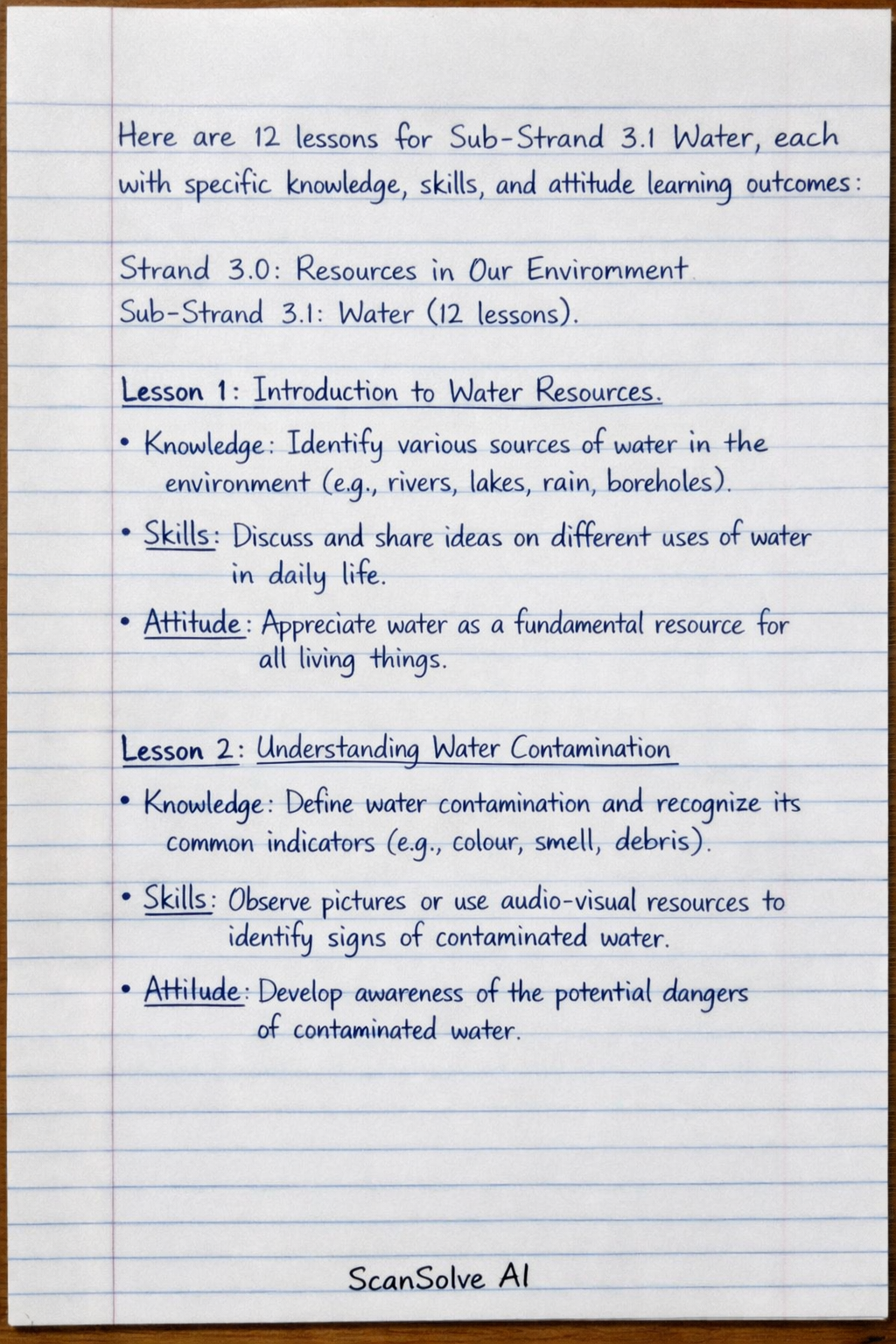
Here are 12 lessons for Sub-Strand 3.1 Water, each with specific knowledge, skills, and attitude learning outcomes:
Strand 3.0: Resources in Our Environment
Sub-Strand 3.1: Water (12 lessons)
Lesson 1: Introduction to Water Resources
- Knowledge: Identify various sources of water in the environment (e.g., rivers, lakes, rain, boreholes).
- Skills: Discuss and share ideas on different uses of water in daily life.
- Attitude: Appreciate water as a fundamental resource for all living things.
Lesson 2: Understanding Water Contamination
- Knowledge: Define water contamination and recognize its common indicators (e.g., colour, smell, debris).
- Skills: Observe pictures or use audio-visual resources to identify signs of contaminated water.
- Attitude: Develop awareness of the potential dangers of contaminated water.
Lesson 3: Sources of Water Pollution
- Knowledge: Name specific ways water can be contaminated in the environment (e.g., industrial waste, agricultural runoff, domestic sewage, improper waste disposal).
- Skills: Gather information on how human activities contribute to water contamination.
- Attitude: Recognize personal and community responsibility in preventing water pollution.
Lesson 4: Basic Water Cleaning Methods
- Knowledge: Describe simple physical methods to clean dirty water (e.g., settling, straining).
- Skills: Identify readily available materials that can be used for initial water cleaning.
- Attitude: Show curiosity about improving the quality of water.
Lesson 5: Improvised Water Filtration
- Knowledge: Explain the basic principles of filtration and the role of different layers in a simple filter.
- Skills: Improvise a water filter using locally available materials (e.g., sand, gravel, cloth, charcoal).
- Attitude: Value practical and accessible solutions for water purification.
Lesson 6: Making Water Safe for Drinking
- Knowledge: Understand methods like boiling and chemical treatment (e.g., chlorine) to make water safe for drinking.
- Skills: Discuss the steps involved in making water safe for consumption.
- Attitude: Prioritize consuming water that is clean and safe to prevent illness.
Lesson 7: Designing a Water Filter
- Knowledge: Recall the components and construction of an improvised water filter.
- Skills: Draw and colour a diagram of an improvised water filter, labeling its parts and materials.
- Attitude: Foster creativity and problem-solving skills in designing water purification systems.
Lesson 8: The Scarcity of Water
- Knowledge: Explain why water is considered a scarce resource in many parts of the world.
- Skills: Discuss the consequences of water scarcity on communities and the environment.
- Attitude: Appreciate water as a precious and limited resource that needs careful management.
Lesson 9: Water Conservation at Home
- Knowledge: Identify practical ways to conserve water in daily household activities (e.g., showering, washing dishes, gardening).
- Skills: Apply water-saving techniques in personal routines at home.
- Attitude: Commit to adopting water-saving habits in daily life.
Lesson 10: Water Conservation at School and Community
- Knowledge: Describe methods for conserving water in school and community settings (e.g., rainwater harvesting, fixing leaks).
- Skills: Discuss ways in which water can be reused for non-potable purposes (e.g., watering plants).
- Attitude: Advocate for water conservation practices within the school and local community.
Lesson 11: Health Impacts of Unsafe Water
- Knowledge: Identify common waterborne diseases and their symptoms.
- Skills: Relate the consumption of unsafe water to various health problems.
- Attitude: Value the importance of clean and safe water for maintaining good health and preventing diseases.
Lesson 12: Promoting Clean Water and Conservation
- Knowledge: Summarize key practices for maintaining clean water sources and conserving water.
- Skills: Make posters or other visual aids to educate others on ways of conserving water in the environment.
- Attitude: Take initiative in promoting clean water practices and advocating for water conservation.
Still stuck on this one?
Ask a follow-up, and the answer starts from this question.
More Geography Questions
Handwritten Step-by-Step Solution
Get this as a handwritten image on WhatsApp — like a tutor wrote it for you.
Try on WhatsApp