
We read your photo as:
Which of the following is a major ecological challenge to biodiversity conservation in Assam's national parks?
ScanSolve AI Answer
d) Which of the following is a major ecological challenge to biodiversity conservation in Assam's national parks?
i) Seasonal flooding: Assam's national parks, particularly those in the Brahmaputra floodplains like Kaziranga, are significantly affected by annual seasonal flooding. While flooding is a natural process that enriches the ecosystem, severe floods pose a major ecological challenge by displacing animals, causing mortality, and altering habitats, thus impacting biodiversity conservation.
ii) Human-wildlife conflict: As human populations expand and encroach on natural habitats, conflicts between humans and wildlife (e.g., elephants, rhinos) become frequent, leading to loss of life and habitat degradation. This is a significant challenge to conservation efforts.
iii) Lack of protected area network: Assam has a network of national parks and wildlife sanctuaries. While improvements are always possible, it is not considered a primary ecological challenge compared to direct environmental impacts or conflicts.
iv) Low rainfall: Assam is known for its high rainfall, not low rainfall. This statement is incorrect.
Both seasonal flooding and human-wildlife conflict are major challenges. However, seasonal flooding is a direct and pervasive ecological process that inherently shapes and challenges the ecosystems of many of Assam's national parks. It directly impacts the physical environment and the survival of species within the parks. Human-wildlife conflict, while having ecological consequences, often stems from anthropogenic pressures at the interface of human and wild areas. Given the options, seasonal flooding is a fundamental and widespread ecological challenge for biodiversity conservation in the region.
The final answer is
e) Assam's economy is called agriculture-based mainly because:
i) Most people live in villages: While a large portion of Assam's population lives in rural areas, this describes a demographic characteristic, not the fundamental reason for the economy being agriculture-based.
ii) Agriculture contributes the highest share to state income and employment: This is the defining characteristic of an agriculture-based economy. If the agricultural sector is the largest contributor to the state's Gross State Domestic Product (GSDP) and provides the most employment opportunities, then the economy is fundamentally dependent on agriculture.
iii) Industries are completely absent: This statement is false. Assam has various industries, including tea, oil, and gas, among others.
iv) Foreign trade is weak: While Assam's foreign trade might be limited, this is a characteristic or consequence, not the primary reason why the economy is classified as agriculture-based. An agriculture-based economy can have strong or weak foreign trade.
Therefore, the most accurate explanation is that agriculture contributes the highest share to state income and employment.
The final answer is
Still stuck on this one?
Ask a follow-up, and the answer starts from this question.
More Geography Questions
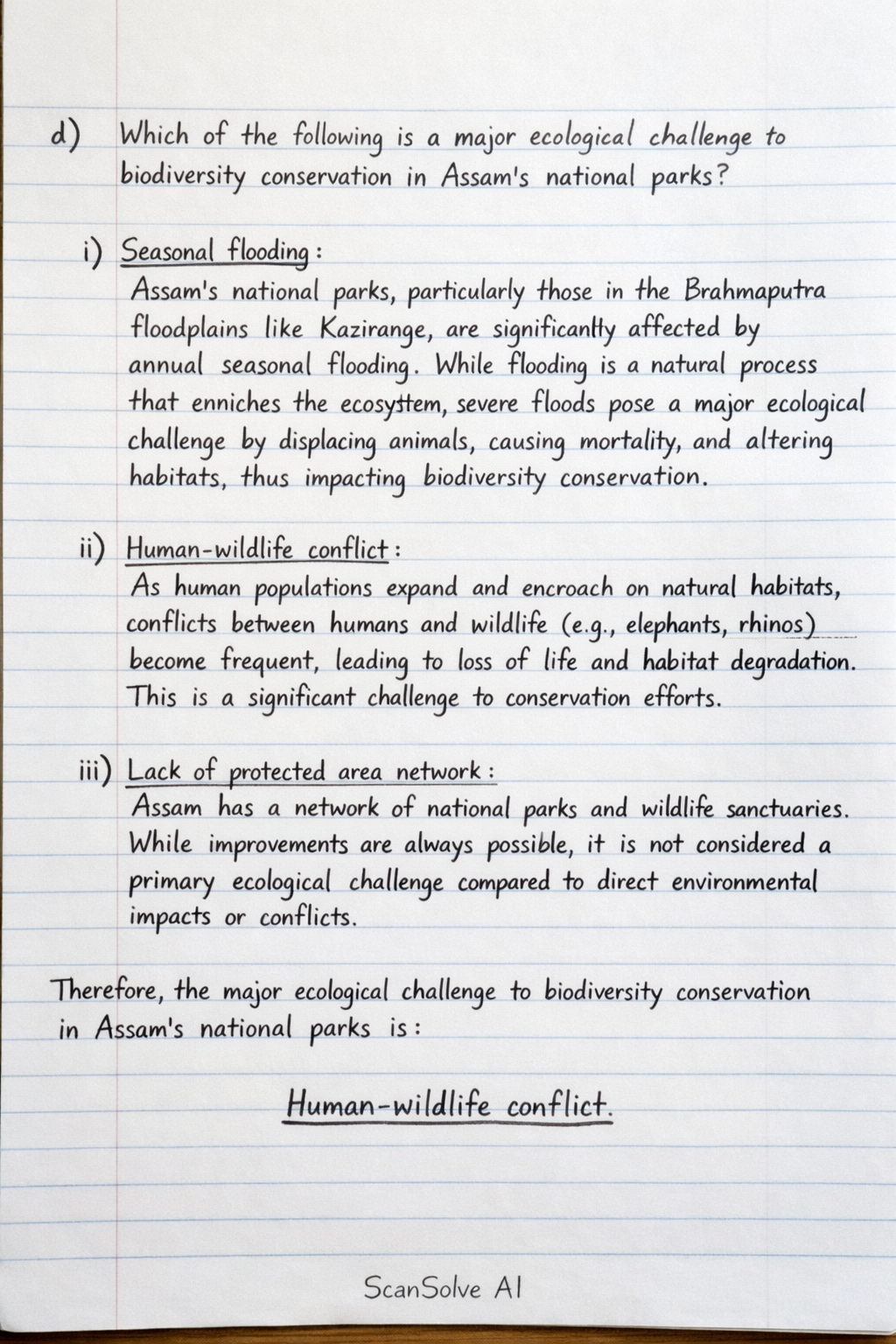
Handwritten Step-by-Step Solution
Get this as a handwritten image on WhatsApp — like a tutor wrote it for you.
Try on WhatsApp