We read your photo as:

Calculate departure, latitude, and horizontal distance between two stations given their coordinates and instrument heights.

Geography

ScanSolve AI Answer

Answers

4 parts
a

265.220 m\text{265.220 m}

285.280 m\text{285.280 m}

b

389.521 m\text{389.521 m}

c

42∘55′11′′42^\circ 55' 11''

d

3∘56′16′′3^\circ 56' 16''

Step-by-step solution

6 steps

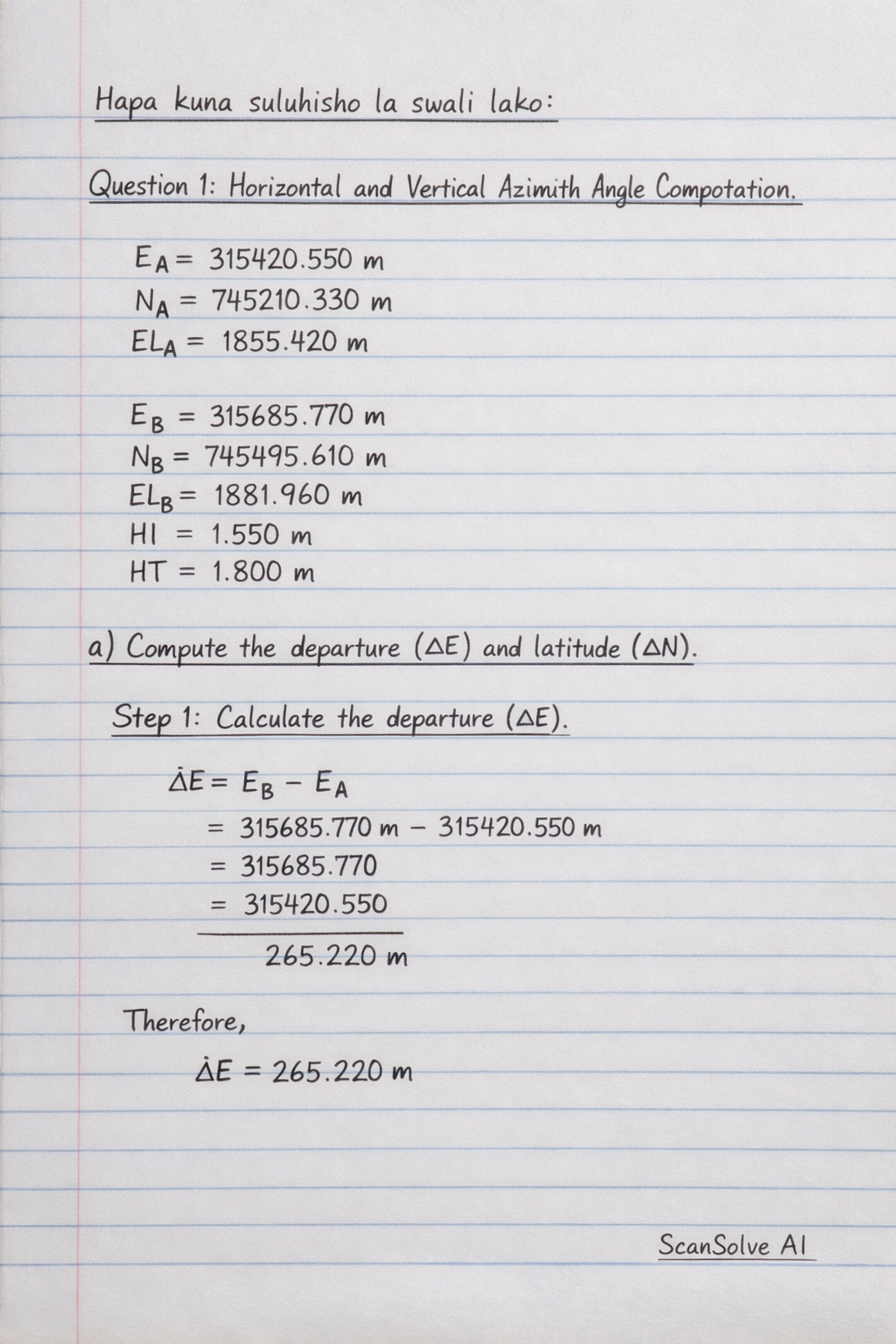
Hapa kuna suluhisho la swali lako:

Part 1

Horizontal and Vertical Azimuth Angle Computation

  • Easting of Station A (EAE_A): 315420.550 m315420.550 \text{ m}
  • Northing of Station A (NAN_A): 745210.330 m745210.330 \text{ m}
  • Elevation of Station A (ELAEL_A): 1855.420 m1855.420 \text{ m}
  • Easting of Station B (EBE_B): 315685.770 m315685.770 \text{ m}
  • Northing of Station B (NBN_B): 745495.610 m745495.610 \text{ m}
  • Elevation of Station B (ELBEL_B): 1881.960 m1881.960 \text{ m}
  • Instrument Height (HI): 1.550 m1.550 \text{ m}
  • Target Height (HT): 1.800 m1.800 \text{ m}

Part a

265.220 m\text{265.220 m}

Compute the departure (ΔE\Delta E) and latitude (ΔN\Delta N).

  1. Calculate the departure (ΔE\Delta E).

    Departure is the change in Easting from Station A to Station B.

    ΔE=EB−EA\Delta E = E_B - E_A ΔE=315685.770 m−315420.550 m\Delta E = 315685.770 \text{ m} - 315420.550 \text{ m} ΔE=265.220 m\Delta E = 265.220 \text{ m}
  2. Calculate the latitude (ΔN\Delta N).

    Latitude is the change in Northing from Station A to Station B.

    ΔN=NB−NA\Delta N = N_B - N_A ΔN=745495.610 m−745210.330 m\Delta N = 745495.610 \text{ m} - 745210.330 \text{ m} ΔN=285.280 m\Delta N = 285.280 \text{ m}

    The departure is 265.220 m\boxed{\text{265.220 m}} and the latitude is 285.280 m\boxed{\text{285.280 m}}.

Part b

389.521 m\text{389.521 m}

Determine the horizontal distance between stations A and B.

  1. Compute the horizontal distance (DD).

    The horizontal distance is calculated using the Pythagorean theorem.

    D=(ΔE)2+(ΔN)2D = \sqrt{(\Delta E)^2 + (\Delta N)^2} D=(265.220 m)2+(285.280 m)2D = \sqrt{(265.220 \text{ m})^2 + (285.280 \text{ m})^2} D=70341.6484 m2+81384.6784 m2D = \sqrt{70341.6484 \text{ m}^2 + 81384.6784 \text{ m}^2} D=151726.3268 m2D = \sqrt{151726.3268 \text{ m}^2} D≈389.521 mD \approx 389.521 \text{ m}

    The horizontal distance is 389.521 m\boxed{\text{389.521 m}}.

Part c

42∘55′11′′42^\circ 55' 11''

Compute the whole circle horizontal azimuth angle from station A to station B.

  1. Calculate the whole circle horizontal azimuth angle.

    Since ΔE\Delta E is positive and ΔN\Delta N is positive, the azimuth is in the first quadrant.

    Azimuth=arctan⁡(ΔEΔN)\text{Azimuth} = \arctan\left(\frac{\Delta E}{\Delta N}\right) Azimuth=arctan⁡(265.220285.280)\text{Azimuth} = \arctan\left(\frac{265.220}{285.280}\right) Azimuth=arctan⁡(0.92968388)\text{Azimuth} = \arctan(0.92968388) Azimuth≈42.9197∘\text{Azimuth} \approx 42.9197^\circ

    Convert to degrees, minutes, and seconds:
    0.9197∘×60=55.182′0.9197^\circ \times 60 = 55.182'
    0.182′×60=10.92′′0.182' \times 60 = 10.92''

    Azimuth=42∘55′11′′\text{Azimuth} = 42^\circ 55' 11''

    The whole circle horizontal azimuth angle is 42∘55′11′′\boxed{42^\circ 55' 11''}.

Part d

3∘56′16′′3^\circ 56' 16''

Compute the vertical angle from station A to station B considering instrument and target heights.

  1. Calculate the corrected change in elevation (ΔH\Delta H).

    The corrected change in elevation accounts for the instrument height at A and the target height at B.

    ΔH=(ELB−ELA)+(HT−HI)\Delta H = (EL_B - EL_A) + (HT - HI) ΔH=(1881.960 m−1855.420 m)+(1.800 m−1.550 m)\Delta H = (1881.960 \text{ m} - 1855.420 \text{ m}) + (1.800 \text{ m} - 1.550 \text{ m}) ΔH=26.540 m+0.250 m\Delta H = 26.540 \text{ m} + 0.250 \text{ m} ΔH=26.790 m\Delta H = 26.790 \text{ m}
  2. Compute the vertical angle (θv\theta_v).

    The vertical angle is calculated using the corrected change in elevation and the horizontal distance.

    θv=arctan⁡(ΔHD)\theta_v = \arctan\left(\frac{\Delta H}{D}\right) θv=arctan⁡(26.790 m389.5206 m)\theta_v = \arctan\left(\frac{26.790 \text{ m}}{389.5206 \text{ m}}\right) θv=arctan⁡(0.068779)\theta_v = \arctan(0.068779) θv≈3.9379∘\theta_v \approx 3.9379^\circ

    Convert to degrees, minutes, and seconds:
    0.9379∘×60=56.274′0.9379^\circ \times 60 = 56.274'
    0.274′×60=16.44′′0.274' \times 60 = 16.44''

    θv=3∘56′16′′\theta_v = 3^\circ 56' 16''

    The vertical angle is 3∘56′16′′\boxed{3^\circ 56' 16''}.

Was this helpful?

Try one yourself

A new problem that tests the same skill.

Still stuck on this one?

Ask a follow-up, and the answer starts from this question.

Got a different question?Ask your own question
Handwritten step-by-step solution preview

Handwritten Step-by-Step Solution

Get this as a handwritten image on WhatsApp — like a tutor wrote it for you.

Try on WhatsApp