
We read your photo as:
Design a field study on population distribution and density in your home village/parish. Include topic, study objectives, and data gathering methods.
Geography
ScanSolve AI Answer
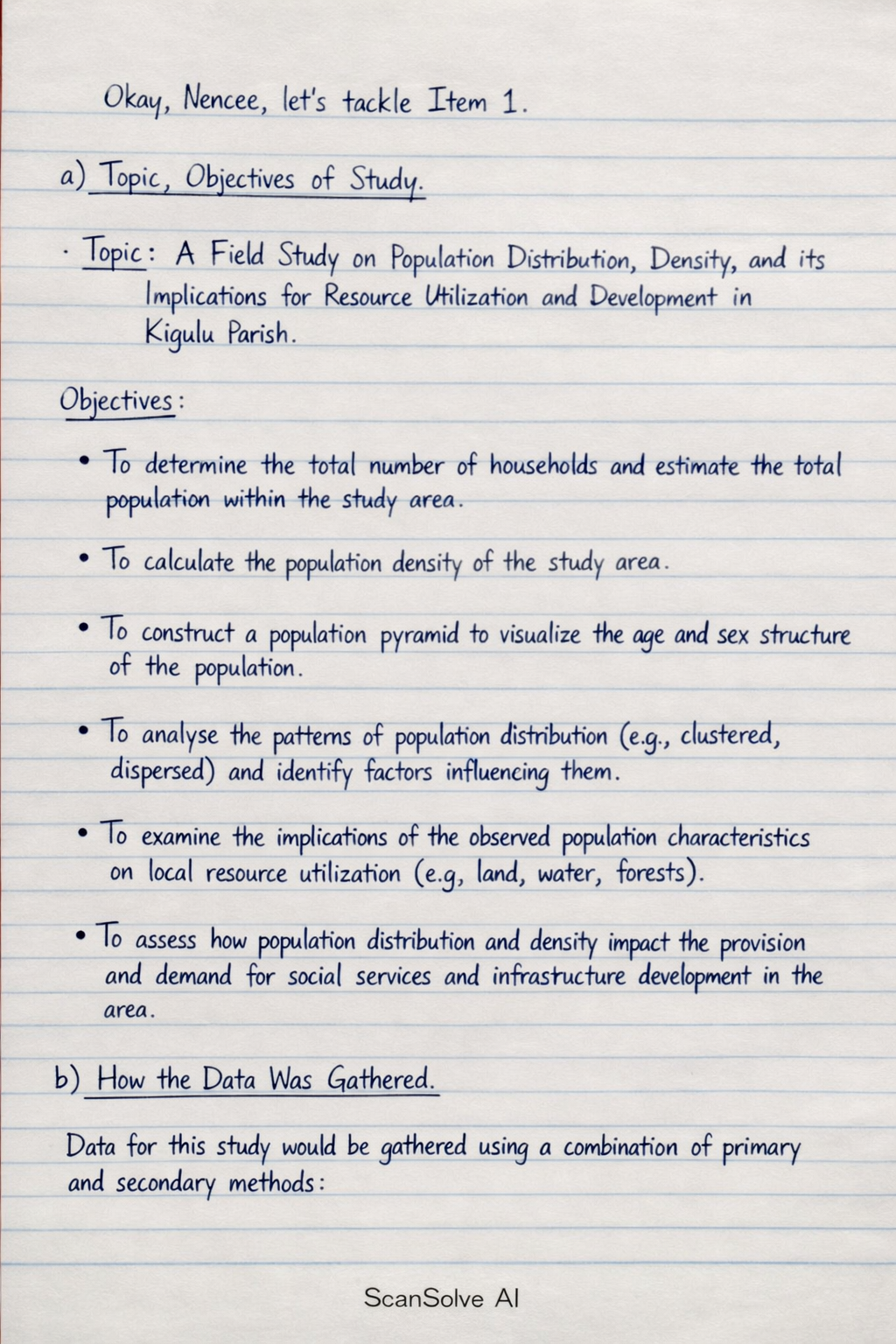
Okay, Nencee, let's tackle Item 1.
a) Topic, Objectives of Study
- Topic: A Field Study on Population Distribution, Density, and its Implications for Resource Utilization and Development in [Your Home Village/Parish Name, e.g., "Kigulu Parish"].
- Objectives:
- To determine the total number of households and estimate the total population within the study area.
- To calculate the population density of the study area.
- To construct a population pyramid to visualize the age and sex structure of the population.
- To analyze the patterns of population distribution (e.g., clustered, dispersed) and identify factors influencing them.
- To examine the implications of the observed population characteristics on local resource utilization (e.g., land, water, forests).
- To assess how population distribution and density impact the provision and demand for social services and infrastructure development in the area.
b) How the Data Was Gathered
Data for this study would be gathered using a combination of primary and secondary methods:
- Household Census/Survey: A systematic count of all households in the designated village/parish. For each household, data would be collected on the number of residents, their age, sex, and relationship to the household head. This could involve direct interviews with household members.
- Mapping and Observation: Using a base map of the area, the location of each household would be marked to understand population distribution patterns. Direct observation would also be used to note land use, available resources, and infrastructure.
- Key Informant Interviews: Discussions with local leaders (e.g., village chairperson, religious leaders, health workers) to gather general population estimates, historical trends, and insights into resource use and development challenges.
- Secondary Data Analysis: Reviewing existing records from local council offices, health centers, or schools for demographic data, birth/death rates, and migration patterns, if available.
- Area Measurement: Using maps or GPS, the total land area of the village/parish would be determined to calculate population density.
c) Your Observations on How the Population of the Area Visited Impact Development
Based on a hypothetical study, observations might include:
- High Population Density: If the area has a high population density, it could lead to land fragmentation, increased pressure on natural resources like forests and water sources, and potential food insecurity due to limited agricultural land. It might also strain existing infrastructure such as schools, health centers, and roads, leading to overcrowding and reduced service quality.
- Youthful Population Structure: A population pyramid showing a large base of young dependents (children and adolescents) would indicate a high dependency ratio. This implies significant investment is needed in education, child healthcare, and youth employment programs. While it represents a future workforce, it also places a burden on the working-age population.
- Uneven Distribution: If the population is clustered in certain areas, it could lead to localized resource depletion and environmental degradation in those specific spots, while other areas remain underutilized. This also affects the equitable provision of services, as it's harder to serve a dispersed population efficiently.
- Migration Patterns: Observations of significant out-migration of young adults might indicate a lack of local economic opportunities, leading to a loss of productive labor and a potential decline in local development initiatives. Conversely, in-migration could bring new skills but also increase competition for resources.
d) How the Development Planner Can Make Use of the Population in the Areas Visited for Development
A development planner can leverage population data to make informed decisions and design effective strategies:
- Resource Allocation: Understanding population density and distribution helps in allocating resources (e.g., land for agriculture, water points, social services) more efficiently to areas with the greatest need or potential.
- Infrastructure Planning: Data on population size, growth rates, and distribution is crucial for planning the location and capacity of schools, health facilities, roads, and housing projects. A youthful population, for instance, necessitates more primary schools.
- Economic Development: Analyzing the age and sex structure helps in identifying the available labor force and potential markets. Planners can design programs for vocational training, job creation, and support for specific economic sectors (e.g., agriculture, small businesses) that align with the population's demographics.
- Environmental Management: Knowledge of population pressure on resources guides the implementation of conservation programs, sustainable land use practices, and waste management strategies to mitigate environmental degradation.
- Policy Formulation: Population data informs the development of targeted policies related to family planning, migration management, and social welfare programs to address specific demographic challenges and opportunities. For example, an aging population might require more geriatric care services.
Was this helpful?
Still stuck on this one?
Ask a follow-up, and the answer starts from this question.
Got a different question?Ask your own question
More Geography Questions
QPrepare a fieldwork report on population distribution and density in your local area, including…QPrepare a fieldwork report on Population Distribution and Density in your local area, including…QWrite in a human hands form lively for me LECTURER'S INSTRUCTIONS FORMAT REQUIREMENTS: • Title font…QUsing the provided data, suggest an appropriate statistical method to represent the affected…QOutline a research methodology to investigate rural development, focusing on alternative energy and…
Handwritten Step-by-Step Solution
Get this as a handwritten image on WhatsApp — like a tutor wrote it for you.
Try on WhatsApp