
We read your photo as:
Explain the difference between weather and climate. Name and briefly describe one erosional and one depositional feature for the coast, river valley, and hot desert.
ScanSolve AI Answer
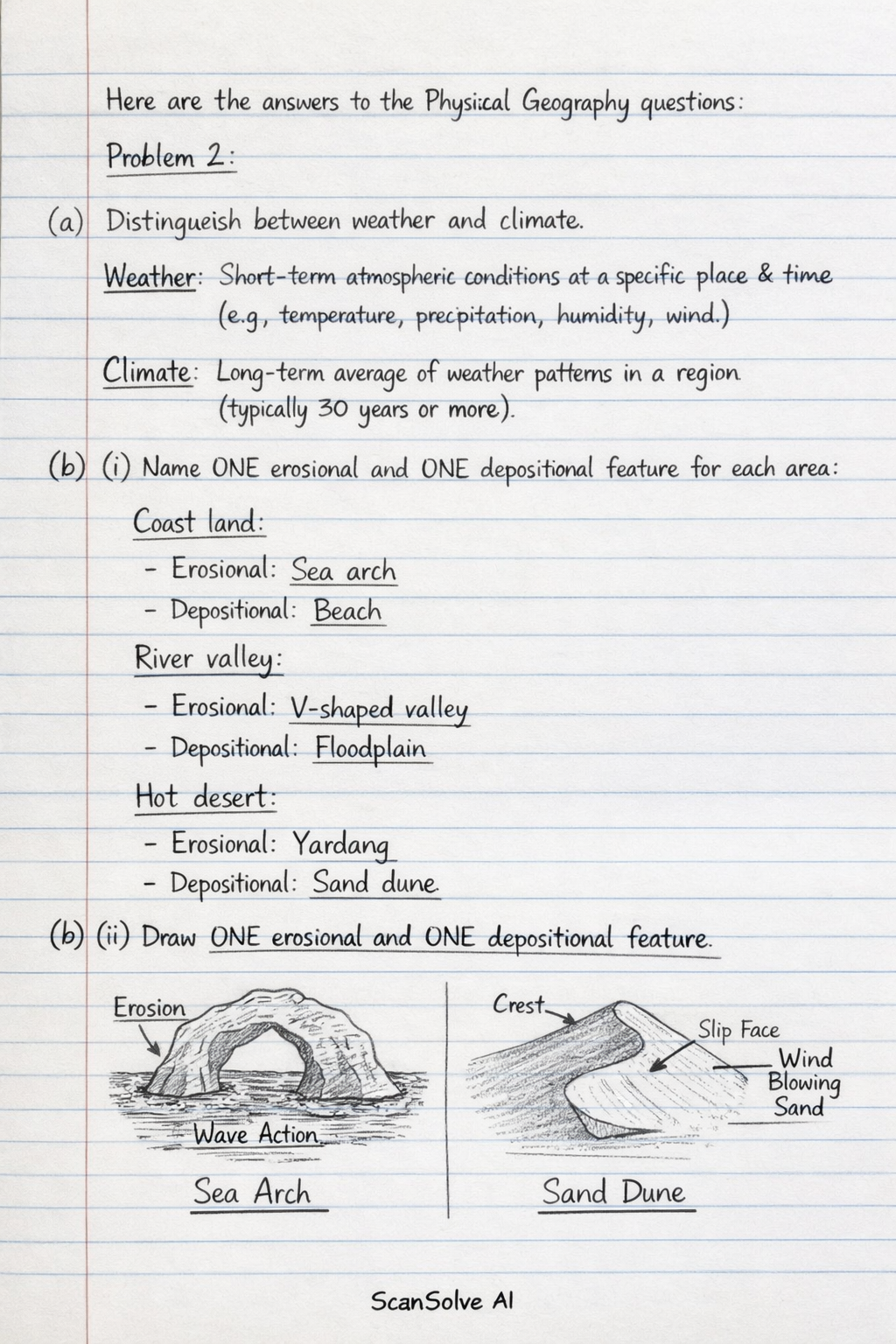
Here are the answers to the Physical Geography questions:
:
a) Distinguish between weather and climate.
- Weather refers to the short-term atmospheric conditions at a specific place and time, including elements like temperature, precipitation, humidity, and wind.
- Climate describes the long-term average of weather patterns in a region, typically measured over a period of 30 years or more, encompassing seasonal variations and extremes.
b) (i) Name ONE erosional and ONE depositional feature from each of the following areas:
- Coast land:
- Erosional: Sea arch
- Depositional: Beach
- River valley:
- Erosional: V-shaped valley
- Depositional: Floodplain
- Hot desert:
- Erosional: Yardang
- Depositional: Sand dune
b) (ii) Draw ONE erosional and ONE depositional feature, from the features named, using a well-annotated diagram.
As an AI, I cannot draw diagrams. However, for a well-annotated diagram:
- For an erosional feature like a sea arch, you would draw a rock formation with an archway carved through it by wave action, showing the sea level and the surrounding cliffs. Annotations would point to the arch, the pillars, and the wave-cut platform.
- For a depositional feature like a beach, you would draw a gently sloping accumulation of sand or pebbles along a coastline, showing the high tide line, low tide line, and possibly features like berms or dunes behind it. Annotations would indicate the sand/pebbles, the water, and the different zones of the beach.
c) Outline the pressure and wind belts of the globe using a well-annotated diagram.
As an AI, I cannot draw diagrams. However, to outline the pressure and wind belts:
- Equatorial Low Pressure Belt (Doldrums): Located near the equator (0-5° N/S), characterized by rising warm, moist air, leading to heavy rainfall and calm winds.
- Subtropical High Pressure Belts (Horse Latitudes): Found around 30° N/S, characterized by sinking cool, dry air, leading to clear skies, low rainfall, and calm conditions.
- Subpolar Low Pressure Belts: Located around 60° N/S, where warm air from the mid-latitudes meets cold polar air, causing rising air, storms, and precipitation.
- Polar High Pressure Belts: Situated at the poles (90° N/S), characterized by very cold, dense, sinking air, resulting in dry conditions.
- Trade Winds: Blow from the Subtropical Highs towards the Equatorial Low (northeast trades in the Northern Hemisphere, southeast trades in the Southern Hemisphere).
- Westerlies: Blow from the Subtropical Highs towards the Subpolar Lows (southwesterly in the Northern Hemisphere, northwesterly in the Southern Hemisphere).
- Polar Easterlies: Blow from the Polar Highs towards the Subpolar Lows.
d) Name TWO human causes of global warming.
- Burning of fossil fuels (coal, oil, natural gas) for electricity, transportation, and industrial processes, releasing large amounts of carbon dioxide and other greenhouse gases.
- Deforestation, which reduces the number of trees available to absorb carbon dioxide from the atmosphere through photosynthesis.
e) What THREE ways can be used by man to stay safely in areas affected by earthquake hazards?
- Implementing and enforcing strict building codes for earthquake-resistant construction, using materials and designs that can withstand seismic shaking.
- Establishing early warning systems that detect initial seismic waves and provide a short lead time for people to take cover or evacuate.
- Educating the public on emergency preparedness, including "drop, cover, and hold on" procedures, having emergency kits, and developing family evacuation plans.
Still stuck on this one?
Ask a follow-up, and the answer starts from this question.
More Geography Questions
Handwritten Step-by-Step Solution
Get this as a handwritten image on WhatsApp — like a tutor wrote it for you.
Try on WhatsApp