
We read your photo as:
Discuss the environmental dangers of Mr. Mukasa's farming practices and suggest sustainable land use alternatives.
Geography
ScanSolve AI Answer
Here are the dangers of Mr. Mukasa's farming practices and how the land can be utilized sustainably:
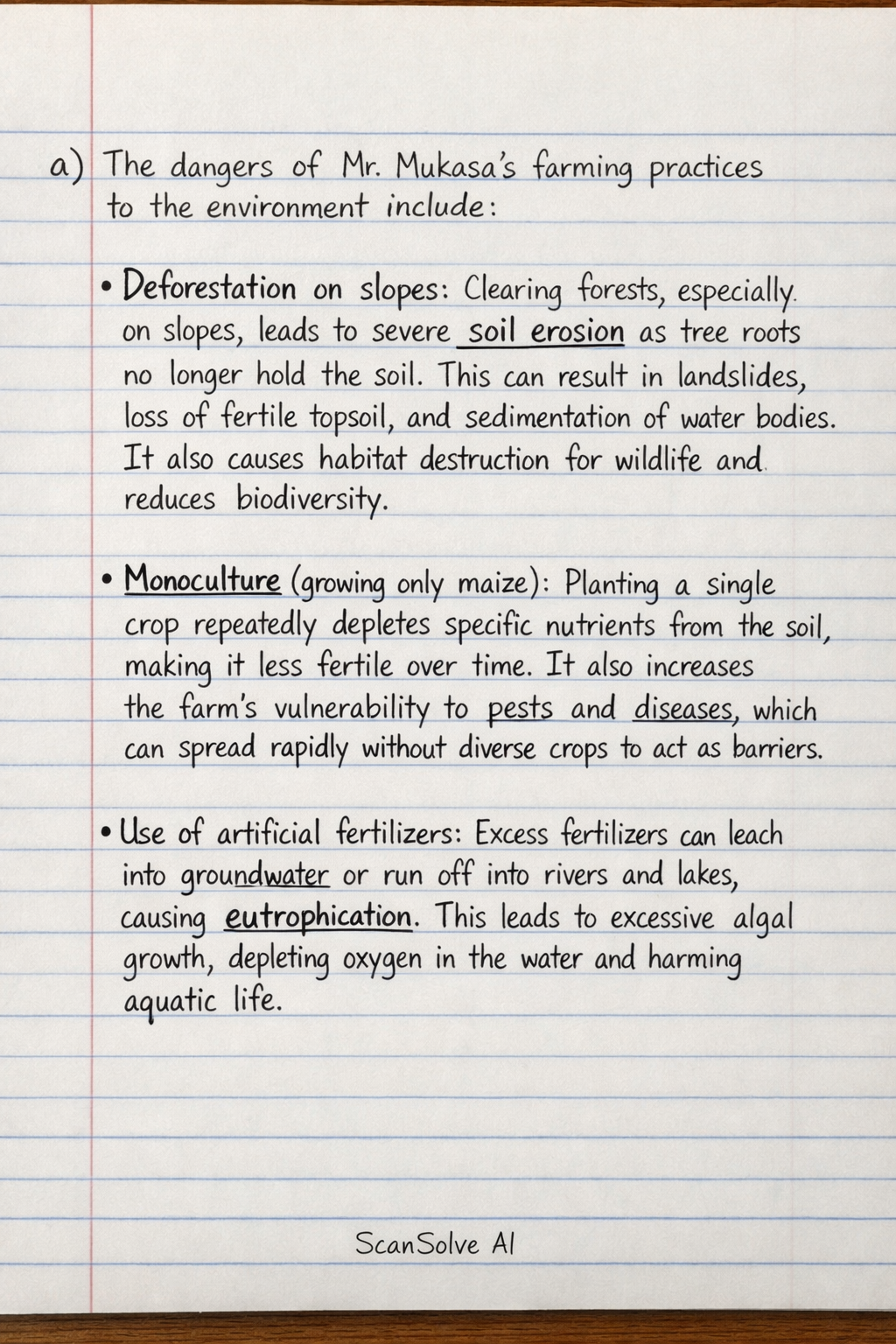
a) The dangers of Mr. Mukasa's farming practices to the environment include:
- Deforestation on slopes: Clearing forests, especially on slopes, leads to severe soil erosion as tree roots no longer hold the soil. This can result in landslides, loss of fertile topsoil, and sedimentation of water bodies. It also causes habitat destruction for wildlife and reduces biodiversity.
- Monoculture (growing only maize): Planting a single crop repeatedly depletes specific nutrients from the soil, making it less fertile over time. It also increases the farm's vulnerability to pests and diseases, which can spread rapidly without diverse crops to act as barriers.
- Use of artificial fertilizers: Excess fertilizers can leach into groundwater or run off into rivers and lakes, causing eutrophication. This leads to excessive algal growth, depleting oxygen in the water and harming aquatic life.
- Use of herbicides: Herbicides can contaminate soil and water, harming non-target plants, beneficial insects, and other organisms. They can also pose health risks to humans and animals through exposure.
- Burning down a garden/crop residue: Burning releases greenhouse gases (like carbon dioxide) into the atmosphere, contributing to climate change. It also destroys valuable organic matter and beneficial microorganisms in the soil, reducing its long-term fertility and structure.
- Ploughing using tractors: While efficient, excessive or improper ploughing, especially with heavy machinery, can lead to soil compaction, reducing water infiltration and root growth. It can also accelerate soil erosion by exposing the soil to wind and rain.
b) To utilize the environment/land sustainably without much danger, Mr. Mukasa could adopt the following practices:
- Agroforestry and Terracing: Instead of clearing forests, he could integrate trees into his farm (agroforestry) to prevent erosion, improve soil fertility, and provide shade. On slopes, terracing or contour ploughing should be implemented to reduce runoff and soil loss.
- Crop Rotation and Diversification: Instead of monoculture, Mr. Mukasa should practice crop rotation, planting different crops in sequence (e.g., maize followed by legumes) to replenish soil nutrients, break pest cycles, and improve soil health. He could also diversify his crops to reduce risks and enhance biodiversity.
- Organic Fertilizers and Integrated Pest Management (IPM): Replace artificial fertilizers with organic alternatives like compost and manure to enrich the soil naturally. For weed and pest control, he should use Integrated Pest Management (IPM) strategies, which include biological control, manual weeding, and planting pest-resistant varieties, minimizing reliance on harmful herbicides.
- No-Till or Minimum Tillage Farming: Instead of burning and extensive ploughing, Mr. Mukasa could adopt no-till or minimum tillage practices. This involves leaving crop residues on the soil surface, which protects the soil from erosion, retains moisture, and adds organic matter, improving soil structure and fertility over time.
- Cover Cropping: Planting cover crops during off-seasons can protect the soil from erosion, suppress weeds, and add organic matter and nitrogen to the soil when tilled in.
Was this helpful?
Still stuck on this one?
Ask a follow-up, and the answer starts from this question.
Got a different question?Ask your own question
More Geography Questions
QDiscuss four benefits of practicing sustainable agriculture in KenyaQWrite a letter to a radio host about the impact of farming technology businesses on Uganda's…QWhat are the key issues to present during the talk show regarding the proposed ethanol manufacturing…QDiscuss the problems of urbanization as illustrated in Meja Mwangi's "An Incident in the Park".QWhat are solutions to prevent soil creep and mudslides in Bungeni village?
Handwritten Step-by-Step Solution
Get this as a handwritten image on WhatsApp — like a tutor wrote it for you.
Try on WhatsApp