
We read your photo as:
Discuss the negative impacts of poor roads on vulnerable groups (women, children, the elderly, people with disabilities) and identify three major causes of road accidents.
ScanSolve AI Answer
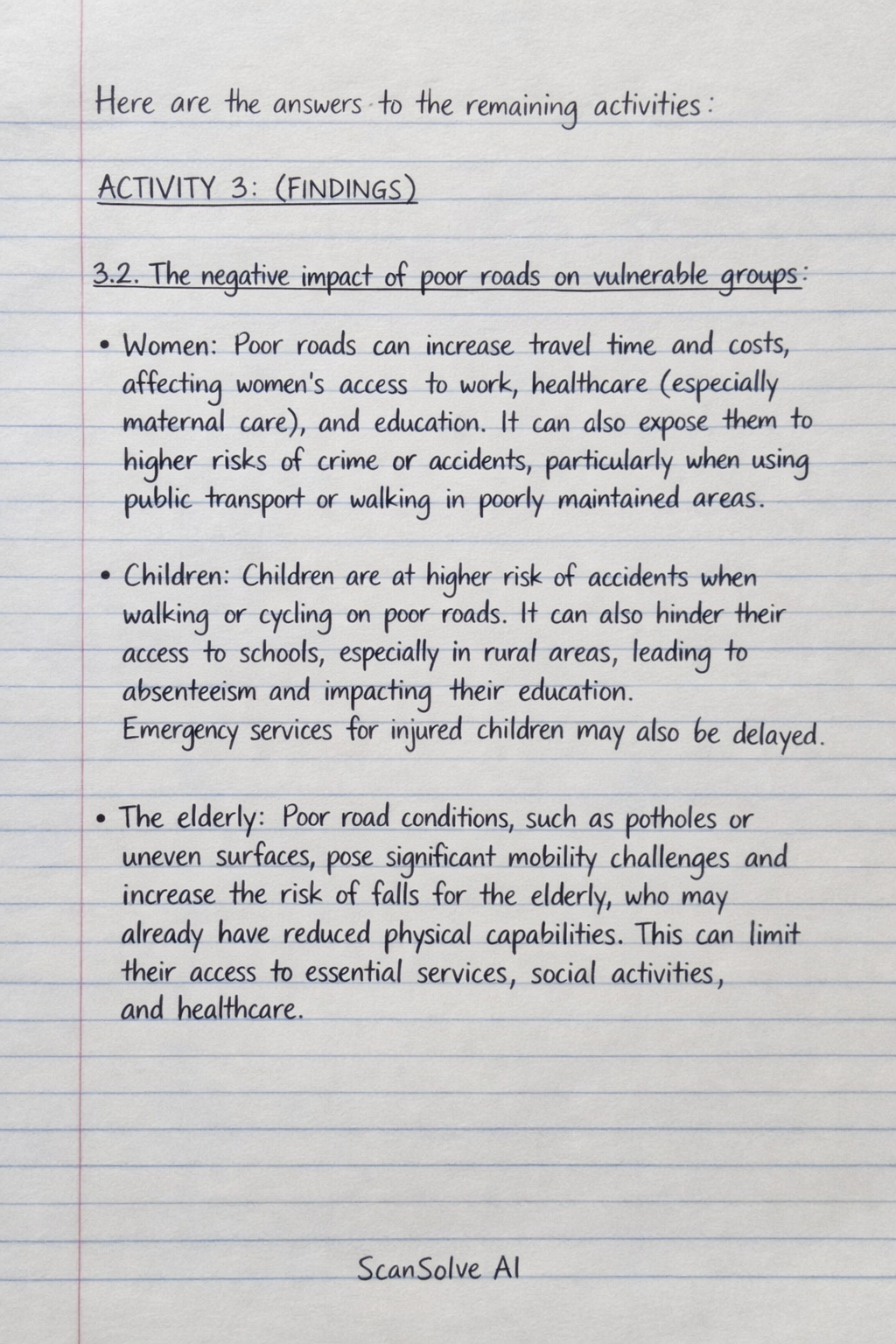
Here are the answers to the remaining activities:
ACTIVITY 3: (FINDINGS)
3.2. The negative impact of poor roads on vulnerable groups:
- Women: Poor roads can increase travel time and costs, affecting women's access to work, healthcare (especially maternal care), and education. It can also expose them to higher risks of crime or accidents, particularly when using public transport or walking in poorly maintained areas.
- Children: Children are at higher risk of accidents when walking or cycling on poor roads. It can also hinder their access to schools, especially in rural areas, leading to absenteeism and impacting their education. Emergency services for injured children may also be delayed.
- The elderly: Poor road conditions, such as potholes or uneven surfaces, pose significant mobility challenges and increase the risk of falls for the elderly, who may already have reduced physical capabilities. This can limit their access to essential services, social activities, and healthcare.
- People with disabilities: Poor roads create major barriers for people with disabilities, especially those using wheelchairs or mobility aids. Uneven surfaces, lack of accessible pavements, and damaged roads make independent travel extremely difficult and unsafe, limiting their participation in community life and access to services.
3.3. THREE major causes of road accidents in South Africa:
- Driver behaviour: This includes speeding, drunk driving, distracted driving (e.g., using cell phones), reckless overtaking, and general disregard for traffic laws. These human errors are a primary contributor to accidents.
- Unroadworthy vehicles: Many vehicles on South African roads are not properly maintained, with issues such as worn tires, faulty brakes, or non-functional lights. These mechanical failures significantly increase the risk of accidents.
- Poor road infrastructure: This includes potholes, inadequate road markings, lack of proper signage, poor lighting, and insufficient barriers or shoulders. These conditions can directly cause accidents or exacerbate their severity.
ACTIVITY 4: (RECOMMENDATIONS)
4.1. TWO ways the ineffectiveness of by-laws used by local municipalities to ensure proper road maintenance:
- Lack of enforcement: By-laws may exist on paper, but municipalities often lack the resources (personnel, vehicles, funding) or political will to consistently enforce them. This means contractors might not be held accountable for poor workmanship, or illegal dumping that damages roads goes unpunished.
- Outdated or inadequate by-laws: Some by-laws may not be comprehensive enough to address modern road maintenance challenges, or they might be outdated and not align with current best practices or national legislation. This can create loopholes or make it difficult to implement effective maintenance strategies.
4.2. How communities and civil society organizations can champion for better roads and hold the government accountable:
- Communities and civil society organizations can advocate for better roads by organizing petitions, protests, and public meetings to raise awareness and pressure local authorities. They can also monitor road conditions and government projects, documenting issues with photos and videos, and reporting them to the media or relevant oversight bodies.
- They can engage directly with local government officials, presenting well-researched proposals for road improvements and demanding accountability for allocated budgets. Furthermore, they can initiate legal action against municipalities for negligence if poor road conditions lead to harm or property damage, thereby forcing compliance and better service delivery.
4.3. ONE short-term solution that can be implemented by local government to improve road safety and uphold human rights:
- Implement immediate, rapid-response pothole repair teams to address critical road hazards within 24-48 hours of being reported. This directly reduces accident risks, protects lives and property, and ensures safer passage for all road users, upholding the right to freedom and security of the person.
4.4. ONE long-term strategy that can be adopted by the local government and private sector to address poor roads and accidents while respecting human rights:
- Establish Public-Private Partnerships (PPPs) for road infrastructure development and maintenance. This involves the government collaborating with private companies to fund, build, and maintain roads, leveraging private sector efficiency and expertise. This ensures sustainable funding, better quality infrastructure, and consistent maintenance, leading to safer roads and fewer accidents, thereby upholding human rights by providing safe access to services and protecting lives.
4.5. TWO roles that can be played by social media platforms such as WhatsApp, Facebook, TikTok, etc., in creating awareness about road maintenance initiatives and road safety in South Africa:
- Information dissemination and reporting: Social media can be used by municipalities to share real-time updates on road closures, maintenance schedules, and safety campaigns. Citizens can also use these platforms to report potholes, accidents, or other road hazards directly to authorities or community groups, often with photos and location data, facilitating quicker response times.
- Advocacy and community mobilization: Social media platforms can serve as powerful tools for community leaders and civil society organizations to launch campaigns, share educational content on road safety, and mobilize public support for better road infrastructure. They can facilitate discussions, gather public opinion, and pressure local government for accountability and action on road maintenance issues.
4.6. Critically discuss ONE economic and ONE social consequence of road accidents caused by potholes:
- Economic consequence: Road accidents caused by potholes lead to significant vehicle damage costs. Motorists incur expenses for tire replacements, wheel alignment, suspension repairs, and other mechanical fixes. This financial burden impacts household budgets, increases insurance premiums, and can lead to a loss of productivity if vehicles are off the road for repairs, ultimately affecting the local economy through increased operational costs for businesses and individuals.
- Social consequence: A major social consequence is the loss of life and severe injuries sustained in accidents. These incidents cause immense emotional trauma and grief for victims and their families, leading to long-term psychological distress. Injuries can result in permanent disabilities, reducing quality of life, increasing healthcare demands, and potentially leading to social isolation or reduced participation in community activities.
ACTIVITY 5: (CONCLUSION)
5.1. How your understanding of these issues informed your behaviour around violation of road safety rules, and what actions can be taken to help maintain roads:
- My understanding of the severe consequences of poor road conditions and accidents has significantly informed my behaviour by making me more cautious and compliant with road safety rules. I am now more aware of the risks associated with speeding, distracted driving, and driving unroadworthy vehicles, especially on damaged roads. This knowledge reinforces the importance of defensive driving and adhering to traffic laws to protect myself and others.
- Actions that can be taken to help maintain roads include reporting potholes and other road damage to local authorities promptly, participating in community clean-up or advocacy initiatives for better infrastructure, and ensuring that my own vehicle is roadworthy to prevent further damage to roads or contribute to accidents. Additionally, supporting local government through responsible payment of taxes contributes to the funding necessary for road maintenance and upgrades.
Still stuck on this one?
Ask a follow-up, and the answer starts from this question.
More Geography Questions
Handwritten Step-by-Step Solution
Get this as a handwritten image on WhatsApp — like a tutor wrote it for you.
Try on WhatsApp