
We read your photo as:
Distinguish between migration and rural-urban migration and discuss four pull factors for rural-urban migration.
Geography
ScanSolve AI Answer
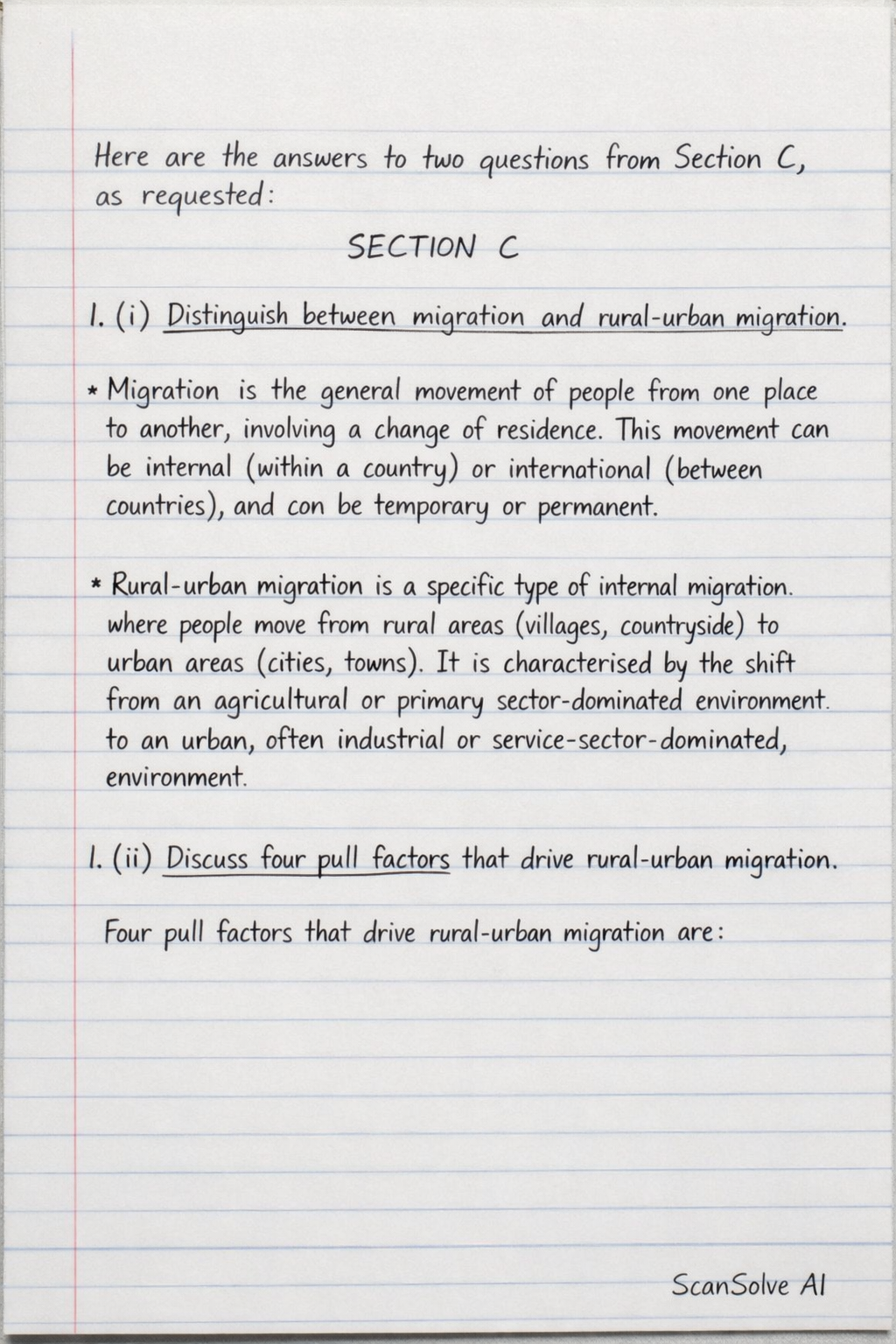
Here are the answers to two questions from Section C, as requested:
SECTION C
1. (i) Distinguish between migration and rural-urban migration.
- Migration is the general movement of people from one place to another, involving a change of residence. This movement can be internal (within a country) or international (between countries), and can be temporary or permanent.
- Rural-urban migration is a specific type of internal migration where people move from rural areas (villages, countryside) to urban areas (cities, towns). It is characterized by the shift from an agricultural or primary sector-dominated environment to an urban, often industrial or service-sector-dominated, environment.
1. (ii) Discuss four pull factors that drive rural-urban migration.
Four pull factors that drive rural-urban migration are:
- Better Employment Opportunities: Cities often have a wider range of jobs in industries, services, and commerce, offering higher wages and more stable employment compared to limited agricultural work in rural areas. This economic attraction is a primary driver.
- Improved Social Amenities and Services: Urban areas typically provide superior access to essential services such as quality education, advanced healthcare facilities, reliable electricity, piped water, and better sanitation, which are often lacking or of lower quality in rural regions.
- Higher Standard of Living: The perception and reality of a better quality of life in cities, including access to modern housing, diverse consumer goods, and various entertainment options, attract people seeking an improved lifestyle.
- Perceived Social Freedom and Modernity: Cities often offer greater social mobility, anonymity, and a more modern lifestyle, which can be appealing to individuals seeking to escape traditional social constraints or to experience a more dynamic environment.
2. (i) Define environmental modification.
- Environmental modification refers to any alteration or change made by humans to the natural environment. These changes can range from minor adjustments to large-scale transformations of ecosystems, landscapes, and atmospheric conditions, often with significant ecological and social consequences.
2. (ii) Identify and explain any four drivers of environmental modification.
Four drivers of environmental modification are:
- Population Growth: An increasing human population demands more resources (food, water, energy, land) and generates more waste, leading to extensive land-use change, deforestation, resource depletion, and pollution to meet these growing needs.
- Industrialization: The development of manufacturing industries involves the extraction of raw materials, energy consumption, and the release of pollutants (air, water, soil), significantly altering natural environments and contributing to climate change.
- Agricultural Practices: Intensive farming methods, including deforestation for farmland, monoculture, excessive use of fertilizers and pesticides, and irrigation, lead to soil degradation, water pollution, habitat loss, and changes in biodiversity.
- Urbanization: The expansion of cities and towns converts natural landscapes into built environments. This process involves habitat destruction, increased impervious surfaces (leading to runoff issues), higher energy consumption, and greater waste generation, all of which modify the local and regional environment.
- Technological Advancements: While often beneficial, technological progress can also drive environmental modification. For example, new extraction technologies allow access to previously inaccessible resources, and advancements in transportation increase fossil fuel consumption and emissions.
Was this helpful?
Still stuck on this one?
Ask a follow-up, and the answer starts from this question.
Got a different question?Ask your own question
More Geography Questions
QUrbanisation involves rural - urban movement. DiscussQBased on the two documents and your knowledge, what are the factors contributing to urbanization in…QWhat are the consequences of rural-urban migration in West African countries?QGive ONE pull factor why people would prefer to stay in urban areas.QWith reference to specific Examples, examine the Pull and Push factors that triggered the 19th…
Handwritten Step-by-Step Solution
Get this as a handwritten image on WhatsApp — like a tutor wrote it for you.
Try on WhatsApp