
Draw the cycle of water
Geography
ScanSolve AI Answer
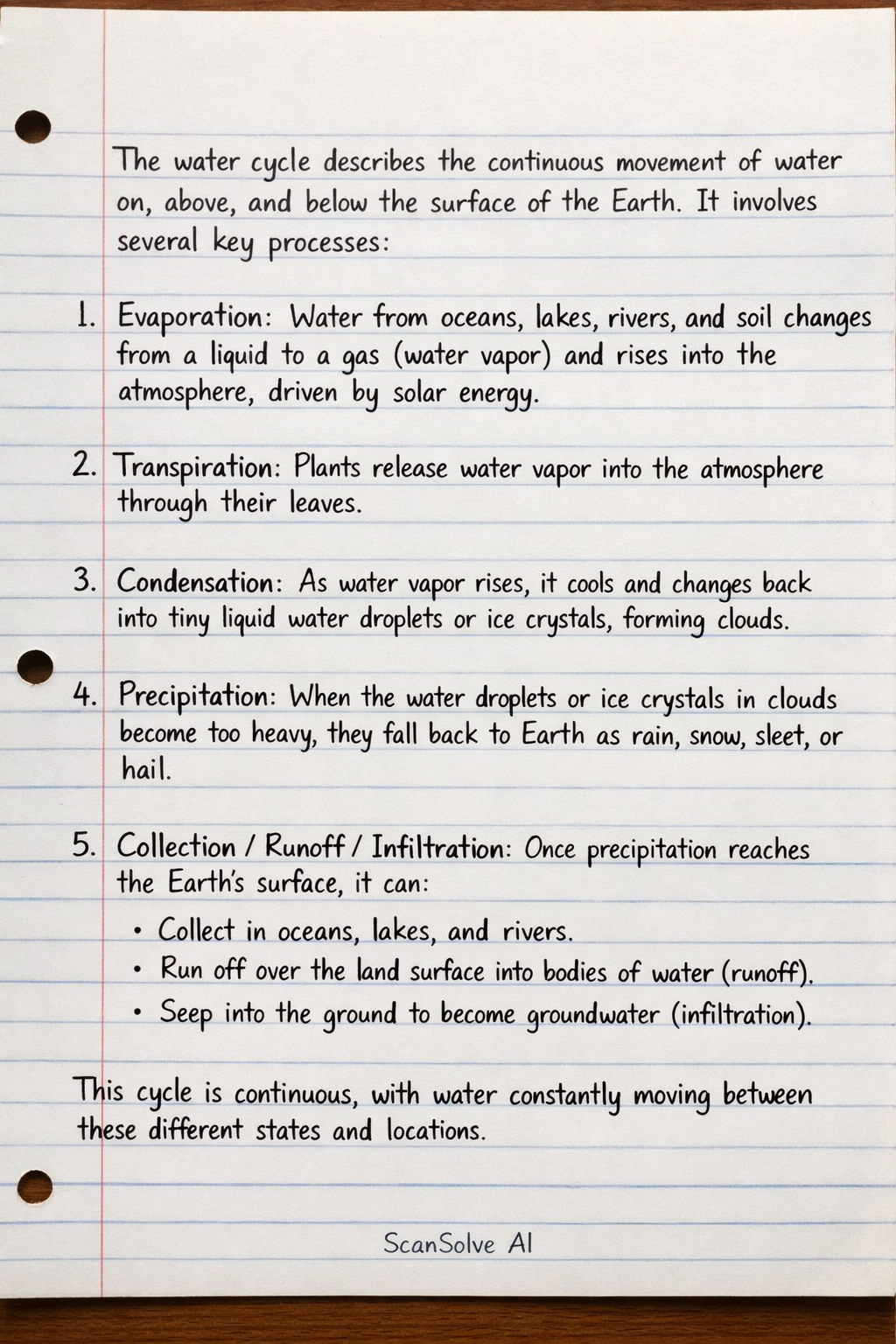
The water cycle describes the continuous movement of water on, above, and below the surface of the Earth. It involves several key processes:
- Evaporation: Water from oceans, lakes, rivers, and soil changes from a liquid to a gas (water vapor) and rises into the atmosphere, primarily driven by solar energy.
- Transpiration: Plants release water vapor into the atmosphere through their leaves.
- Condensation: As water vapor rises, it cools and changes back into tiny liquid water droplets or ice crystals, forming clouds.
- Precipitation: When the water droplets or ice crystals in clouds become too heavy, they fall back to Earth as rain, snow, sleet, or hail.
- Collection/Runoff/Infiltration: Once precipitation reaches the Earth's surface, it can:
- Collect in oceans, lakes, and rivers.
- Run off over the land surface into bodies of water (runoff).
- Seep into the ground to become groundwater (infiltration).
This cycle is continuous, with water constantly moving between these different states and locations.
Was this helpful?
Still stuck on this one?
Ask a follow-up, and the answer starts from this question.
Got a different question?Ask your own question
More Geography Questions
Handwritten Step-by-Step Solution
Get this as a handwritten image on WhatsApp — like a tutor wrote it for you.
Try on WhatsApp