
We read your photo as:
Explain the formation of coastal depositional features based on the scenario provided.
ScanSolve AI Answer
Step-by-step solution
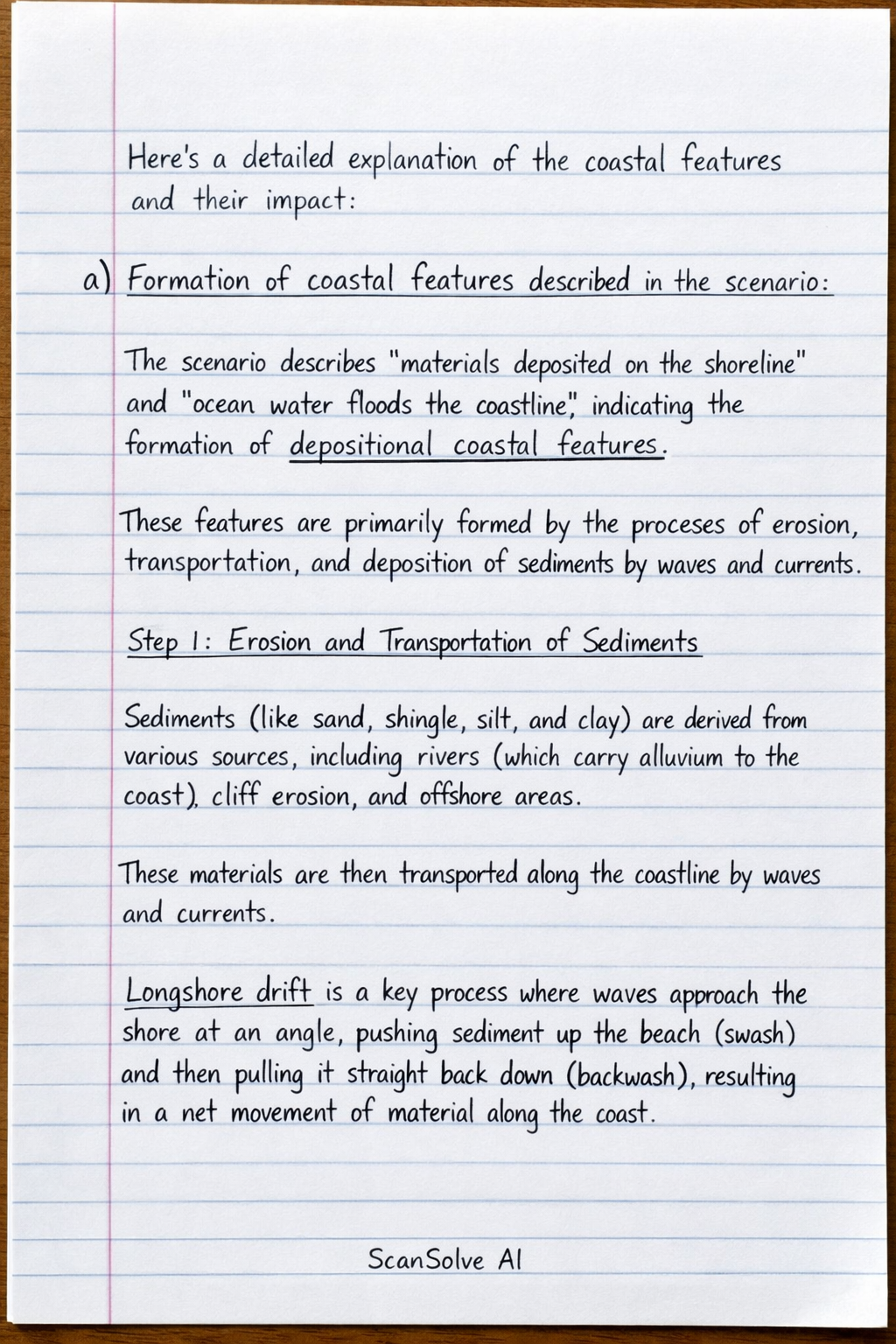
5 stepsHere's a detailed explanation of the coastal features and their impact:
Part a· 3 steps
Formation of coastal features described in the scenario
The scenario describes "materials deposited on the shoreline" and "ocean water floods the coastline," indicating the formation of depositional coastal features. These features are primarily formed by the processes of erosion, transportation, and deposition of sediments by waves and currents.
Erosion and Transportation of Sediments
Sediments (like sand, shingle, silt, and clay) are derived from various sources, including rivers (which carry alluvium to the coast), cliff erosion, and offshore areas. These materials are then transported along the coastline by waves and currents. Longshore drift is a key process where waves approach the shore at an angle, pushing sediment up the beach (swash) and then pulling it straight back down (backwash), resulting in a net movement of material along the coast.
Deposition of Sediments
Deposition occurs when the energy of the waves and currents decreases. This typically happens in sheltered areas such as bays, estuaries, or where the coastline changes direction. Constructive waves, which have a strong swash and weak backwash, are particularly effective at depositing material on the beach. Over time, the accumulation of these sediments leads to the formation of various landforms.
Specific Depositional Features
- Beaches: These are accumulations of sand, shingle, or pebbles along the coastline, formed by the continuous deposition of sediment by constructive waves.
- Spits: A spit is a long, narrow ridge of sand or shingle that extends from the land into the sea, often across a bay or estuary. It forms when longshore drift carries sediment along the coast and deposits it where the coastline changes direction or where a river mouth reduces wave energy. The end of a spit may curve inwards due to wave refraction or secondary currents, forming a hooked or recurved spit.
- Bars: If a spit grows completely across a bay, connecting two headlands, it forms a bar. This encloses a body of water behind it, often creating a lagoon.
- Tombolos: A tombolo is a bar that connects an island to the mainland or to another island.
- Mudflats and Salt Marshes: In very sheltered, low-energy environments, such as estuaries or behind spits and bars, fine sediments (silt and clay) are deposited by tides and rivers. Over time, these accumulate to form mudflats. Pioneer vegetation then colonizes the mudflats, trapping more sediment and gradually building up the land to form salt marshes.
Part b· 2 steps
Impact of coasts and coastal features on East Africa
Coasts and their associated features have significant economic, environmental, and social impacts on East Africa.
Economic Impacts
- Tourism: The beautiful sandy beaches, coral reefs, and coastal national parks (e.g., Diani Beach in Kenya, Zanzibar in Tanzania) attract millions of tourists, generating substantial revenue, creating employment opportunities, and supporting local businesses.
- Fishing: Coastal waters are rich fishing grounds, providing livelihoods for many communities and contributing to food security. Fishing ports and related industries thrive along the coast.
- Trade and Transport: Natural harbors and deep-water ports (e.g., Mombasa in Kenya, Dar es Salaam in Tanzania) are crucial for international trade, facilitating imports and exports, and serving as gateways for landlocked countries in the region.
- Salt Production: Coastal areas with suitable climates are utilized for salt harvesting through evaporation, providing a valuable commodity.
Environmental and Social Impacts
- Biodiversity: Coastal ecosystems like coral reefs, mangrove forests, and estuaries are biodiversity hotspots, supporting a wide array of marine life and providing essential breeding grounds for fish and other species.
- Coastal Protection: Mangrove forests and coral reefs act as natural barriers, protecting the coastline from erosion, storm surges, and tsunamis, thereby safeguarding coastal communities and infrastructure.
- Settlement and Livelihoods: Coastal areas are often densely populated due to access to resources, trade routes, and fertile land. Many communities depend directly on coastal resources for their sustenance and cultural practices.
- Challenges: Coasts also face challenges such as coastal erosion, marine pollution from land-based activities and shipping, and the impacts of climate change (e.g., sea-level rise), which threaten ecosystems and human settlements.
Still stuck on this one?
Ask a follow-up, and the answer starts from this question.
More Geography Questions
Handwritten Step-by-Step Solution
Get this as a handwritten image on WhatsApp — like a tutor wrote it for you.
Try on WhatsApp