
We read your photo as:
State four similarities between plantation farming and extensive mechanized farming. Describe three problems facing fish and forest resources.
ScanSolve AI Answer
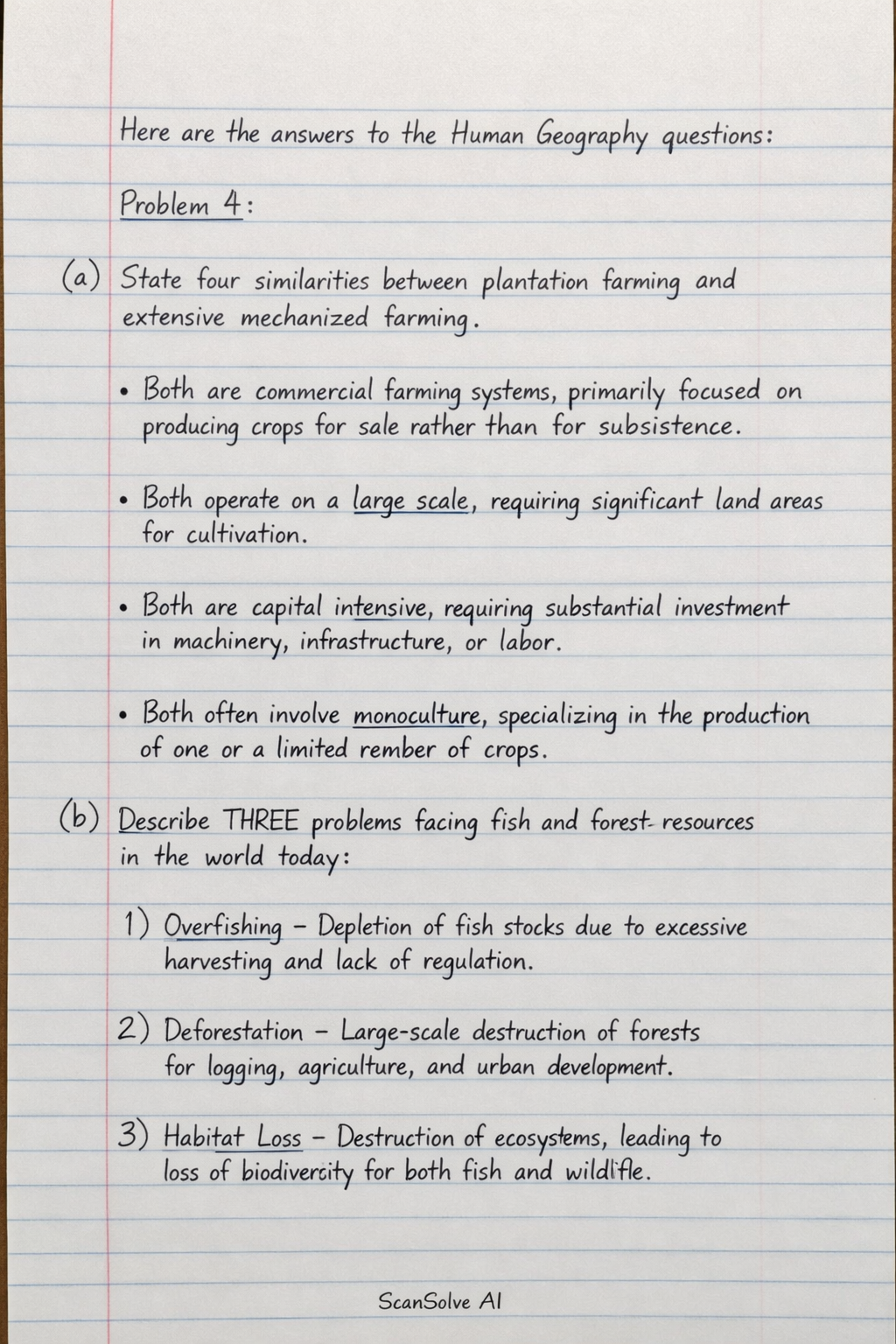
Here are the answers to the Human Geography questions:
:
a) State four similarities between plantation farming and extensive mechanized farming.
- Both are commercial farming systems, primarily focused on producing crops for sale rather than for subsistence.
- Both operate on a large scale, requiring significant land areas for cultivation.
- Both are capital intensive, requiring substantial investment in machinery, infrastructure, or labor.
- Both often involve monoculture, specializing in the production of one or a limited number of crops.
b) Describe THREE problems facing fish and forest resources in the world today.
- Fish Resources:
- Overfishing: Many fish stocks are being harvested faster than they can reproduce, leading to a decline in fish populations and threatening marine ecosystems.
- Marine Pollution: Oceans are contaminated by plastics, industrial waste, agricultural runoff, and oil spills, which harm fish health, destroy habitats, and accumulate toxins in the food chain.
- Habitat Destruction: Critical marine habitats like coral reefs, mangroves, and seagrass beds are being destroyed by coastal development, bottom trawling, and pollution, reducing breeding grounds and food sources for fish.
- Forest Resources:
- Deforestation: Forests are being cleared at an alarming rate for agriculture, logging, urbanization, and mining, leading to loss of biodiversity, soil erosion, and increased greenhouse gas emissions.
- Illegal Logging: Unregulated and unsustainable harvesting of timber contributes to deforestation, often without regard for environmental regulations or local communities.
- Forest Fires: Both natural and human-caused fires are increasing in frequency and intensity, destroying vast areas of forest, releasing carbon, and displacing wildlife.
c) Account for the growth of many urban centres in the world since the 1950s.
The growth of urban centers since the 1950s is largely due to rural-to-urban migration, as people move to cities seeking better economic opportunities, higher wages, and improved access to education, healthcare, and other services. Industrialization and the expansion of the service sector in cities created numerous jobs, acting as a strong pull factor. Additionally, natural population increase within urban areas contributes to growth, and technological advancements in agriculture have reduced the need for rural labor, pushing people towards urban centers.
d) Explain, using THREE reasons, why many manufacturing industries are few in Developing Countries.
- Lack of Capital and Investment: Developing countries often struggle to attract sufficient domestic and foreign investment needed to establish and expand manufacturing industries, including funding for factories, machinery, and research.
- Inadequate Infrastructure: Poorly developed transportation networks (roads, railways, ports), unreliable power supply, and limited access to modern communication systems significantly increase operational costs and hinder the efficiency of manufacturing.
- Shortage of Skilled Labor and Technology: Many developing countries face a deficit of trained engineers, technicians, and skilled workers required for complex manufacturing processes. They also often lack access to advanced technology and the capacity for innovation, making it difficult to compete globally.
Still stuck on this one?
Ask a follow-up, and the answer starts from this question.
More Geography Questions
Handwritten Step-by-Step Solution
Get this as a handwritten image on WhatsApp — like a tutor wrote it for you.
Try on WhatsApp