
Government 5.0, Sustainable Development Goals (SDGs), and ICT for Development (ICT4D) The purpose of this portfolio is to assess students’ understanding of how digital technologies support development-oriented governance, social inclusion, and sustainable development. The portfolio introduces students to Government 5.0, the United Nations Sustainable Development Goals (SDGs), and the role of Information and Communication Technologies for Development (ICT4D) in addressing societal challenges. Section A: (± 600 words) (Use appropriate headings) Explain the concepts of Government 5.0, the Sustainable Development Goals (SDGs), and Information and Communication Technologies for Development (ICT4D). In your response, you should: 1. Introduction - Define and explain: • Government 5.0 • The Sustainable Development Goals (SDGs) • ICT4D 2. Body - Demonstrate understanding of how: • Government 5.0 uses digital technologies to improve public services. • ICT4D supports development in communities. • The SDGs guide governments in addressing social, economic, and environmental challenges. Provide practical examples (e.g., e-government services, digital health systems, online education platforms, mobile banking, smart cities, etc.). Show clearly how digital technologies can: • Improve service delivery • Promote inclusion • Reduce inequality • Enhance citizen participation 3. Conclusion (Summarize the content you provided in this section) • Your conclusion should address this question: Why does the integration of Government 5.0, SDGs, and ICT4D matter for improving citizens’ lives?”
ScanSolve AI Answer
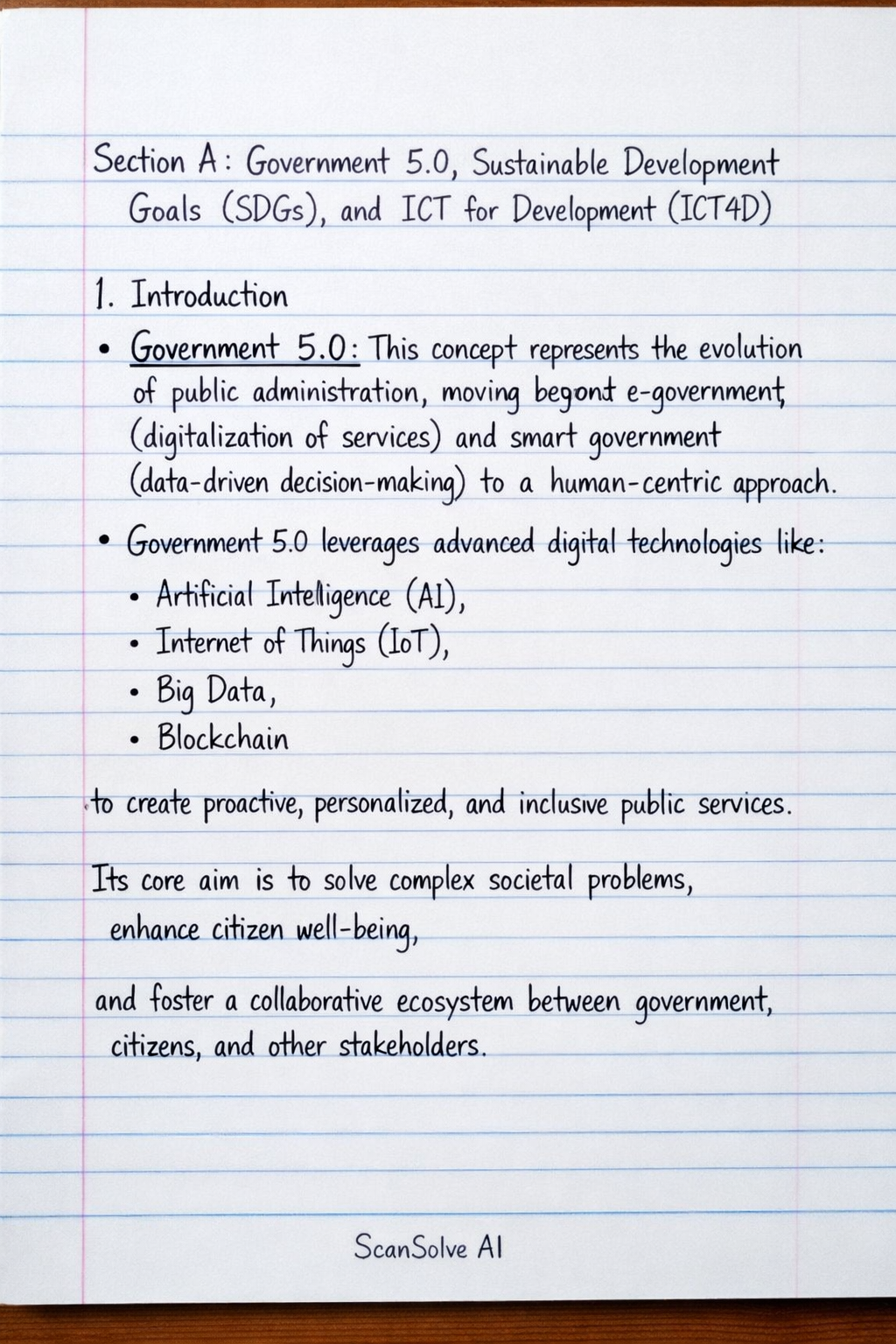
Section A: Government 5.0, Sustainable Development Goals (SDGs), and ICT for Development (ICT4D)
1. Introduction
-
Government 5.0: This concept represents the evolution of public administration, moving beyond e-government (digitalization of services) and smart government (data-driven decision-making) to a human-centric approach. Government 5.0 leverages advanced digital technologies like Artificial Intelligence (AI), the Internet of Things (IoT), big data, and blockchain to create proactive, personalized, and inclusive public services. Its core aim is to solve complex societal problems, enhance citizen well-being, and foster a collaborative ecosystem between government, citizens, and other stakeholders.
-
The Sustainable Development Goals (SDGs): Adopted by all United Nations Member States in 2015, the SDGs are a universal call to action to end poverty, protect the planet, and ensure that all people enjoy peace and prosperity by 2030. Comprising 17 interconnected goals and 169 targets, they address global challenges including poverty, hunger, health, education, climate change, gender equality, water, sanitation, energy, economic growth, innovation, inequality, sustainable cities, responsible consumption, life below water, life on land, peace, justice, and partnerships. The SDGs provide a comprehensive framework for governments, organizations, and individuals to guide their development efforts.
-
ICT for Development (ICT4D): This refers to the application of Information and Communication Technologies (ICTs) to facilitate the socio-economic development of communities and nations. ICT4D encompasses the strategic use of digital tools such as mobile phones, the internet, software applications, and digital infrastructure to address development challenges in various sectors, including education, health, governance, economic empowerment, and environmental sustainability. The goal is to leverage technology to improve living standards, bridge digital divides, and empower marginalized populations.
2. Body
The integration of Government 5.0, ICT4D, and the SDGs creates a powerful synergy for addressing societal challenges and improving citizens' lives.
-
Government 5.0 uses digital technologies to improve public services: By adopting a human-centric approach, Government 5.0 deploys advanced digital technologies to transform service delivery. For instance, smart cities utilize IoT sensors and data analytics for efficient traffic management, optimized waste collection, and enhanced public safety, directly improving urban living conditions. AI-powered chatbots and virtual assistants provide 24/7 citizen support for inquiries and service applications, reducing wait times and improving accessibility. These innovations improve service delivery by making government interactions more efficient, responsive, and convenient. They also enhance citizen participation through digital platforms for policy feedback, online consultations, and e-voting, allowing citizens to actively contribute to governance and decision-making processes.
-
ICT4D supports development in communities: ICT4D initiatives are crucial for fostering development, particularly in underserved communities. Digital health systems, such as telemedicine platforms and electronic health records, extend healthcare access to remote areas, enabling consultations with specialists and efficient management of patient data, thereby improving service delivery and reducing inequality in health outcomes. Online education platforms (e.g., Massive Open Online Courses - MOOCs) provide flexible and accessible learning opportunities, empowering individuals with new skills and knowledge, which promotes inclusion and addresses SDG 4 (Quality Education). Mobile banking and fintech solutions (e.g., M-Pesa) offer financial services to the unbanked, enabling secure transactions, savings, and access to credit, significantly promoting inclusion and reducing inequality in economic participation, aligning with SDG 1 (No Poverty) and SDG 10 (Reduced Inequalities).
-
The SDGs guide governments in addressing social, economic, and environmental challenges: The SDGs provide a universal framework that directs governments in prioritizing and integrating their development efforts. For example, SDG 4 (Quality Education) guides governments to invest in online education platforms and digital literacy programs (ICT4D) to ensure equitable access to learning, aligning with Government 5.0's goal of inclusive public services. SDG 3 (Good Health and Well-being) encourages the adoption of digital health systems (ICT4D) to improve healthcare access and efficiency, which Government 5.0 can implement through integrated citizen-centric platforms. SDG 10 (Reduced Inequalities) is directly addressed by ICT4D initiatives like mobile banking that provide financial inclusion, and Government 5.0's focus on accessible digital services ensures these benefits reach all segments of society. Furthermore, SDG 16 (Peace, Justice, and Strong Institutions) is supported by Government 5.0's emphasis on transparency, accountability, and enhanced citizen participation through digital governance tools, fostering trust and good governance.
3. Conclusion
The integration of Government 5.0, the SDGs, and ICT4D matters profoundly for improving citizens' lives because it creates a synergistic and purposeful approach to development. Government 5.0 provides the technological and philosophical framework for citizen-centric governance, while ICT4D offers the practical tools and solutions to implement digital transformation. The SDGs, in turn, provide the overarching goals and targets, ensuring that technological advancements and governance reforms are directed towards addressing the most pressing social, economic, and environmental challenges. This integrated approach leads to more efficient, inclusive, and responsive public services, empowers citizens through greater access to information and participation, reduces disparities by extending essential services to all, and ultimately fosters sustainable development that genuinely enhances the overall quality of life for everyone.
Still stuck on this one?
Ask a follow-up, and the answer starts from this question.
More Geography Questions
Handwritten Step-by-Step Solution
Get this as a handwritten image on WhatsApp — like a tutor wrote it for you.
Try on WhatsApp