
We read your photo as:
Explain agro-forestry and discuss the factors influencing forest distribution in Kenya.
ScanSolve AI Answer
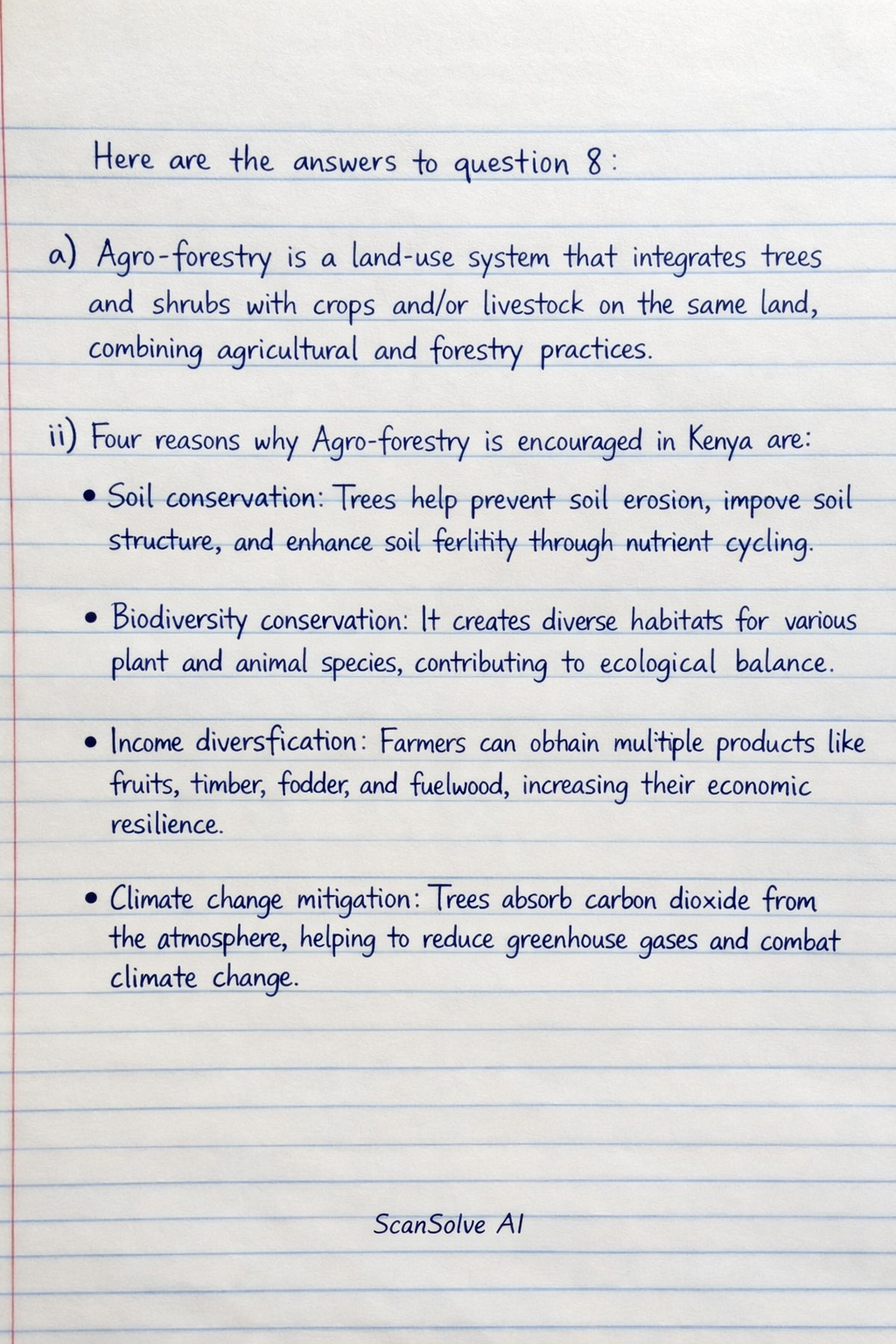
Here are the answers to question 8:
a)
i) Agro-forestry is a land-use system that integrates trees and shrubs with crops and/or livestock on the same land, combining agricultural and forestry practices.
ii) Four reasons why Agro-forestry is encouraged in Kenya are:
- Soil conservation: Trees help prevent soil erosion, improve soil structure, and enhance soil fertility through nutrient cycling.
- Biodiversity conservation: It creates diverse habitats for various plant and animal species, contributing to ecological balance.
- Income diversification: Farmers can obtain multiple products like fruits, timber, fodder, and fuelwood, increasing their economic resilience.
- Climate change mitigation: Trees absorb carbon dioxide from the atmosphere, helping to reduce greenhouse gases and combat climate change.
b) The following factors influence the distribution of forests in Kenya:
i) Relief:
- Altitude: Higher altitudes generally experience cooler temperatures and higher rainfall, favoring the growth of montane forests (e.g., Aberdare, Mau Forests). Lower, hotter, and drier areas tend to have sparser vegetation or different forest types.
- Aspect: Slopes facing prevailing moist winds (windward side) receive more rainfall and support denser forests, while leeward slopes (rain shadow areas) are drier and have less forest cover.
- Drainage: Well-drained slopes are suitable for most forest types, whereas waterlogged areas might only support specialized swamp forests or inhibit tree growth.
ii) Soil:
- Fertility: Deep, fertile soils with adequate organic matter and nutrients support lush and extensive forest growth. Poor, shallow, or infertile soils limit forest development.
- Drainage: Well-drained soils are crucial for most tree species, as waterlogging can suffocate roots.
- Depth: Deep soils allow for extensive root systems, providing stability and better access to water and nutrients, leading to healthier forests.
- pH: The acidity or alkalinity of the soil (pH) determines which tree species can thrive in a particular area.
c) Five challenges experienced in the exploitation of tropical hardwood forests are:
- Inaccessibility: Many tropical hardwood forests are located in remote, dense areas with poor infrastructure, making logging and transportation difficult and costly.
- Slow growth rate: Tropical hardwoods grow very slowly, meaning that regeneration after logging takes a long time, making sustainable exploitation challenging.
- Destruction of biodiversity: Logging operations can destroy habitats, leading to the loss of unique plant and animal species and disrupting ecosystems.
- Illegal logging: Uncontrolled and illegal harvesting depletes forest resources rapidly, undermines sustainable management efforts, and causes significant environmental damage.
- High cost of exploitation: Extracting tropical hardwoods requires specialized and expensive equipment, skilled labor, and significant investment in infrastructure like roads and bridges.
d) You plan to carry out a field study in a forest:
i) Three secondary sources of information you would use to prepare for the field study are:
- Maps: Such as topographic maps, forest cover maps, and land use maps to understand the terrain, forest boundaries, and surrounding land use.
- Books and Journals: Scientific publications, forestry textbooks, and ecological studies related to the specific forest or similar ecosystems.
- Government Reports: Reports from the Kenya Forest Service, environmental impact assessments, or local administrative records concerning the forest.
ii) Disadvantages of using secondary methods of collecting data in this kind of study would be:
- Outdated information: The data might not be current, especially for dynamic environments like forests that change over time due to natural processes or human activities.
- Bias: The original data might have been collected for a different purpose, potentially leading to bias or selective reporting that doesn't align with your study's objectives.
- Inaccuracy or unreliability: The quality and accuracy of secondary data can vary, and it might be difficult to verify the methods used or the reliability of the sources.
Still stuck on this one?
Ask a follow-up, and the answer starts from this question.
More Geography Questions
Handwritten Step-by-Step Solution
Get this as a handwritten image on WhatsApp — like a tutor wrote it for you.
Try on WhatsApp