
We read your photo as:
Identify the plates involved in Diagram A, describe the plate movements in A and B, classify boundaries A and B, explain the processes occurring at each boundary, differentiate between folding and fau
Geography
ScanSolve AI Answer
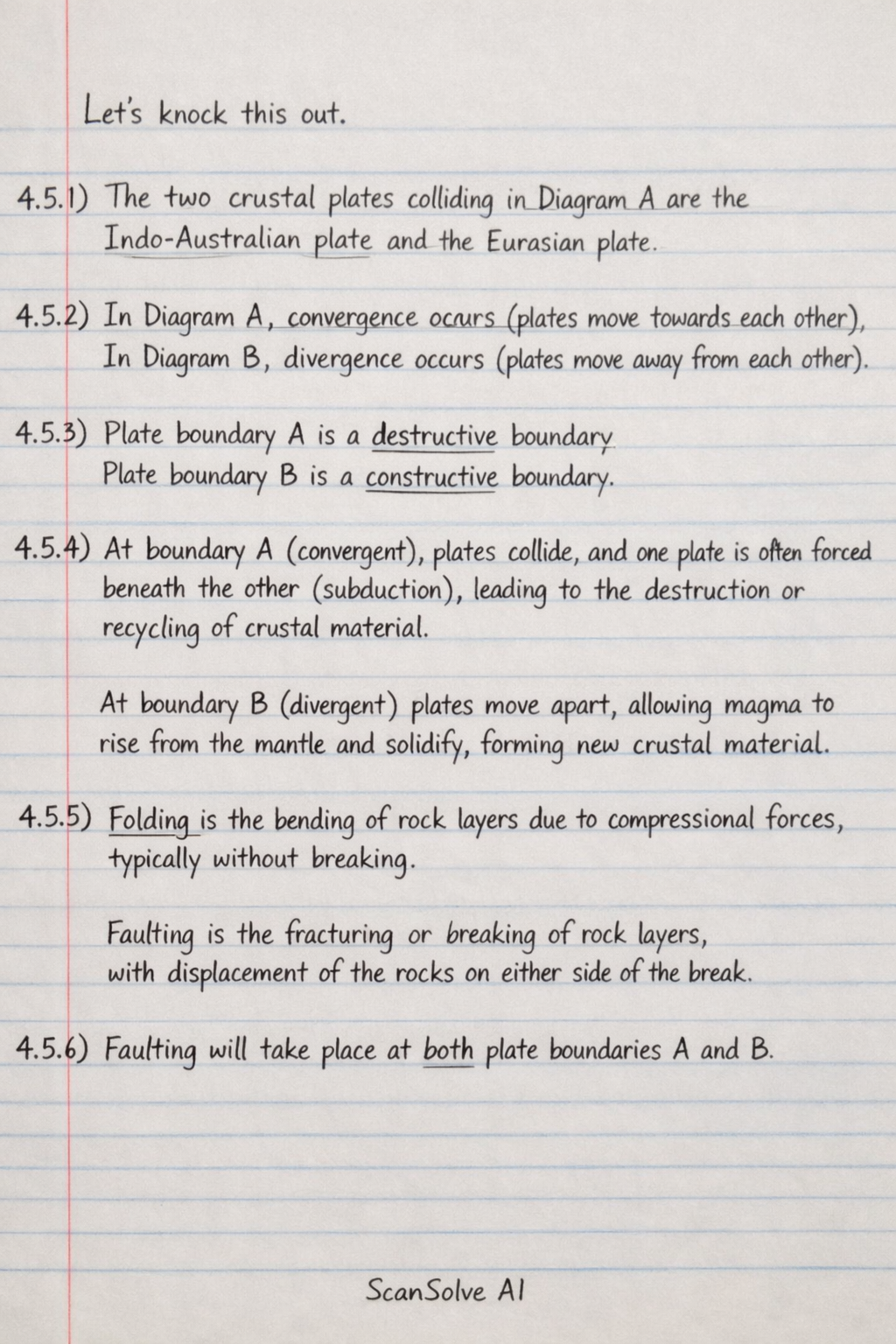
Let's knock this out.
4.5.1) The two crustal plates colliding in Diagram A are the Indo-Australian plate and the Eurasian plate.
4.5.2) In Diagram A, convergence occurs (plates move towards each other). In Diagram B, divergence occurs (plates move away from each other).
4.5.3) Plate boundary A is a destructive boundary. Plate boundary B is a constructive boundary.
4.5.4)
- At boundary A (convergent), plates collide, and one plate is often forced beneath the other (subduction), leading to the destruction or recycling of crustal material.
- At boundary B (divergent), plates move apart, allowing magma to rise from the mantle and solidify, forming new crustal material.
4.5.5)
- Folding is the bending of rock layers due to compressional forces, typically without breaking.
- Faulting is the fracturing or breaking of rock layers, with displacement of the rocks on either side of the break.
4.5.6) Faulting will take place at both plate boundaries A and B.
4.5.7)
- At boundary A (convergent), the immense compressional forces cause rocks to break and slide past each other, forming reverse or thrust faults.
- At boundary B (divergent), tensional forces pull the crust apart, causing it to stretch and fracture, resulting in normal faults and the formation of a rift valley.
Was this helpful?
Still stuck on this one?
Ask a follow-up, and the answer starts from this question.
Got a different question?Ask your own question
More Geography Questions
QIdentify the rock formation types labeled A and B, and list the three main types of tectonic plate…QIdentify the type of plate margin shown in each of the three diagrams in Activity 2.QName the following plate margins based on the descriptions and diagrams, and perform a plate…QStudy Figure 2.7 and identify a margin where; A. two plates are moving apart. B. two plates are…QWhat are the names of the three types of plate margins shown in the diagrams for Activity 2?
Handwritten Step-by-Step Solution
Get this as a handwritten image on WhatsApp — like a tutor wrote it for you.
Try on WhatsApp