
JAMB BIOLOGY QUESTIONS (ECOLOGY) (2026 STANDARD) 1. Which of the following best explains the flow of energy in an ecosystem? A. It is recycled continuously B. It flows in one direction C. It remains constant D. It increases at higher trophic levels ⸻ 2. In a food chain, organisms that manufacture their own food are: A. Consumers B. Decomposers C. Producers D. Parasites ⸻ 3. Which trophic level receives the least amount of energy? A. Producers B. Primary consumers C. Secondary consumers D. Tertiary consumers ⸻ 4. If all the predators in an ecosystem are removed, the immediate effect will be: A. Decrease in prey population B. Increase in prey population C. No change in ecosystem D. Increase in producers ⸻ 5. Organisms that break down dead organic matter are: A. Producers B. Consumers C. Decomposers D. Parasites ⸻ 6. Which of the following processes releases carbon dioxide into the atmosphere? A. Photosynthesis B. Respiration C. Nitrogen fixation D. Transpiration ⸻ 7. The process by which nitrogen gas is converted into ammonia is: A. Nitrification B. Denitrification C. Nitrogen fixation D. Ammonification ⸻ 8. Which of the following organisms is involved in nitrification? A. Fungi B. Bacteria C. Plants D. Animals ⸻ 9. Denitrification results in the: A. Formation of nitrates B. Release of nitrogen gas C. Formation of ammonia D. Absorption of nitrogen ⸻ 10. Which of the following best describes a food web? A. A single feeding relationship B. A linear feeding sequence C. Interconnected food chains D. A cycle of nutrients ⸻ 11. An organism that feeds on both plants and animals is a: A. Herbivore B. Carnivore C. Omnivore D. Parasite ⸻ 12. The maximum number of individuals an environment can support is known as: A. Population density B. Carrying capacity C. Growth rate D. Biomass ⸻ 13. A population that grows rapidly and then stabilizes follows a: A. J-shaped curve B. S-shaped curve C. Straight line D. Circular pattern ⸻ 14. Which factor does NOT limit population growth? A. Food supply B. Predation C. Climate D. Photosynthesis ⸻ 15. Which of the following interactions benefits both organisms? A. Parasitism B. Predation C. Mutualism D. Competition ⸻ 16. An organism that benefits while the other is neither harmed nor helped is: A. Mutualism B. Commensalism C. Parasitism D. Competition ⸻ 17. Which of the following represents a predator-prey relationship? A. Tick and dog B. Lion and antelope C. Remora and shark D. Fungus and tree ⸻ 18. Which of the following is a biotic factor? A. Temperature B. Soil C. Plants D. Water ⸻ 19. Which of the following is an abiotic factor? A. Bacteria B. Plants C. Animals D. Temperature ⸻ 20. Which of the following leads to eutrophication in water bodies? A. Oil spills B. Excess nutrients C. Overfishing D. Deforestation ⸻ 21. Which type of pollution affects the atmosphere? A. Water pollution B. Soil pollution C. Air pollution D. Noise pollution ⸻ 22. Deforestation primarily leads to: A. Increased rainfall B. Loss of biodiversity C. Soil formation D. Decreased temperature ⸻ 23. Which of the following best describes biomass? A. Total number of organisms B. Total mass of living matter C. Total energy in ecosystem D. Total nutrients available ⸻ 24. Which level of organization includes both living and non-living components? A. Population B. Community C. Ecosystem D. Species ⸻ 25. Competition occurs when organisms: A. Cooperate for survival B. Share resources freely C. Struggle for limited resources D. Avoid each other ⸻ 26. Which of the following processes removes carbon dioxide from the atmosphere? A. Respiration B. Combustion C. Photosynthesis D. Decomposition ⸻ 27. Which organism occupies the first trophic level? A. Herbivores B. Carnivores C. Producers D. Decomposers ⸻ 28. Which of the following best explains population density? A. Total population size B. Number of organisms per unit area C. Growth rate of population D. Movement of organisms ⸻ 29.
ScanSolve AI Answer
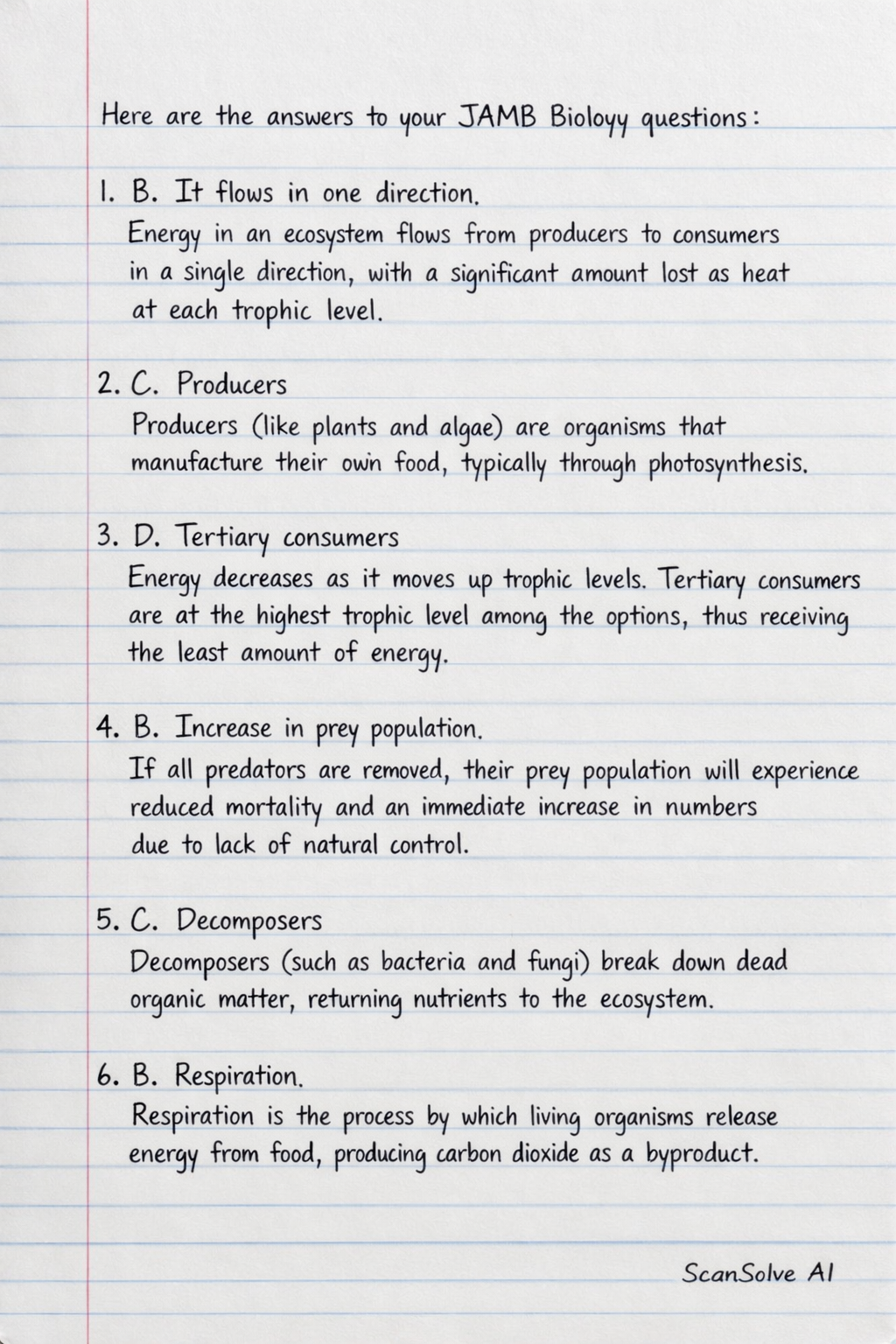
Here are the answers to your JAMB Biology questions:
-
B. It flows in one direction Energy in an ecosystem flows from producers to consumers in a single direction, with a significant amount lost as heat at each trophic level.
-
C. Producers Producers (like plants and algae) are organisms that manufacture their own food, typically through photosynthesis.
-
D. Tertiary consumers Energy decreases as it moves up trophic levels. Tertiary consumers are at the highest trophic level among the options, thus receiving the least amount of energy.
-
B. Increase in prey population If all predators are removed, their prey population will experience reduced mortality and an immediate increase in numbers due to lack of natural control.
-
C. Decomposers Decomposers (such as bacteria and fungi) break down dead organic matter, returning nutrients to the ecosystem.
-
B. Respiration Respiration is the process by which living organisms release energy from food, producing carbon dioxide as a byproduct.
-
C. Nitrogen fixation Nitrogen fixation is the process where atmospheric nitrogen gas () is converted into ammonia () by certain microorganisms.
-
B. Bacteria Bacteria (specifically nitrifying bacteria) are involved in nitrification, converting ammonia to nitrites and then to nitrates.
-
B. Release of nitrogen gas Denitrification is the process where nitrates are converted back into atmospheric nitrogen gas () by denitrifying bacteria.
-
C. Interconnected food chains A food web represents the complex network of feeding relationships, showing how multiple food chains are interconnected within an ecosystem.
-
C. Omnivore An omnivore is an organism that feeds on both plants (producers) and animals (consumers).
-
B. Carrying capacity Carrying capacity is the maximum number of individuals of a particular species that an environment can sustainably support indefinitely.
-
B. S-shaped curve A population that grows rapidly and then stabilizes at its carrying capacity follows an S-shaped curve (logistic growth curve).
-
D. Photosynthesis Photosynthesis is a process that produces food and oxygen, supporting life. It does not limit population growth in the same way that factors like food supply, predation, or climate do.
-
C. Mutualism Mutualism is a symbiotic relationship where both interacting organisms benefit from the association.
-
B. Commensalism Commensalism is an interaction where one organism benefits, while the other is neither significantly harmed nor helped.
-
B. Lion and antelope A lion and antelope represent a classic predator-prey relationship, where the lion hunts and kills the antelope for food.
-
C. Plants Plants are living organisms and therefore constitute a biotic factor in an ecosystem.
-
D. Temperature Temperature is a non-living physical factor, making it an abiotic component of an ecosystem.
-
B. Excess nutrients Eutrophication is primarily caused by the excessive input of nutrients, particularly nitrogen and phosphorus, into water bodies, leading to algal blooms and oxygen depletion.
-
C. Air pollution Air pollution refers to the contamination of the atmosphere by harmful substances.
-
B. Loss of biodiversity Deforestation primarily leads to the destruction of habitats, resulting in a significant loss of biodiversity as species lose their homes and resources.
-
B. Total mass of living matter Biomass refers to the total mass of living organisms (or organic matter) in a given area or ecosystem.
-
C. Ecosystem An ecosystem includes both the living organisms (biotic components) and their non-living physical environment (abiotic components).
-
C. Struggle for limited resources Competition occurs when organisms, either of the same or different species, vie for the same limited resources such as food, water, space, or mates.
-
C. Photosynthesis Photosynthesis is the process by which plants and other producers use carbon dioxide from the atmosphere to synthesize organic compounds.
-
C. Producers Producers (e.g., plants) occupy the first trophic level as they convert light energy into chemical energy, forming the base of the food chain.
-
B. Number of organisms per unit area Population density is a measure of how many individuals of a population are present within a specific unit of area or volume.
Still stuck on this one?
Ask a follow-up, and the answer starts from this question.
More Geography Questions
Handwritten Step-by-Step Solution
Get this as a handwritten image on WhatsApp — like a tutor wrote it for you.
Try on WhatsApp