

This geography problem is solved step by step below, with detailed explanations to help you understand the method and arrive at the correct answer.
ScanSolve AI Answer
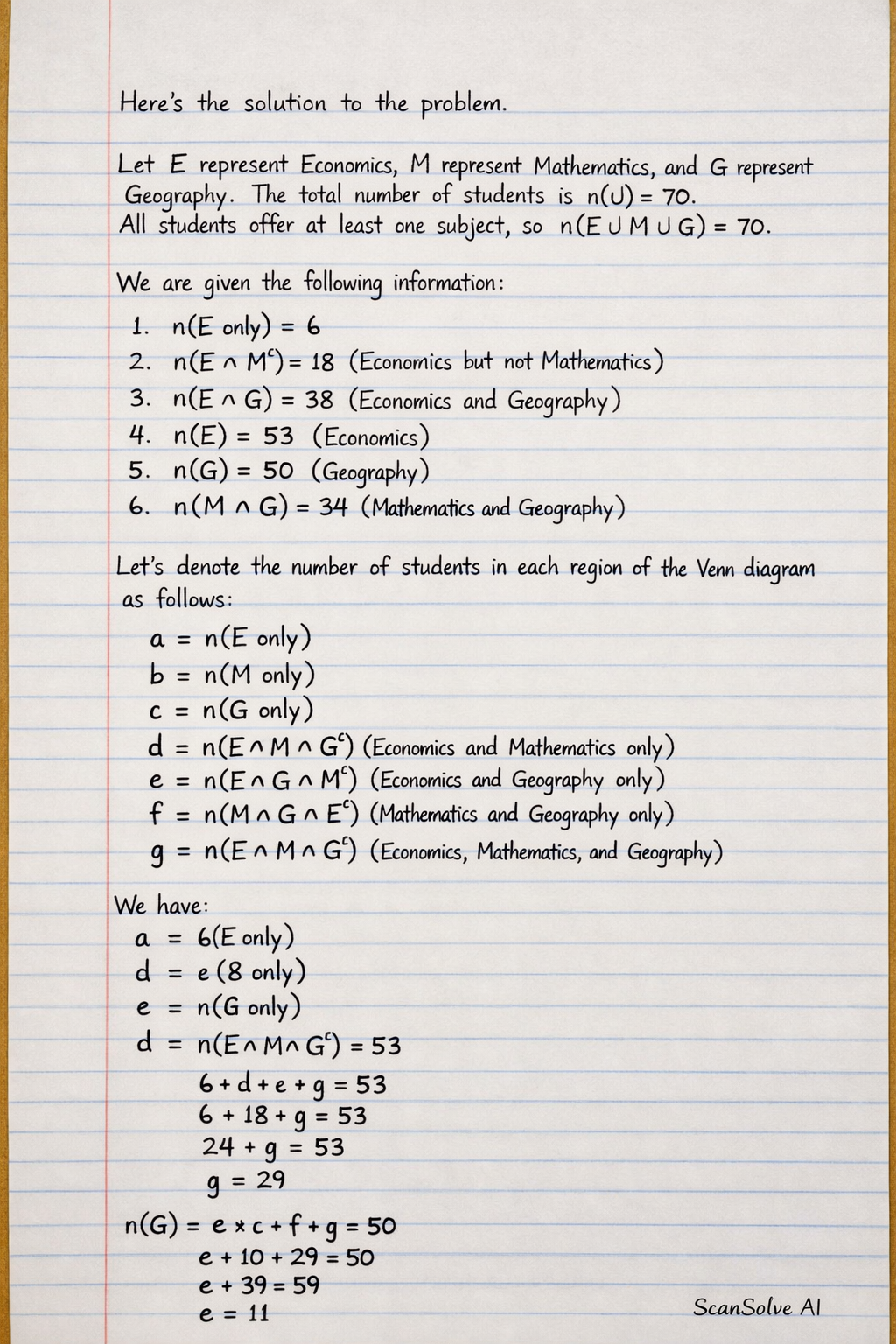
Here's the solution to the problem. Let E represent Economics, M represent Mathematics, and G represent Geography. The total number of students is n(U) = 70. All students offer at least one subject, so n(E M G) = 70. We are given the following information: 1. n(E only) = 6 2. n(E M^c) = 18 (Economics but not Mathematics) 3. n(E G) = 38 (Economics and Geography) 4. n(E) = 53 (Economics) 5. n(G) = 50 (Geography) 6. n(M G) = 34 (Mathematics and Geography) Let's denote the number of students in each region of the Venn diagram as follows: • a = n(E only) • b = n(M only) • c = n(G only) • d = n(E M G^c) (Economics and Mathematics only) • e = n(E G M^c) (Economics and Geography only) • f = n(M G E^c) (Mathematics and Geography only) • g = n(E M G) (Economics, Mathematics, and Geography) Using the given information to find the values for each region: Step 1: From (1), a = 6. Step 2: From (2), n(E M^c) = a + e = 18. Since a=6, we have 6 + e = 18 e = 12. Step 3: From (3), n(E G) = e + g = 38. Since e=12, we have 12 + g = 38 g = 26. Step 4: From (4), n(E) = a + d + e + g = 53. Since a=6, e=12, g=26, we have 6 + d + 12 + 26 = 53 d + 44 = 53 d = 9. Step 5: From (6), n(M G) = f + g = 34. Since g=26, we have f + 26 = 34 f = 8. Step 6: From (5), n(G) = c + e + f + g = 50. Since e=12, f=8, g=26, we have c + 12 + 8 + 26 = 50 c + 46 = 50 c = 4. Step 7: Since all students offer at least one subject, $n(E M G) = a + b + c + d +