
We read your photo as:
Meaning of Soil Erosion:
Geography
ScanSolve AI Answer
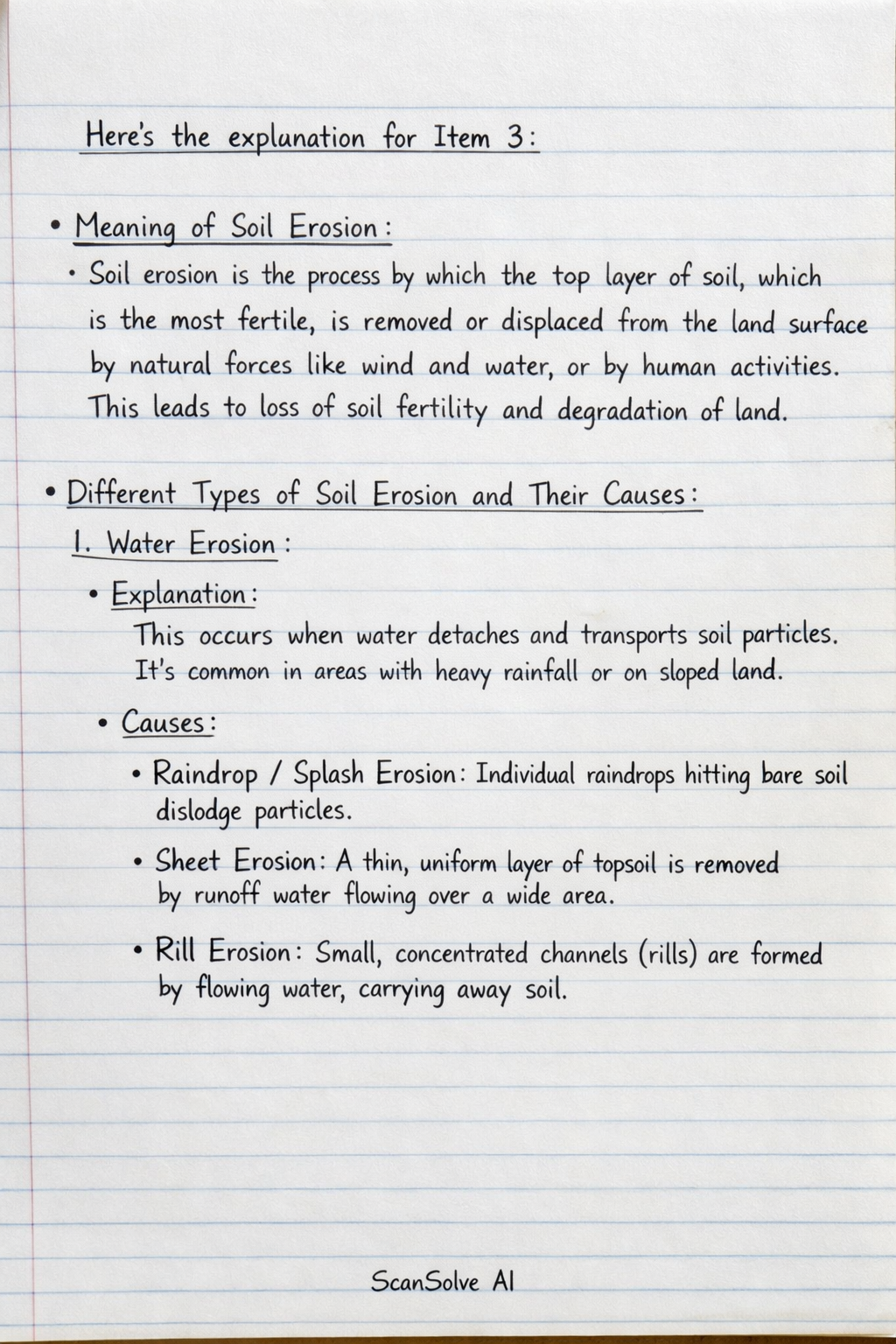
Here's the explanation for Item 3:
-
Meaning of Soil Erosion:
- Soil erosion is the process by which the top layer of soil, which is the most fertile, is removed or displaced from the land surface by natural forces like wind and water, or by human activities. This leads to loss of soil fertility and degradation of land.
-
Different Types of Soil Erosion and Their Causes:
-
Water Erosion:
- Explanation: This occurs when water detaches and transports soil particles. It's common in areas with heavy rainfall or on sloped land.
- Causes:
- Raindrop/Splash Erosion: Individual raindrops hitting bare soil dislodge particles.
- Sheet Erosion: A thin, uniform layer of topsoil is removed by runoff water flowing over a wide area.
- Rill Erosion: Small, concentrated channels (rills) are formed by flowing water, carrying away soil.
- Gully Erosion: Rills enlarge into deep, wide channels (gullies) that cannot be removed by normal tillage, causing significant land degradation.
- Riverbank Erosion: The flowing water of rivers wears away the soil along their banks.
-
Wind Erosion:
- Explanation: This occurs when strong winds lift and carry away loose, dry soil particles, especially in arid and semi-arid regions or on bare, exposed fields.
- Causes:
- Lack of vegetation cover: Bare soil is easily picked up by wind.
- Dry soil conditions: Moisture helps bind soil particles; dry soil is more susceptible.
- Strong winds: High wind speeds provide the energy to detach and transport soil.
- Fine, loose soil particles: Sandy or silty soils are more prone to wind erosion than clay soils.
-
Mass Movement (e.g., Landslides):
- Explanation: This involves the downslope movement of soil and rock under the influence of gravity, often triggered by heavy rainfall or earthquakes.
- Causes:
- Steep slopes: Gravity has a stronger pull on steeper inclines.
- Excessive water saturation: Water adds weight to the soil and reduces friction between particles, making it unstable.
- Lack of vegetation: Plant roots help stabilize soil on slopes.
- Earthquakes or vibrations: Can dislodge unstable soil masses.
-
Was this helpful?
Still stuck on this one?
Ask a follow-up, and the answer starts from this question.
Got a different question?Ask your own question
More Geography Questions
QWhat is soil erosionQWhat's is soil erosionQQuestion 4: Erosion is the movement of soil, rock/ sediment.QDiagram A: Soil erosion*QDiffertiate between soil erosion and soil depletion
Browse by topic:Earth Science
Handwritten Step-by-Step Solution
Get this as a handwritten image on WhatsApp — like a tutor wrote it for you.
Try on WhatsApp