
We read your photo as:
Explain the mechanisms responsible for the movement of plates in the interior of the earth.
ScanSolve AI Answer
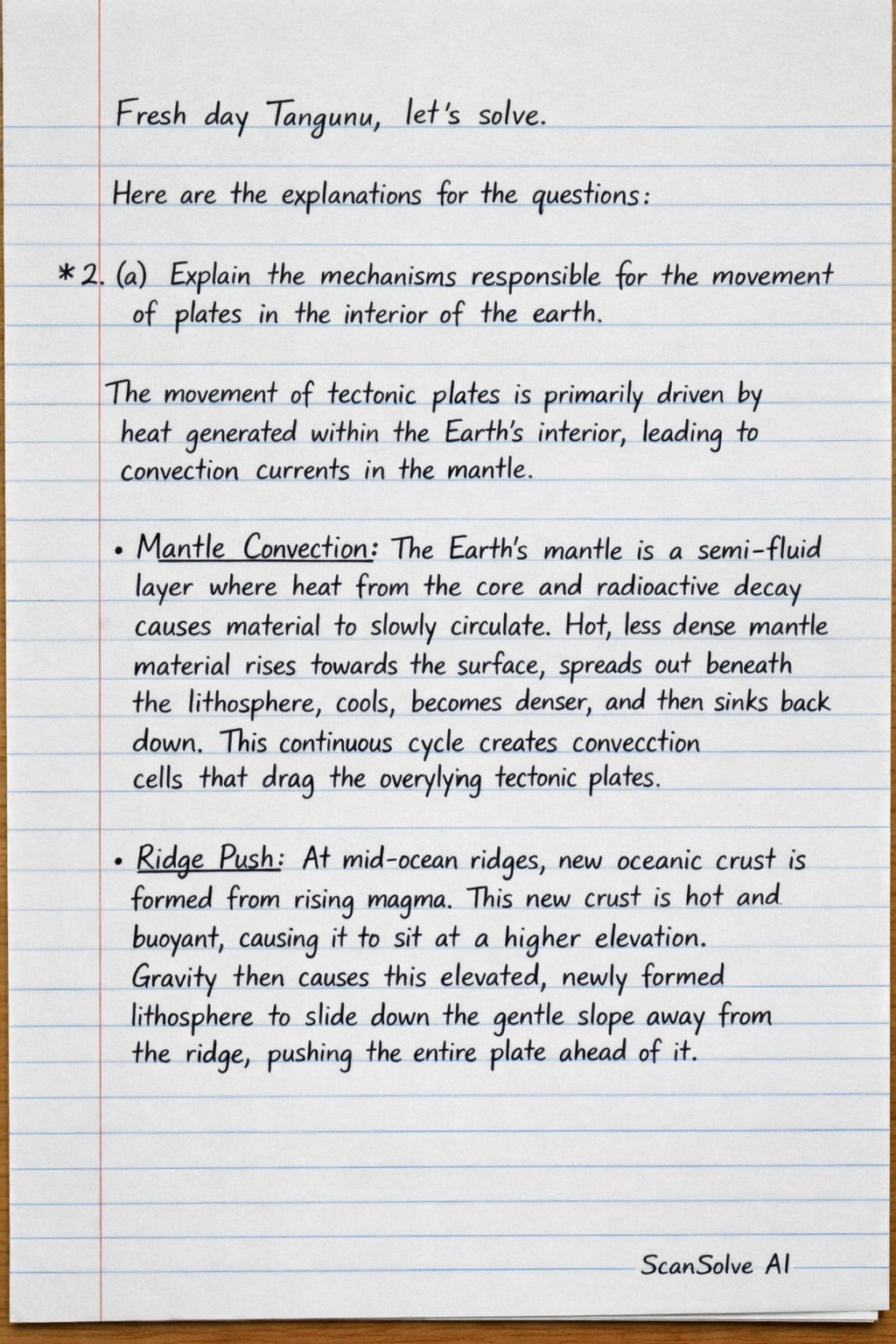
Here are the explanations for the questions:
2. (a) Explain the mechanisms responsible for the movement of plates in the interior of the earth.
The movement of tectonic plates is primarily driven by heat generated within the Earth's interior, leading to convection currents in the mantle.
- Mantle Convection: The Earth's mantle is a semi-fluid layer where heat from the core and radioactive decay causes material to slowly circulate. Hot, less dense mantle material rises towards the surface, spreads out beneath the lithosphere, cools, becomes denser, and then sinks back down. This continuous cycle creates convection cells that drag the overlying tectonic plates.
- Ridge Push: At mid-ocean ridges, new oceanic crust is formed from rising magma. This new crust is hot and buoyant, causing it to sit at a higher elevation. Gravity then causes this elevated, newly formed lithosphere to slide down the gentle slope away from the ridge, pushing the entire plate ahead of it.
- Slab Pull: This is considered the most significant driving force. At subduction zones, cold, dense oceanic lithosphere sinks back into the mantle. As the dense slab descends, its weight pulls the rest of the plate along behind it, much like a tablecloth sliding off a table. The greater the density and length of the subducting slab, the stronger the slab pull force.
- Mantle Drag: The friction between the circulating mantle material and the base of the lithospheric plates also contributes to the movement, either by dragging the plates along or by resisting their motion.
2. (b) Explain any THREE hard engineering methods that can be used to sustainably manage coastal landscape.
Hard engineering methods involve constructing artificial structures to protect coastal areas. For sustainable management, these methods aim for long-term effectiveness with minimal negative environmental impact.
- Sea Walls: These are large concrete or rock barriers built parallel to the coast to absorb wave energy and prevent erosion and flooding. For sustainability, they can be designed with stepped profiles to dissipate wave energy more effectively, reducing scour, and can incorporate features that allow for ecological colonization, though their construction is often resource-intensive and can alter natural coastal processes.
- Groynes: These are timber, rock, or concrete structures built perpendicular to the coastline, extending into the sea. Their purpose is to trap sediment transported by longshore drift, thereby building up and maintaining a wider beach. Sustainably, groynes help maintain natural beach defenses, but careful planning is needed to ensure they do not excessively starve down-drift beaches of sediment, which could lead to increased erosion elsewhere.
- Rock Armour (Rip-rap): This involves placing large, angular boulders at the base of cliffs or along the shoreline. The irregular surface of the rocks dissipates wave energy, protecting the land behind them from erosion. Rock armour is durable and can be relatively low-maintenance. From a sustainability perspective, it can create habitats for marine life within the gaps between the rocks and is often a more natural-looking solution than concrete walls, though sourcing and transporting the rocks can have environmental impacts.
2. (c) Comment on the relief characteristics of the Cameroon volcanic line (CVL).
The Cameroon Volcanic Line (CVL) is a prominent geological feature characterized by a chain of volcanoes and volcanic massifs extending from the Atlantic Ocean (Pagalu Island) through mainland Cameroon to the interior.
- Linear Arrangement: The most striking characteristic is its linear alignment, stretching for over from the Atlantic into the continent.
- High Elevations: The CVL features some of the highest peaks in West and Central Africa, notably Mount Cameroon, which is an active stratovolcano reaching (). Other significant peaks include Mount Manengouba and Mount Bamboutos, creating a rugged, mountainous landscape.
- Volcanic Cones and Massifs: The line is composed of numerous volcanic cones, craters, and extensive volcanic massifs. These range from active stratovolcanoes (like Mount Cameroon) to older, eroded shield volcanoes and basaltic plateaus.
- Crater Lakes: Many volcanoes along the CVL host crater lakes, such as Lake Nyos and Lake Monoun, which are known for their limnic eruptions (release of dissolved gases). These lakes add to the distinctive relief.
- Associated Rift Valleys and Faulting: The CVL is associated with a series of grabens (rift valleys) and fault systems, particularly in its continental section. These structural features contribute to the varied topography, with depressions alongside elevated volcanic structures.
- Varied Topography: Overall, the relief along the CVL is highly varied, ranging from coastal plains near the Atlantic (where Mount Cameroon rises abruptly) to high plateaus and deeply incised valleys in the interior, all shaped by volcanic activity and associated tectonic processes.
Still stuck on this one?
Ask a follow-up, and the answer starts from this question.
More Geography Questions
Handwritten Step-by-Step Solution
Get this as a handwritten image on WhatsApp — like a tutor wrote it for you.
Try on WhatsApp