
We read your photo as:
Explain the physical geography of West Africa, including its highlands, lowlands, coastal plains, Jos Plateau, River Volta, and climatic zones.
Geography
ScanSolve AI Answer
Step-by-step solution
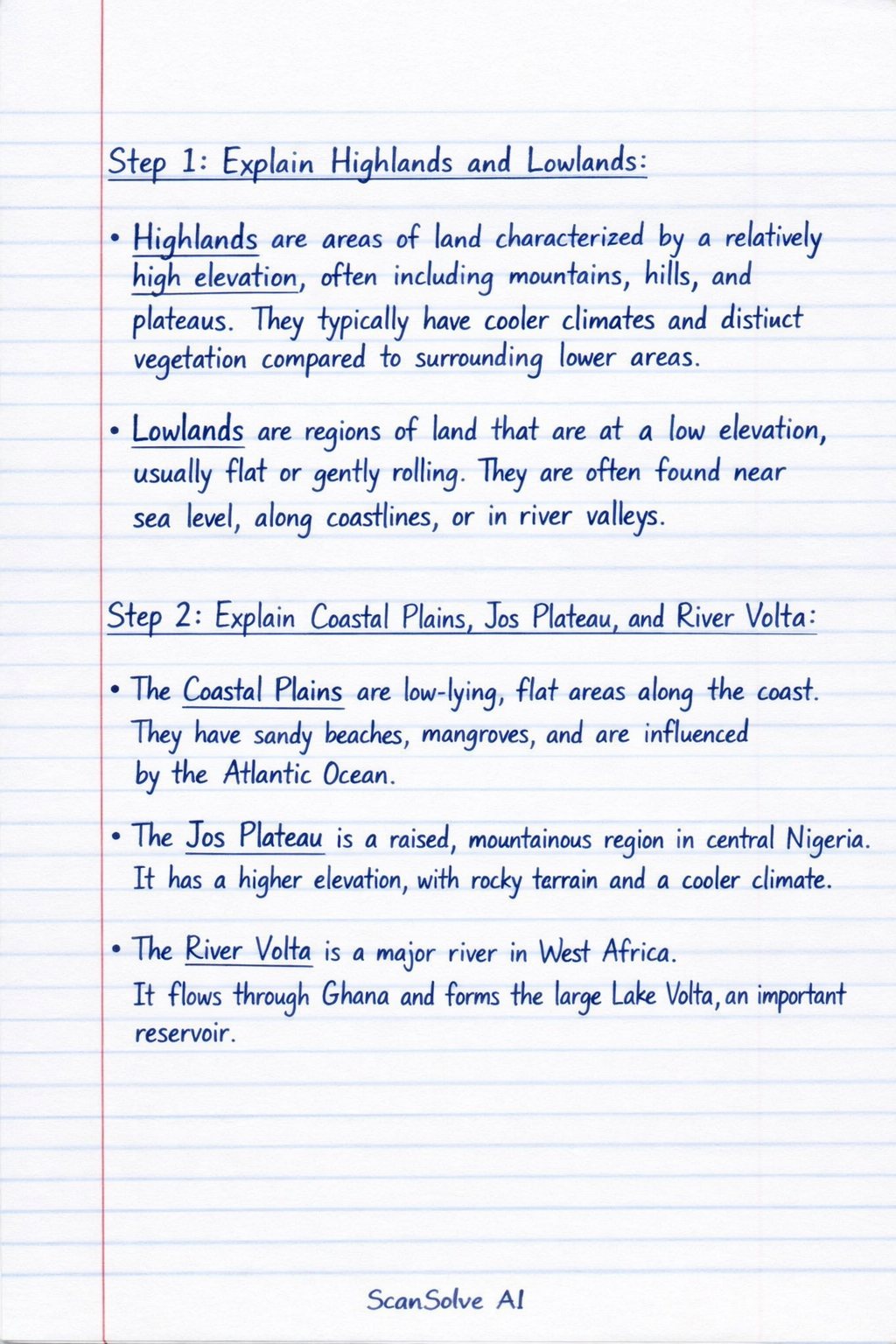
3 stepsExplain Highlands and Lowlands.
- Highlands are areas of land characterized by a relatively high elevation, often including mountains, hills, and plateaus. They typically have cooler climates and distinct vegetation compared to surrounding lower areas.
- Lowlands are regions of land that are at a low elevation, usually flat or gently rolling. They are often found near sea level, along coastlines, or in river valleys.
Explain Coastal Plains, Jos Plateau, and River Volta.
- Coastal Plains are flat, low-lying areas of land adjacent to a sea or ocean. They are typically formed by the deposition of sediments carried by rivers or ocean currents and are often fertile.
- The Jos Plateau is a distinctive plateau region located in the middle belt of Nigeria. It is known for its relatively high altitude, cooler climate, and historical significance in tin mining.
- The River Volta is a major river system in West Africa, primarily flowing through Ghana. It is formed by the confluence of the Black Volta, White Volta, and Red Volta rivers, eventually emptying into the Atlantic Ocean.
Locate the climatic zones of West Africa.
West Africa features several distinct climatic zones, generally arranged in bands from south to north:
- The southernmost part, along the coast, experiences an Equatorial/Tropical Rainforest climate. This zone is characterized by high temperatures and heavy rainfall throughout the year, supporting dense forests.
- Moving north, the climate transitions into the Tropical Savanna climate. This zone has distinct wet and dry seasons, with grasslands and scattered trees.
- Further north lies the Sahelian climate, which is semi-arid. It has a shorter rainy season and sparse vegetation, acting as a transition zone between the savanna and the desert.
- The northernmost part of West Africa extends into the Sahara Desert climate. This region is extremely arid, with very little rainfall and extreme temperatures, supporting minimal vegetation.
Was this helpful?
Still stuck on this one?
Ask a follow-up, and the answer starts from this question.
Got a different question?Ask your own question
More Geography Questions
QOn an outline map of Ghana, locate and name the following: (i) The Akuapim - Togo Ranges (ii) The…QDescribe four significant geographical features of Africa and Ghana and explain two ways these…QBriefly describe the geography and climate of Sierra Leone.Q2026 WASSCE – GEOGRAPHY PAPER 2 – ESSAY (THEORY) Answer FIVE questions only. Question 1 is…Q3a. In two or three sentences, describe South Africa's physical geography. Use the information in…
Handwritten Step-by-Step Solution
Get this as a handwritten image on WhatsApp — like a tutor wrote it for you.
Try on WhatsApp