
We read your photo as:
Describe how poor roads and accidents affect access to healthcare, education, and employment. Discuss in two ways the ineffective.
ScanSolve AI Answer
Here are the solutions to the questions based on the provided image:
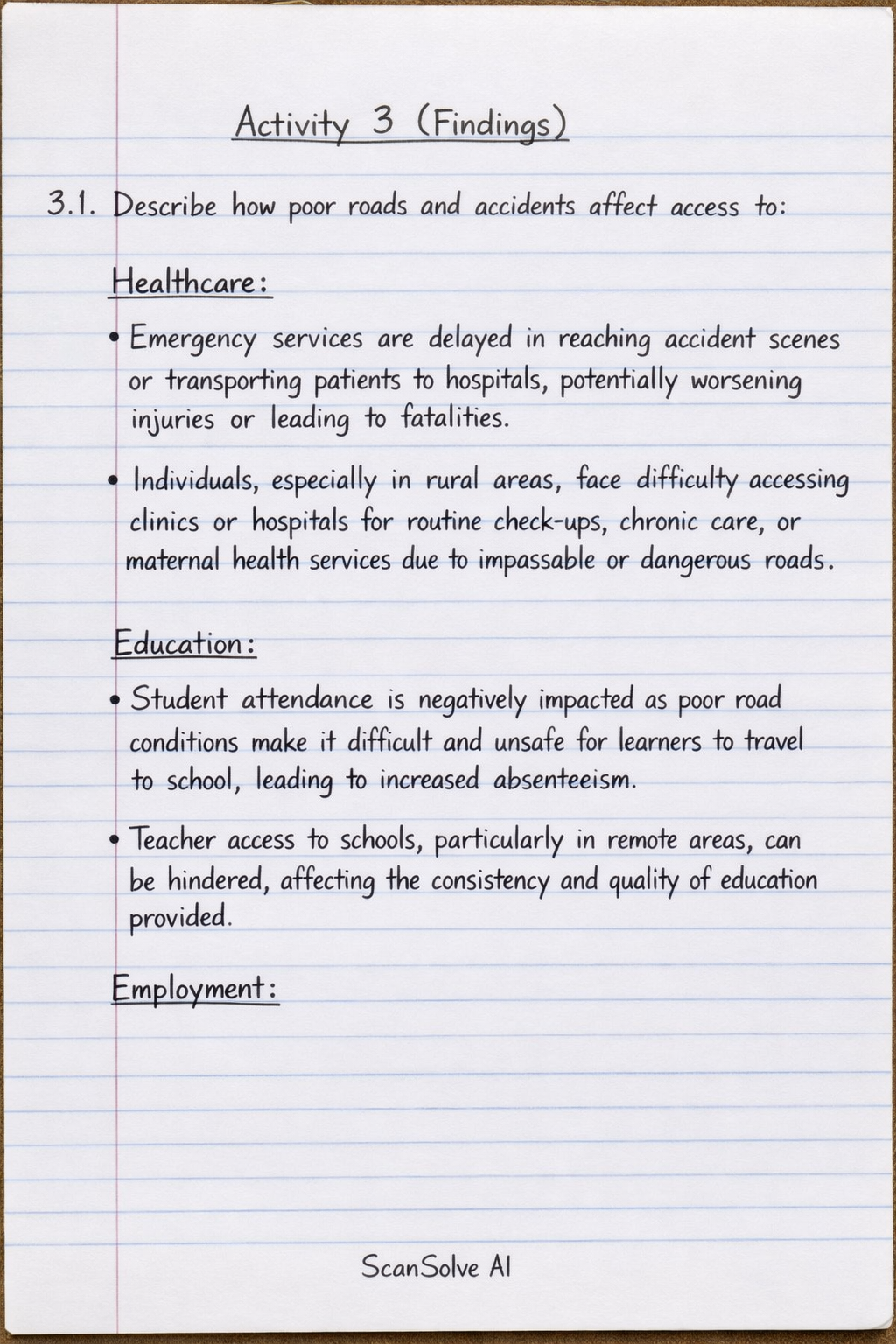
Activity 3 (Findings)
- 3.1. Describe how poor roads and accidents affect access to:
- Healthcare:
- Emergency services are delayed in reaching accident scenes or transporting patients to hospitals, potentially worsening injuries or leading to fatalities.
- Individuals, especially in rural areas, face difficulty accessing clinics or hospitals for routine check-ups, chronic care, or maternal health services due to impassable or dangerous roads.
- Education:
- Student attendance is negatively impacted as poor road conditions make it difficult and unsafe for learners to travel to school, leading to increased absenteeism.
- Teacher access to schools, particularly in remote areas, can be hindered, affecting the consistency and quality of education provided.
- Employment:
- Commuting challenges arise, making travel to work longer, more dangerous, and more expensive due to vehicle damage and increased fuel consumption. This can lead to job loss or reduced productivity.
- Economic development is stifled as businesses are reluctant to invest in areas with poor infrastructure, limiting job creation and hindering overall growth.
- Healthcare:
Activity 4 (Recommendations)
-
4.1. Discuss in TWO ways the ineffectiveness of the by-laws that are used by your local municipality to effectively ensure proper road maintenance.
- Lack of enforcement: Existing by-laws may not be consistently applied or penalties for non-compliance are not enforced, leading to continued neglect of road maintenance standards.
- Outdated by-laws: The by-laws might be old and not adequately address current challenges in road construction, maintenance technologies, or environmental factors, making them irrelevant to modern needs.
-
4.2. Assess how communities and civil society organizations can champion for better roads and hold the government accountable.
- Advocacy and lobbying: Communities can organize petitions, protests, and engage directly with local councilors and government officials to demand action and highlight the urgency of road repairs.
- Monitoring and reporting: Civil society organizations can establish systems for monitoring road conditions, documenting issues with photos and videos, and systematically reporting them to authorities, while also tracking response times and outcomes.
- Public awareness campaigns: They can educate citizens about their rights regarding safe infrastructure and encourage active participation in holding the government accountable through various media channels.
-
4.3. Suggest ONE short-term solution that can be implemented by local government to improve road safety and uphold human rights?
- Rapid pothole repair campaigns: Implement immediate, focused campaigns to fill critical potholes and repair minor road damages that pose immediate risks to motorists and pedestrians, thereby reducing accident rates.
-
4.4. Recommend ONE long-term strategy that can be adopted by the local government and private sector to address poor roads and accidents while respecting human rights?
- Public-Private Partnerships (PPPs) for infrastructure development: Establish formal collaborations where the private sector contributes expertise, funding, and technology for the sustainable construction and maintenance of roads, with clear performance indicators and transparent accountability mechanisms to ensure quality and human rights are upheld.
-
4.5. Propose TWO roles that can be played by social media platforms such as WhatsApp, Facebook, TikTok etc. in creating awareness about road maintenance initiatives and road safety in South Africa.
- Reporting and documentation: Social media allows users to easily share real-time photos and videos of poor road conditions, accidents, and maintenance issues, creating a public record and pressuring authorities for action.
- Information dissemination and education: Local authorities and community groups can use these platforms to share updates on road maintenance projects, launch road safety campaigns, and educate the public on safe driving practices and the importance of reporting hazards.
-
4.6. Critically discuss ONE economic and ONE social consequence of road accidents caused by potholes.
- Economic consequence: Road accidents caused by potholes lead to significant vehicle damage and repair costs for individuals and businesses, including tire blowouts, damaged rims, and suspension issues. This results in increased insurance claims, higher premiums, and a general economic burden on households and the transport sector.
- Social consequence: Pothole-related accidents cause injuries, disabilities, and fatalities, leading to immense personal suffering, grief for families, and increased strain on public healthcare services. This also contributes to a reduced quality of life for affected individuals and a general sense of insecurity on the roads.
Activity 5 (Conclusion)
- 5.1. Indicate how your understanding of these issues informed your behaviour around violation of road safety rules, and what actions can be taken to help maintain roads.
- My understanding of the severe consequences of poor road conditions and accidents, including human rights violations and economic impacts, has reinforced my commitment to adhering strictly to road safety rules. I am now more conscious of driving defensively, maintaining safe speeds, and being extra vigilant in areas with known road hazards to protect myself and others.
- To help maintain roads, I can actively report potholes and other road damage to local municipal authorities through official channels. I can also advocate for better road infrastructure by participating in community discussions or supporting initiatives aimed at holding local government accountable for road maintenance.
Still stuck on this one?
Ask a follow-up, and the answer starts from this question.
More Geography Questions
Handwritten Step-by-Step Solution
Get this as a handwritten image on WhatsApp — like a tutor wrote it for you.
Try on WhatsApp