
We read your photo as:
What is population distribution? Explain any four causes of unequal distribution of population in Nepal.
ScanSolve AI Answer
Step-by-step solution
7 stepsHere are the solutions to the questions:
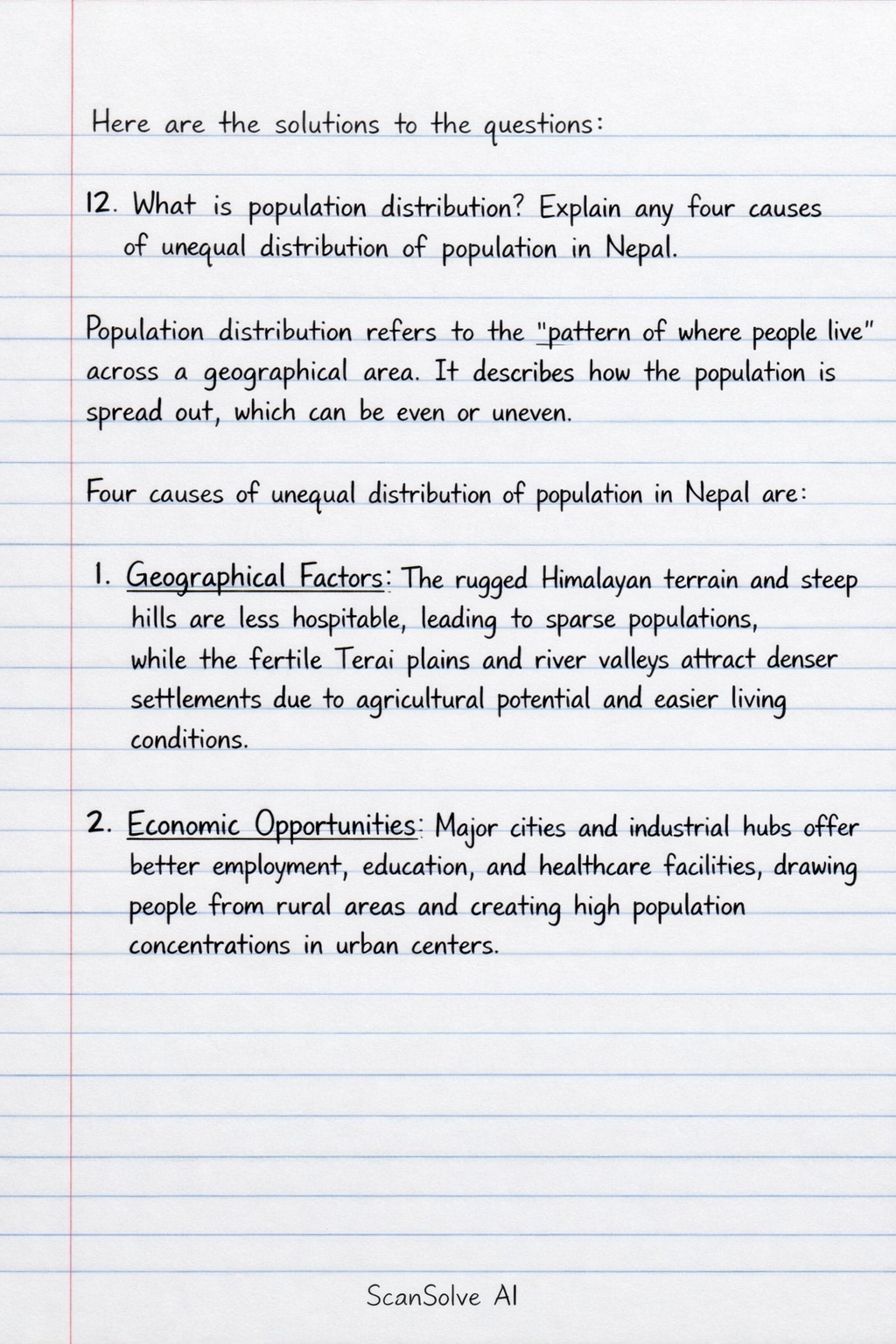
12. What is population distribution? Explain any four causes of unequal distribution of population in Nepal.
Population distribution refers to the pattern of where people live across a geographical area. It describes how the population is spread out, which can be even or uneven.
Four causes of unequal distribution of population in Nepal are:
- Geographical Factors: The rugged Himalayan terrain and steep hills are less hospitable, leading to sparse populations, while the fertile Terai plains and river valleys attract denser settlements due to agricultural potential and easier living conditions.
- Economic Opportunities: Major cities and industrial hubs offer better employment, education, and healthcare facilities, drawing people from rural areas and creating high population concentrations in urban centers.
- Historical and Political Factors: Historically, certain areas developed as administrative or trade centers, leading to early settlement and continued growth. Government policies and infrastructure development also influence where people choose to live.
- Accessibility and Infrastructure: Areas with better road networks, electricity, communication, and social services (schools, hospitals) tend to have higher population densities compared to remote regions lacking such infrastructure.
13. Under what condition can abortion be performed in context of Nepal? Discuss any five conditions.
In Nepal, abortion is legal under specific conditions. Here are five such conditions:
- Risk to the woman's life or health: If continuing the pregnancy poses a serious threat to the physical or mental health of the pregnant woman.
- Rape or Incest: If the pregnancy is a result of rape or incest, abortion is permitted.
- Fetal abnormalities: If the fetus is diagnosed with a severe congenital anomaly or incurable disease that would make it incompatible with life or result in severe disability.
- Age of pregnancy: Abortion is generally permitted up to 12 weeks of gestation on the woman's request. This period can be extended under specific circumstances.
- Woman's consent: The woman must provide her informed consent for the abortion. For minors, parental or guardian consent may also be required, depending on the specific laws and age.
14. Define migration and write any four measures to control internal migration in Nepal.
Migration is the movement of people from one place to another with the intention of settling temporarily or permanently in a new location. Internal migration refers to movement within the same country.
Four measures to control internal migration in Nepal are:
- Balanced Regional Development: Implementing development projects and allocating resources evenly across all regions to create opportunities and improve living standards in rural and less developed areas.
- Job Creation in Rural Areas: Promoting agriculture, small-scale industries, and tourism in rural regions to provide local employment opportunities and reduce the need for people to move to urban centers for work.
- Infrastructure Development: Expanding access to essential services like education, healthcare, clean water, electricity, and transportation in rural and remote areas to make them more livable and attractive.
- Decentralization of Services: Shifting administrative and economic functions from major cities to smaller towns and district headquarters to distribute growth and reduce the pull factors of the capital and other large urban areas.
OR
Find the growth rate by using geometric growth method if the population of Nepal in 2001 was 2,31,51,423 and it was 2,64,94,504 in 2011 AD census.
Identify the given values.
Initial Population () = 23,151,423 (in 2001)
Final Population () = 26,494,504 (in 2011)
Time period () = yearsUse the geometric growth formula.
The formula for geometric growth is:
Where is the annual growth rate.
Substitute the values into the formula.
Isolate .
Solve for .
Solve for .
Convert the growth rate to a percentage.
The growth rate by using the geometric growth method is .
15. Mention any five causes of discrimination based on gender.
Five causes of discrimination based on gender are:
- Patriarchal Social Structures: Societies where men hold primary power and authority often perpetuate norms that disadvantage women and other genders.
- Lack of Education: Unequal access to education for girls and women limits their opportunities and reinforces traditional gender roles.
- Economic Disparity: Wage gaps, limited access to property ownership, and fewer opportunities for career advancement for women contribute to economic discrimination.
- Cultural Norms and Traditions: Deep-rooted cultural beliefs and practices often assign specific, restrictive roles to genders, leading to unequal treatment and expectations.
- Legal and Policy Gaps: Insufficient or poorly enforced laws and policies regarding gender equality can allow discrimination to persist in various spheres of life.
16. What are the types of rehabilitation? Discuss in brief.
Rehabilitation is a process aimed at restoring a person's functional abilities and quality of life after an injury, illness, or disability. It helps individuals regain independence and participate fully in society.
Key types of rehabilitation include:
- Physical Rehabilitation (Physiotherapy): Focuses on restoring physical function, strength, mobility, and reducing pain through exercises, manual therapy, and other physical modalities. It's common for musculoskeletal injuries, post-surgery recovery, or neurological conditions.
- Occupational Rehabilitation: Helps individuals regain skills for daily living and work. It focuses on adapting tasks and environments to enable participation in activities like dressing, eating, working, and hobbies.
- Speech and Language Rehabilitation: Addresses communication and swallowing disorders. It helps individuals improve speech clarity, language comprehension, voice quality, and safe swallowing techniques.
- Cognitive Rehabilitation: Targets cognitive impairments such as memory loss, attention deficits, and problem-solving difficulties, often following brain injury or stroke, to improve mental functions.
- Vocational Rehabilitation: Assists individuals with disabilities or chronic health conditions in finding or returning to employment. It includes job training, career counseling, and workplace modifications.
17. What are the permanent methods of contraception in male and female? Explain any two of them in brief.
Permanent methods of contraception are surgical procedures that provide long-term and highly effective birth control.
Two permanent methods are:
- Vasectomy (for males): This is a minor surgical procedure where the vas deferens, the tubes that carry sperm from the testicles, are cut, tied, or sealed. This prevents sperm from mixing with semen, so ejaculation still occurs but without sperm, making it impossible to fertilize an egg. It is a highly effective and safe procedure.
- Tubal Ligation (for females): Also known as "tying the tubes," this surgical procedure involves cutting, tying, blocking, or sealing the fallopian tubes. This prevents eggs from traveling from the ovaries to the uterus and blocks sperm from reaching the eggs, thus preventing fertilization. It is also a highly effective and safe method.
18. Discuss the importance of Vital Registration System.
A Vital Registration System is a continuous, permanent, compulsory, and universal recording of the occurrence and characteristics of vital events (live births, deaths, fetal deaths, marriages, divorces) as provided by law.
Its importance includes:
- Legal Identity and Rights: It provides individuals with legal proof of birth, age, parentage, and nationality, which are essential for accessing education, healthcare, employment, and other civil rights.
- Demographic Data for Planning: It generates crucial data on population dynamics (birth rates, death rates, fertility rates) that governments use for evidence-based policy-making, resource allocation, and planning for social services like schools and hospitals.
- Public Health Monitoring: By recording causes of death and birth defects, it helps public health authorities identify health trends, monitor disease outbreaks, evaluate health programs, and target interventions.
- Statistical Analysis and Research: The data collected is vital for researchers and statisticians to study population changes, migration patterns, and socio-economic indicators, contributing to a deeper understanding of societal development.
19. How is the relationship between sustainable development goals and population? Explain it in brief.
The relationship between Sustainable Development Goals (SDGs) and population is intertwined and reciprocal. Population dynamics (size, growth, distribution, age structure) significantly influence the achievement of the SDGs, and conversely, progress on the SDGs impacts population trends.
- Population Impact on SDGs: Rapid population growth can strain resources, making it harder to achieve goals like ending poverty (SDG 1), ensuring food security (SDG 2), providing quality education (SDG 4), and managing natural resources (SDG 15). High population density in urban areas can exacerbate challenges related to sustainable cities (SDG 11) and climate action (SDG 13).
- SDGs Impact on Population: Achieving SDGs like good health and well-being (SDG 3), gender equality (SDG 5), and access to clean water and sanitation (SDG 6) directly leads to improved health outcomes, reduced mortality, and often, a demographic transition towards lower fertility rates. Empowering women through education and reproductive health services (SDG 5) gives them control over family size, influencing population growth. Therefore, sustainable development aims to create conditions where population dynamics are managed in a way that supports human well-being and planetary health.
Still stuck on this one?
Ask a follow-up, and the answer starts from this question.
More Geography Questions
Handwritten Step-by-Step Solution
Get this as a handwritten image on WhatsApp — like a tutor wrote it for you.
Try on WhatsApp