
We read your photo as:
Provide answers for Item 3 (Traditional Methods for Predicting Weather Changes) and Item 4 (Human Contributions to Climate Change).
ScanSolve AI Answer
Step-by-step solution
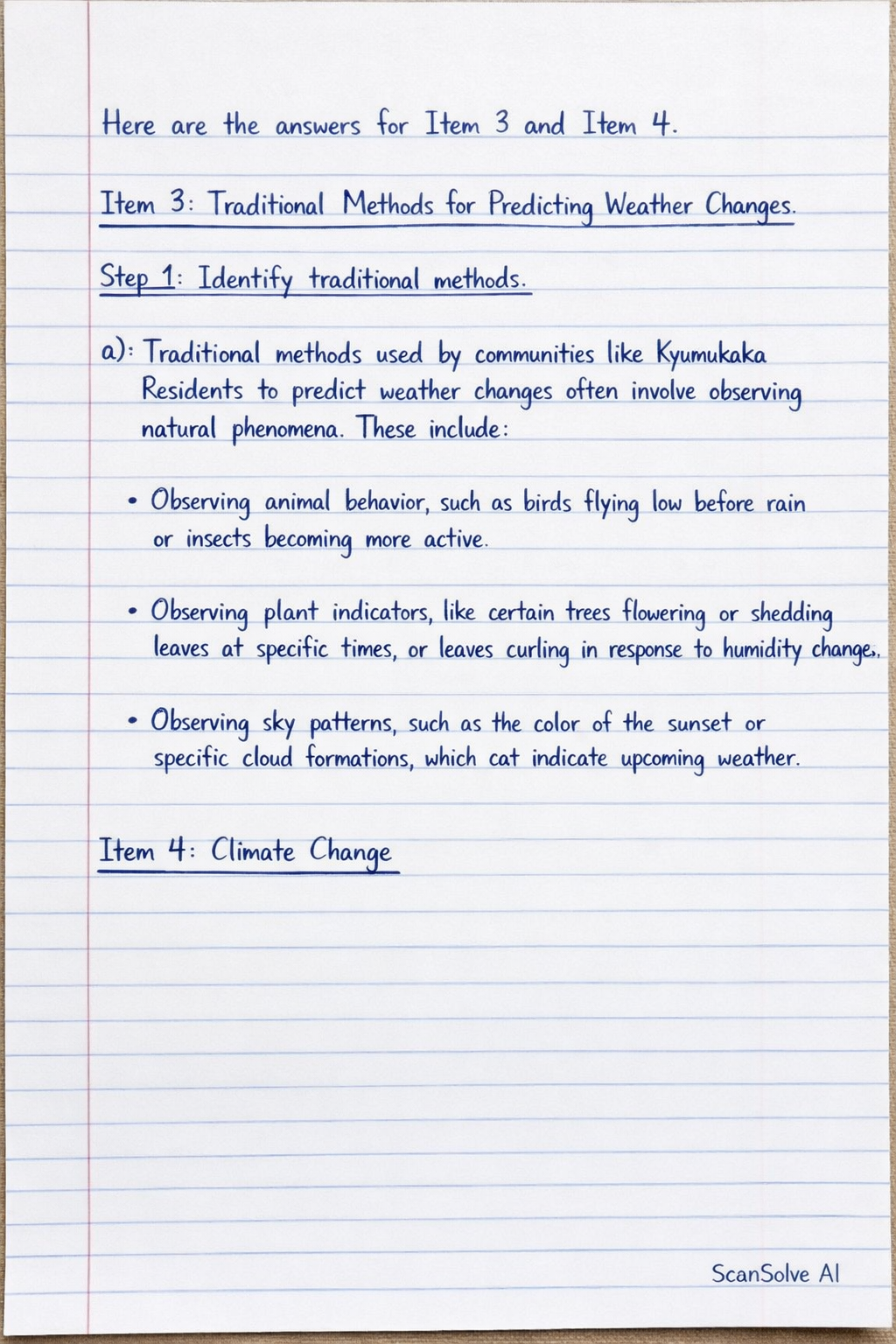
4 stepsHere are the answers for Item 3 and Item 4.
Item 3: Traditional Methods for Predicting Weather Changes
Identify traditional methods.
a) Traditional methods used by communities like Kyumukaka Residents to predict weather changes often involve observing natural phenomena. These include:
- Observing animal behavior, such as birds flying low before rain or insects becoming more active.
- Observing plant indicators, like certain trees flowering or shedding leaves at specific times, or leaves curling in response to humidity changes.
- Observing sky patterns, such as the color of the sunset or specific cloud formations, which can indicate upcoming weather.
Item 4: Climate Change
Explain human contributions to climate change.
a) Human beings contribute to the climate change problem primarily through activities that release greenhouse gases into the atmosphere. Key ways include:
- The burning of fossil fuels (coal, oil, and natural gas) for electricity generation, transportation, and industrial processes, which releases large amounts of carbon dioxide ().
- Deforestation, where forests are cleared for agriculture, logging, or development. Trees absorb , so their removal reduces the Earth's capacity to remove this greenhouse gas from the atmosphere.
- Industrial processes and agriculture, which release other potent greenhouse gases like methane () from livestock and landfills, and nitrous oxide () from fertilizers.
Discuss other effects of climate change on the environment and people.
b) Beyond melting glaciers and rising lake/river levels, climate change has several other significant impacts:
- Increased frequency and intensity of extreme weather events such as droughts, heatwaves, and severe storms, leading to crop failures and infrastructure damage.
- Sea-level rise due to thermal expansion of water and melting ice sheets, threatening coastal communities and ecosystems with inundation and erosion.
- Disruption of ecosystems and loss of biodiversity, as species struggle to adapt to rapid changes in temperature and habitat.
- Impacts on human health, including the spread of vector-borne diseases (e.g., malaria) due to altered climate patterns, and respiratory problems from increased air pollution.
Combat climate change at a local level.
c) At a local level, communities can combat climate change through various actions:
- Planting trees (afforestation and reforestation) to absorb and restore local ecosystems.
- Promoting energy conservation by encouraging the use of energy-efficient appliances, turning off lights, and reducing overall energy consumption in homes and public buildings.
- Implementing sustainable waste management practices, such as recycling, composting organic waste, and reducing single-use plastics to minimize landfill emissions.
- Encouraging the use of public transportation, cycling, and walking instead of private vehicles to reduce fossil fuel consumption and emissions.
Still stuck on this one?
Ask a follow-up, and the answer starts from this question.
More Geography Questions
Handwritten Step-by-Step Solution
Get this as a handwritten image on WhatsApp — like a tutor wrote it for you.
Try on WhatsApp