
We read your photo as:
Provide answers for questions 3.1.1 through 3.1.5 regarding the N3 national route and its economic impact.
ScanSolve AI Answer
Step-by-step solution
6 stepsAnswer 3.1.1
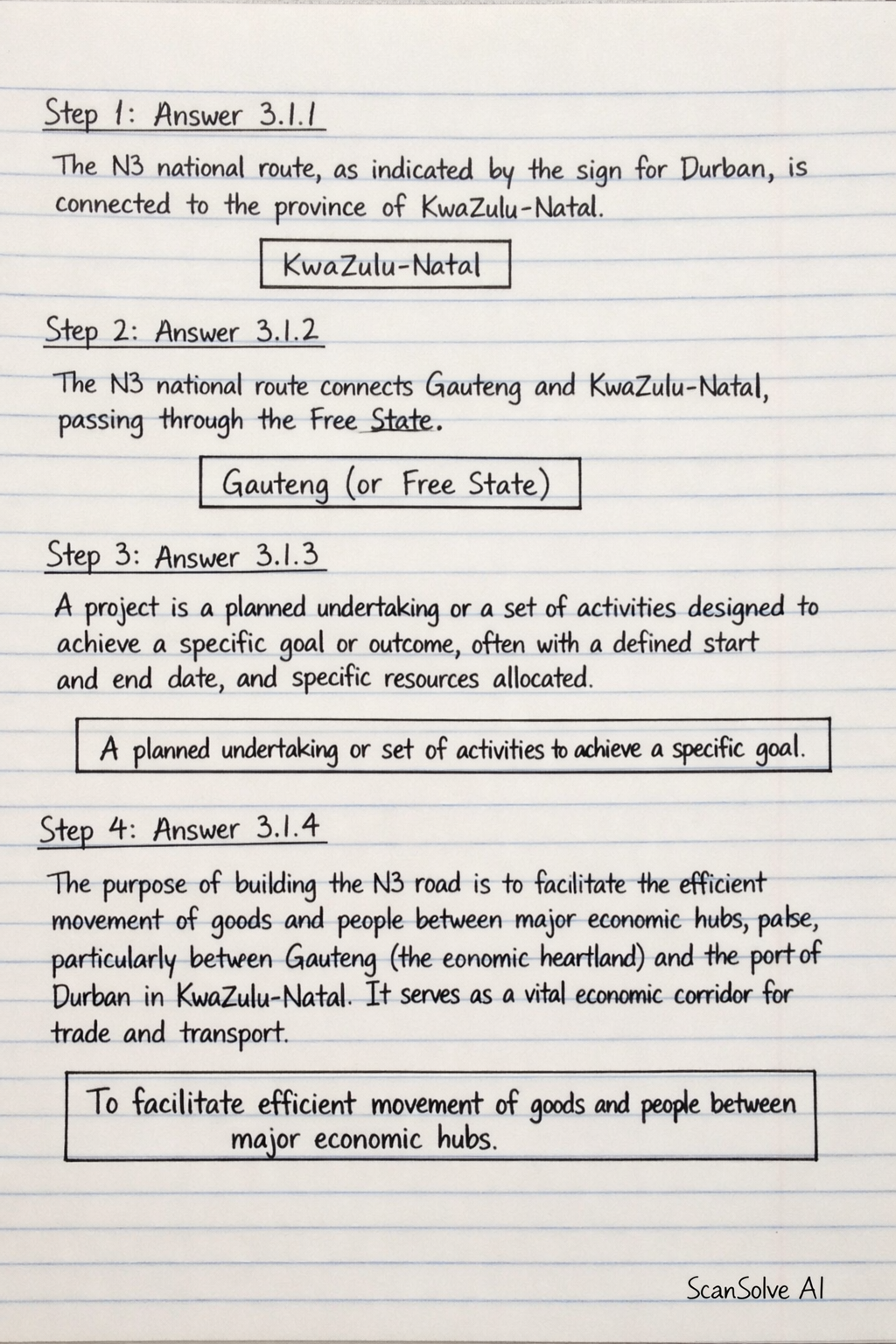
The N3 national route, as indicated by the sign for Durban, is connected to the province of KwaZulu-Natal.
Answer 3.1.2
The N3 national route connects Gauteng and KwaZulu-Natal, passing through the Free State.
Answer 3.1.3
A project is a planned undertaking or a set of activities designed to achieve a specific goal or outcome, often with a defined start and end date, and specific resources allocated.
Answer 3.1.4
The purpose of building the N3 road is to facilitate the efficient movement of goods and people between major economic hubs, particularly between Gauteng (the economic heartland) and the port of Durban in KwaZulu-Natal. It serves as a vital economic corridor for trade and transport.
Answer 3.1.5
The economy benefits from the N3 project in several ways:
- Reduced transport costs and time: Businesses can transport goods more quickly and cheaply, leading to lower production costs and more competitive prices.
- Increased trade and economic activity: Improved infrastructure supports greater volumes of trade, both domestically and internationally, boosting economic growth.
- Job creation: The construction and maintenance of the road create employment opportunities.
- Improved access to markets: Farmers and businesses in areas along the route gain better access to larger markets, stimulating local economies.
- Tourism: Easier travel encourages tourism, benefiting related industries like hospitality and retail.
Answer 3.2
Negative externalities caused by the N3 road project are costs imposed on third parties who are not directly involved in the production or consumption of the road's services. These include:
- Environmental pollution: Increased vehicle traffic leads to higher air pollution (emissions of greenhouse gases and other pollutants) and noise pollution, affecting nearby communities and ecosystems.
- Habitat destruction: The construction of the road can lead to the destruction of natural habitats, fragmentation of ecosystems, and loss of biodiversity.
- Increased traffic congestion: While the road aims to reduce congestion, increased accessibility can sometimes lead to more vehicles on the road, causing congestion in urban areas connected by the N3.
- Accidents: A higher volume of traffic can lead to an increased risk of road accidents, resulting in injuries, fatalities, and property damage for road users and nearby residents.
- Visual blight: Large infrastructure projects can alter the natural landscape, leading to a loss of aesthetic value in certain areas.
Analysis with the aid of a graph:
A negative externality of production, such as pollution from increased traffic on the N3, means that the social cost of production is greater than the private cost.\begin{tikzpicture} \begin{axis}[ axis lines=left, xlabel={Quantity of Transport (Q)}, ylabel={Price/Cost (P)}, xmin=0, xmax=10, ymin=0, ymax=10, xtick=\empty, ytick=\empty, legend pos=south east, legend style={font=\small} ] \addplot[domain=1:9, blue, thick] {x-1} node[above right, pos=0.8] {$S_{private} = MPC$}; \addplot[domain=1:9, red, thick, dashed] {x+1} node[above right, pos=0.8] {$S_{social} = MSC$}; \addplot[domain=1:9, black, thick] {10-x} node[below left, pos=0.8] {$D = MSB$}; \coordinate (Q_private) at (axis cs:5.5,4.5); \coordinate (P_private) at (axis cs:4.5,5.5); \coordinate (Q_social) at (axis cs:4.5,5.5); \coordinate (P_social) at (axis cs:5.5,6.5); \draw[dashed] (Q_private |- 0,0) node[below] {$Q_{private}$} -- (Q_private); \draw[dashed] (0,0 -| Q_private) node[left] {$P_{private}$} -- (Q_private); \draw[dashed] (Q_social |- 0,0) node[below] {$Q_{social}$} -- (Q_social); \draw[dashed] (0,0 -| Q_social) node[left] {$P_{social}$} -- (Q_social); \fill[black] (Q_private) circle (1.5pt) node[above right] {$E_{private}$}; \fill[black] (Q_social) circle (1.5pt) node[above right] {$E_{social}$}; \draw[<->, thick, gray] (axis cs:6, 5) -- (axis cs:6, 7) node[midway, right] {External Cost}; \end{axis} \end{tikzpicture}In the graph:
- The Demand curve (D) represents the Marginal Social Benefit (MSB) of transport.
- The private supply curve () represents the Marginal Private Cost (MPC) of using the road (e.g., fuel, tolls).
- The social supply curve () represents the Marginal Social Cost (MSC), which includes MPC plus the external costs (e.g., pollution, congestion).
- The private equilibrium () occurs where MPC = MSB, leading to a quantity of transport and price .
- The socially optimal equilibrium () occurs where MSC = MSB, leading to a lower quantity of transport and a higher price . The gap between and represents the external cost per unit of transport. Because these external costs are not borne by the road users or operators, the market produces more transport than is socially optimal (), leading to a misallocation of resources and a deadweight loss to society.
Still stuck on this one?
Ask a follow-up, and the answer starts from this question.
More Geography Questions
Handwritten Step-by-Step Solution
Get this as a handwritten image on WhatsApp — like a tutor wrote it for you.
Try on WhatsApp