
We read your photo as:
Q6: A rural health clinic is deciding whether to continue using the syndromic approach for STI management or switch to an etiologic approach. Giving the clinic's limited budget and lack of laborator
ScanSolve AI Answer
Step-by-step solution
13 stepsHere are the answers to the questions from the image you sent.
Q6: A rural health clinic is deciding whether to continue using the syndromic approach for STI management or switch to an etiologic approach. Giving the clinic's limited budget and lack of laboratory facilities, compare and contrast these two approaches. Your analysis must address diagnostic accuracy, time to treatment initiation, and resource requirement to determine which approach is most suitable for this setting.
The syndromic approach involves treating STIs based on a patient's presenting symptoms (syndromes) without laboratory confirmation.
The etiologic approach relies on laboratory tests to identify the specific causative pathogen before initiating treatment.
Step 2
- Diagnostic Accuracy: The syndromic approach has lower diagnostic accuracy as it treats for the most likely pathogens based on symptoms, potentially leading to overtreatment or undertreatment if the actual cause differs. The etiologic approach offers higher diagnostic accuracy because it identifies the specific pathogen, allowing for targeted treatment.
- Time to Treatment Initiation: The syndromic approach allows for rapid treatment initiation as therapy begins immediately upon clinical assessment. The etiologic approach has a slower time to treatment initiation due to the time required for sample collection, transport, laboratory processing, and result reporting.
- Resource Requirement: The syndromic approach has low resource requirements, needing minimal laboratory facilities and relying on clinical algorithms and pre-packaged drugs. The etiologic approach has high resource requirements, demanding well-equipped laboratories, trained personnel, and a robust supply chain for reagents and equipment.
Given the rural health clinic's limited budget and lack of available laboratory facilities, the syndromic approach is the most suitable.
It ensures rapid and accessible treatment, which is crucial in settings where laboratory diagnostics are not feasible, despite its lower diagnostic accuracy.
Q7: A clinician is implementing Syndromic management for a patient with genital ulcer disease. Describe the four (4) essential components of this management strategy beyond providing pharmacological treatment. Explain how each component contributes to public health goals.
Beyond pharmacological treatment, the four essential components of STI management, particularly for genital ulcer disease, are Counseling, Compliance, Contact Tracing, and Condom Promotion.
Counseling* involves educating the patient about their genital ulcer disease, its transmission, the importance of treatment adherence, and safe sexual practices.
This contributes to public health goals by empowering individuals to make informed decisions, reducing risky behaviors, and preventing further transmission within the community.
Compliance* refers to the patient's adherence to the full prescribed treatment regimen.
For public health, this ensures the individual is cured, prevents the development of drug resistance, shortens the period of infectivity, and ultimately stops the spread of the infection to others.
Contact Tracing* involves identifying, notifying, and treating sexual partners of the infected individual.
This is vital for public health as it prevents reinfection of the primary patient, interrupts chains of transmission, and reduces the overall prevalence of STIs in the community.
Condom Promotion* focuses on educating patients about the correct and consistent use of condoms and providing access to them.
This contributes to public health by serving as a primary barrier method to prevent the acquisition and transmission of STIs, thereby reducing the incidence of new infections.
Q8: Public health initiatives often struggle with cultural barriers. Explain how a lack of "openness and mixed messages" regarding sexuality specifically impede the clinical management and control of STIs. Your response should analyze how these.
A lack of openness and mixed messages regarding sexuality create significant cultural barriers that impede both the clinical management and public health control of STIs.
Lack of openness* (often stemming from stigma and taboo) impedes clinical management because individuals may delay seeking care due to shame, fear of judgment, or social repercussions.
This leads to advanced disease, complications, and continued transmission. Patients may also be reluctant to disclose their sexual history or partners accurately to clinicians, hindering proper diagnosis and partner notification.
This lack of openness impedes STI control by preventing open discussions about sexual health and STIs within communities.
This silence undermines prevention campaigns, limits effective sexual health education, and perpetuates misconceptions, making it difficult to implement widespread screening and early detection programs.
Mixed messages* regarding sexuality (e.g., conflicting information from religious leaders, family, peers, and health professionals) impede clinical management as patients may become confused about symptoms, prevention methods, and the efficacy of medical treatments.
This confusion can lead to non-adherence to prescribed therapies or reliance on unproven remedies, compromising individual recovery.
Mixed messages impede STI control by eroding trust in public health authorities and creating inconsistent understanding of risk and protective behaviors.
For example, conflicting advice on abstinence-only versus comprehensive sex education can leave adolescents ill-equipped to make informed decisions, ultimately reducing the effectiveness of public health interventions aimed at preventing STI transmission.
Still stuck on this one?
Ask a follow-up, and the answer starts from this question.
More Geography Questions
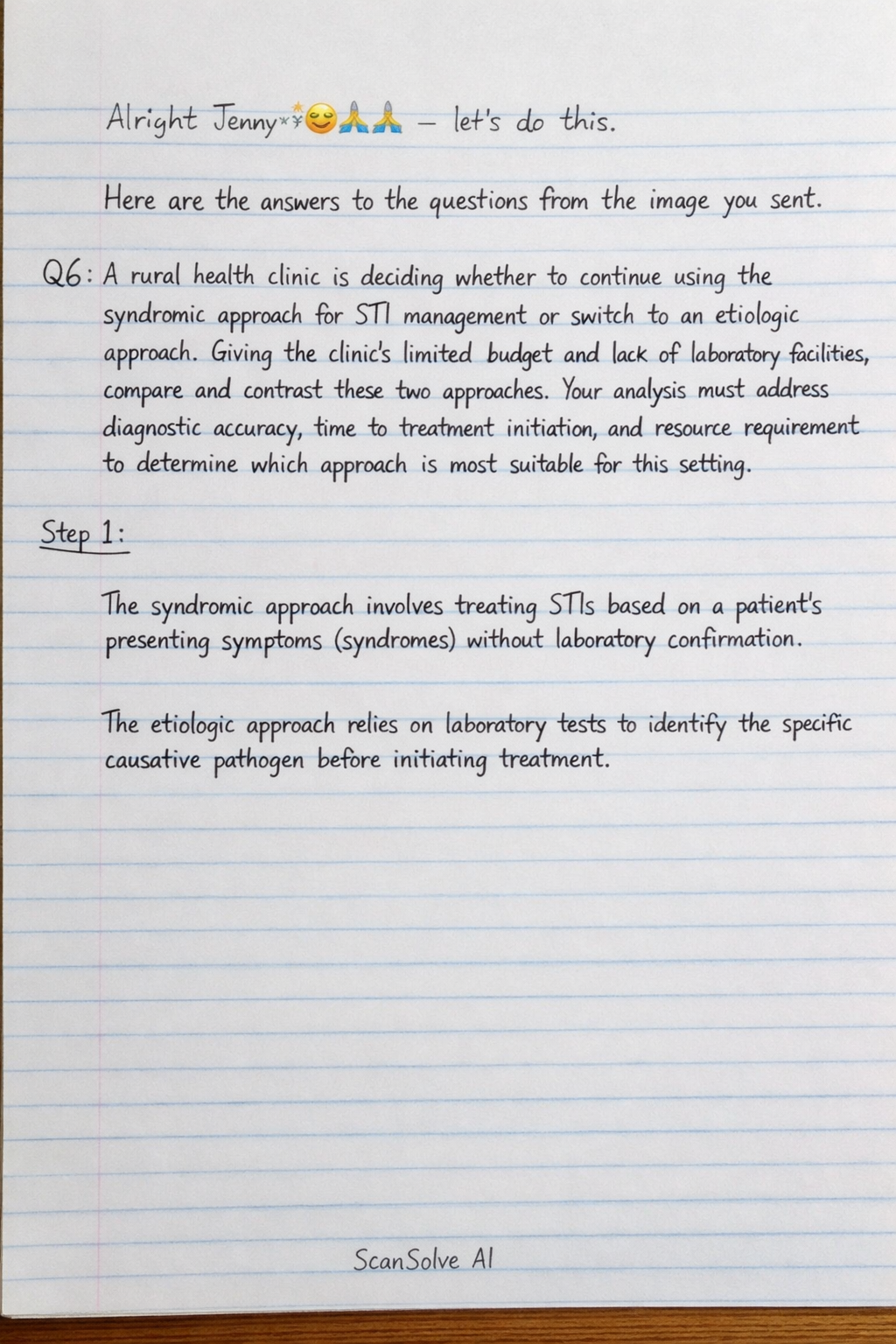
Handwritten Step-by-Step Solution
Get this as a handwritten image on WhatsApp — like a tutor wrote it for you.
Try on WhatsApp