

This geography problem is solved step by step below, with detailed explanations to help you understand the method and arrive at the correct answer.
ScanSolve AI Answer
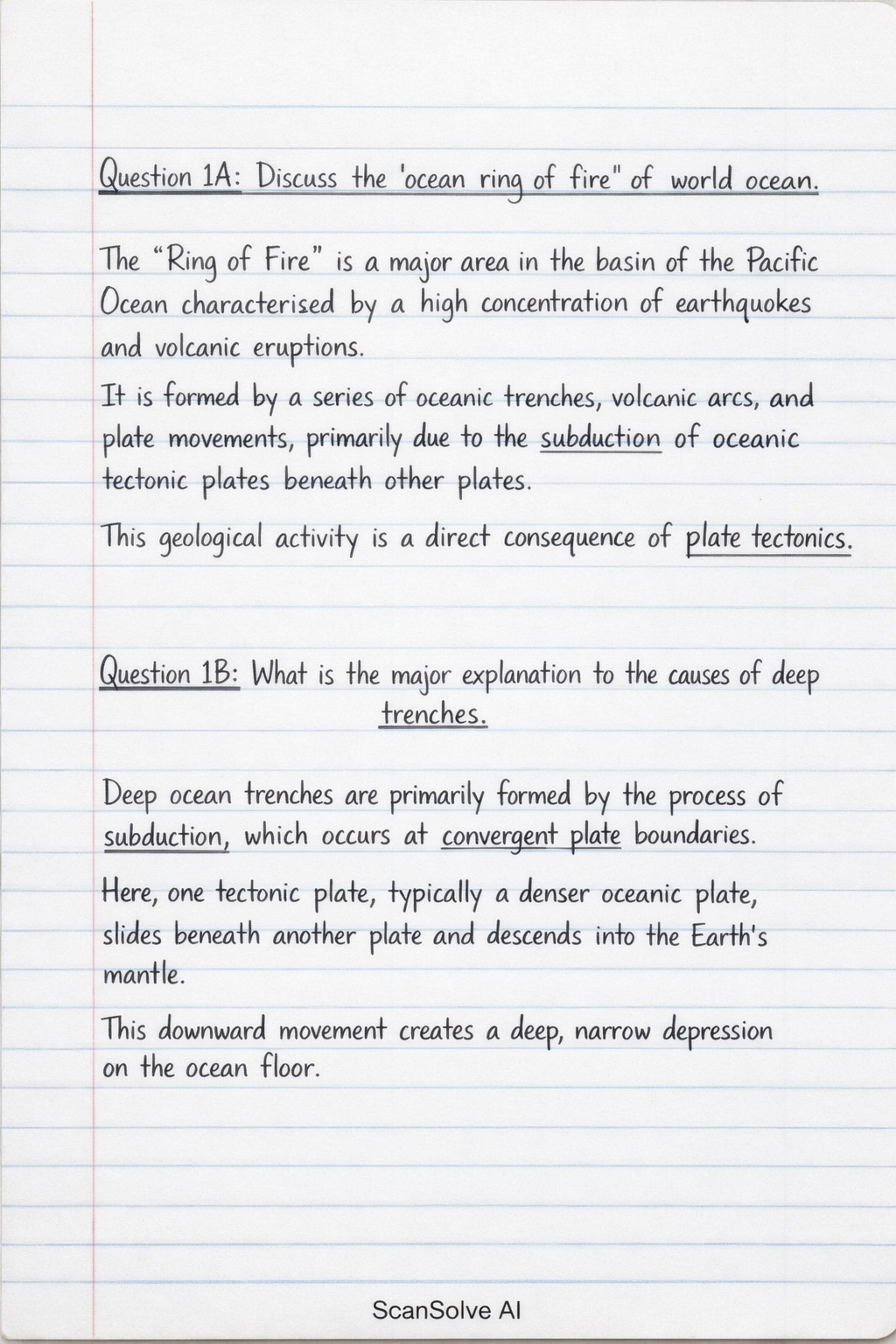
Question 1A: Discuss the "ocean ring of fire" of world ocean. The "Ring of Fire" is a major area in the basin of the Pacific Ocean characterized by a high concentration of earthquakes and volcanic eruptions. It is formed by a series of oceanic trenches, volcanic arcs, and plate movements, primarily due to the subduction of oceanic tectonic plates beneath other plates. This geological activity is a direct consequence of plate tectonics. Question 1B: What is the major explanation to the causes of deep trenches. Deep ocean trenches are primarily formed by the process of subduction, which occurs at convergent plate boundaries. Here, one tectonic plate, typically a denser oceanic plate, slides beneath another plate and descends into the Earth's mantle. This downward movement creates a deep, narrow depression on the ocean floor. Question 1C: Why is the middle of ocean not deepest as one will expect? The middle of the ocean, particularly along mid-ocean ridges, is not the deepest because it is where new oceanic crust is continuously formed through seafloor spreading. Magma rises from the mantle, solidifies, and creates elevated underwater mountain ranges. These areas are shallower compared to the deep ocean trenches found at subduction zones. Question 1D: Discuss any bio significant of volcanic eruption in the deep oceans. Deep-ocean volcanic eruptions are biologically significant because they create hydrothermal vents. These vents release superheated, mineral-rich fluids that support unique chemosynthetic ecosystems. Organisms like chemoautotrophic bacteria form the base of the food web, converting chemicals into energy, sustaining diverse communities of specialized invertebrates and fish in the absence of sunlight. Question 1E: Differentiate between sea and ocean. An ocean is a vast, continuous body of saltwater that covers most of the Earth's surface, typically referring to the five major oceanic divisions. A sea is generally a smaller, often partially enclosed body of saltwater, usually located on the margins of an ocean and partially enclosed by land. Seas are typically shallower and have more direct interaction with landmasses. Question 2A: Compare corrosion effects on structures at 100m and 10m of ocean depths. Corrosion effects differ with depth due to varying environmental conditions. At 10m depth, higher oxygen availability, warmer temperatures, and increased biological fouling (e.g., barnacles) generally accelerate corrosion rates. At 100m depth, oxygen levels are typically lower, temperatures are colder, and biological activity is reduced, which can slow down oxygen-dependent corrosion processes. However, increased pressure at 100m can also influence material behavior. Question 2B: Describe the earth without the ocean. Without the ocean, Earth would be a barren, dry planet with extreme temperature fluctuations between day and night. The hydrological cycle would cease, eliminating rain, rivers, and lakes. The absence of oceans would lead to the collapse of marine ecosystems, significantly alter atmospheric composition, and remove the primary moderator of global temperatures, rendering the planet largely uninhabitable for complex life. Question 2C: What exactly will happen today if the sun seizes to exist? If the sun ceased to exist today, Earth would experience immediate darkness, though light from the sun would continue to reach us for about 8 minutes. Photosynthesis would stop, leading to the collapse of most food webs. Global temperatures would rapidly plummet, causing oceans to freeze and the atmosphere to eventually dissipate. Earth would continue its orbital path for a period before drifting into interstellar space as a frozen, lifeless rogue planet. Question 2D: Why do we say that tides in west Africa is semi diurnal? Tides in West Africa are described as semi-diurnal because the region experiences two high tides and two low tides of approximately equal height within each lunar day (about 24 hours and 50 minutes). This pattern is a common tidal regime influenced by the gravitational forces of the Moon and Sun, as well as the specific characteristics of the ocean basin. Question 2E: The Gulf of Mexico and part of Malaysia and Indonesia have diurnal tides. What is diurnal tide? And what could be the possible reason(s) it happens compared to the semi diurnal system? A diurnal tide is a tidal pattern characterized by one high tide and one low tide per lunar day. This differs from the more common semi-diurnal system. The primary reason for diurnal tides in specific regions like the Gulf of Mexico or parts of Southeast Asia is the shape and bathymetry of the ocean basin. The resonant period of these basins can amplify the diurnal tidal components while suppressing the semi-diurnal components, leading to a single high and low tide cycle. Question 3A: With simple charts, describe the relationship between salinity and temperature, density and temperature. Salinity and Temperature: A chart would typically show temperature on the x-axis and salinity on the y-axis. In surface waters, the relationship is complex; warmer waters can have higher salinity due to evaporation, but also lower due to precipitation. In deeper waters, temperature decreases with depth, while salinity can vary. Density and Temperature: A chart would show temperature on the x-axis and density on the y-axis. There is a strong inverse relationship*: as temperature increases, water density decreases (water becomes lighter). Conversely, as temperature decreases, water density increases (water becomes denser), up to a certain point (e.g., 4^ for fresh water, lower for saltwater). Question 3B: Usually, motion of fluid is from area of high pressure to areas of low pressure. For both wind and the ocean body, describe agents and processes that can produce wind and ocean water high pressures. 8mks Wind High Pressures: Agents: The primary agent is differential heating of the Earth's surface* by solar radiation. Processes: When air cools, it becomes denser and sinks, creating an area of high atmospheric pressure* at the surface. This cooling can result from radiative cooling, subsidence of air from the upper atmosphere (e.g., in subtropical high-pressure belts), or the advection of cold air masses. Ocean Water High Pressures: Agents: Key agents include temperature, salinity, and wind stress*. Processes: Cold, salty water is denser and sinks, creating areas of higher pressure at depth, which drives thermohaline circulation. For example, in polar regions, surface water cools and forms ice, leaving behind saltier, denser water that sinks. Additionally, persistent wind stress can pile up* surface water in certain areas,