
We read your photo as:
What is soil erosion and what are its causes? What is crop rotation and what are its benefits?
ScanSolve AI Answer
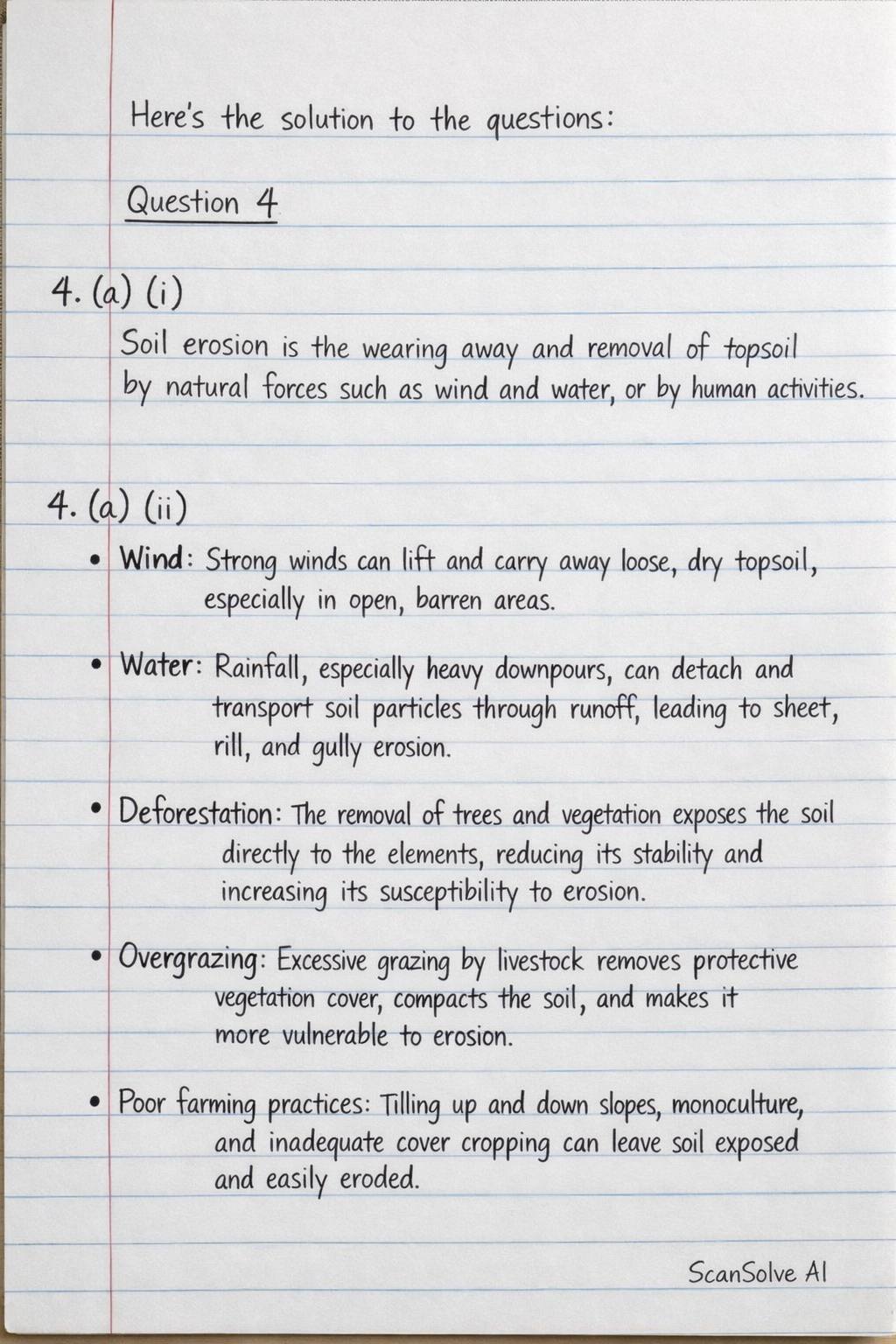
Here's the solution to the questions:
Question 4
4. (a) (i)
Soil erosion is the wearing away and removal of topsoil by natural forces such as wind and water, or by human activities.
4. (a) (ii)
- Wind: Strong winds can lift and carry away loose, dry topsoil, especially in open, barren areas.
- Water: Rainfall, especially heavy downpours, can detach and transport soil particles through runoff, leading to sheet, rill, and gully erosion.
- Deforestation: The removal of trees and vegetation exposes the soil directly to the elements, reducing its stability and increasing its susceptibility to erosion.
- Overgrazing: Excessive grazing by livestock removes protective vegetation cover, compacts the soil, and makes it more vulnerable to erosion.
- Poor farming practices: Tilling up and down slopes, monoculture, and inadequate cover cropping can leave soil exposed and easily eroded.
4. (b) (i)
Crop rotation is an agricultural practice where different types of crops are grown in the same area in sequenced seasons. This practice helps to maintain soil health, optimize nutrient cycling, and combat pests and weeds.
4. (b) (ii)
- It improves soil fertility by allowing different crops to replenish or utilize different nutrients, especially when legumes are included to fix nitrogen.
- It reduces pest and disease build-up by breaking the life cycles of specific pests and pathogens that target certain crops.
- It enhances soil structure and organic matter content, leading to better water infiltration and reduced erosion.
- It can increase crop yields over time due to improved soil health and reduced pest pressure.
4. (c)
- Contour ploughing: This method involves ploughing and planting crops along the contours of a slope, rather than up and down. The furrows created by contour ploughing act as small dams, slowing down water runoff and allowing more water to infiltrate the soil, thereby reducing soil erosion.
- Terracing: Terracing involves constructing a series of broad, level steps or platforms along hillsides. These terraces intercept water runoff, reduce its velocity, and prevent soil from being washed downhill. They are particularly effective on steep slopes.
- Afforestation/Reforestation: Planting trees and other vegetation helps to bind the soil with their root systems, protecting it from the direct impact of rain and wind. The canopy also reduces the force of raindrops hitting the soil.
- Cover cropping: Planting non-cash crops (cover crops) between main crop seasons or alongside them helps to protect the soil surface from wind and water erosion, adds organic matter, and improves soil structure.
4. (d)
- Loss of biodiversity: Deforestation destroys habitats for countless plant and animal species, leading to a significant reduction in biodiversity and, in many cases, species extinction. This disrupts ecosystems and can have cascading effects on food webs and ecological balance.
- Climate change: Forests act as carbon sinks, absorbing large amounts of carbon dioxide from the atmosphere. Deforestation releases this stored carbon back into the atmosphere, contributing to increased greenhouse gas concentrations and accelerating global warming and climate change.
- Soil erosion and degradation: With the removal of tree cover, soil is directly exposed to rain and wind, leading to increased soil erosion. The loss of organic matter and nutrients from the topsoil degrades soil quality, making it less fertile and productive.
- Disruption of water cycles: Forests play a crucial role in regulating local and regional water cycles through transpiration. Deforestation can lead to reduced rainfall, increased runoff, and a higher risk of floods and droughts in affected areas.
Question 5
5. (a) (i)
Respiration is the biochemical process by which living organisms convert glucose (food) into energy (ATP) for cellular activities, releasing carbon dioxide and water as byproducts.
5. (a) (ii)
| Feature | Aerobic Respiration | Anaerobic Respiration |
|---|---|---|
| Oxygen required | Requires oxygen | Does not require oxygen |
| Energy yield | High (approx. 30-32 ATP molecules per glucose) | Low (2 ATP molecules per glucose) |
| Products | Carbon dioxide () and water () | Lactic acid (in animals) or ethanol and (in plants/yeast) |
| Location | Cytoplasm and mitochondria | Cytoplasm only |
| Efficiency | More efficient breakdown of glucose | Less efficient breakdown of glucose |
5. (b) (i)
- Transport of oxygen: Blood carries oxygen from the lungs to all body tissues.
- Transport of nutrients: It transports absorbed nutrients (e.g., glucose, amino acids) from the digestive system to cells.
- Transport of waste products: It carries metabolic waste products (e.g., urea, carbon dioxide) to the kidneys and lungs for excretion.
- Regulation of body temperature: Blood helps to distribute heat throughout the body, maintaining a stable core temperature.
- Defense against pathogens: White blood cells and antibodies in the blood protect the body from infections and diseases.
5. (b) (ii)
- Plasma
- Red blood cells (Erythrocytes)
- White blood cells (Leukocytes)
- Platelets (Thrombocytes)
5. (c)
- Hypertension (High Blood Pressure): This is a condition where the force of blood against the artery walls is consistently too high. It often has no symptoms but can lead to serious health problems like heart attack, stroke, and kidney disease if left untreated. Causes include genetics, unhealthy diet, lack of exercise, and stress.
- Atherosclerosis: This disease involves the hardening and narrowing of arteries due to the build-up of plaque (fats, cholesterol, and other substances) on their inner walls. This plaque can restrict blood flow, leading to conditions like heart attack, stroke, and peripheral artery disease. Risk factors include high cholesterol, high blood pressure, smoking, and diabetes.
- Coronary Artery Disease (CAD): This occurs when the blood vessels that supply blood to the heart muscle become narrowed or blocked, usually due to atherosclerosis. This can lead to chest pain (angina), heart attack, or heart failure.
5. (d)
- Eating a balanced diet: Consuming a variety of fruits, vegetables, whole grains, lean proteins, and healthy fats, while limiting processed foods, sugary drinks, and excessive saturated/trans fats.
- Engaging in regular physical activity: Participating in at least 150 minutes of moderate-intensity aerobic exercise or 75 minutes of vigorous-intensity exercise per week, along with strength training.
- Getting adequate sleep: Aiming for 7-9 hours of quality sleep per night to allow the body to rest and repair.
- Avoiding harmful substances: Refraining from smoking, excessive alcohol consumption, and illicit drug use.
- Managing stress: Practicing stress-reduction techniques such as meditation, yoga, or spending time in nature.
Still stuck on this one?
Ask a follow-up, and the answer starts from this question.
More Geography Questions
Handwritten Step-by-Step Solution
Get this as a handwritten image on WhatsApp — like a tutor wrote it for you.
Try on WhatsApp