

This geography problem is solved step by step below, with detailed explanations to help you understand the method and arrive at the correct answer.
ScanSolve AI Answer
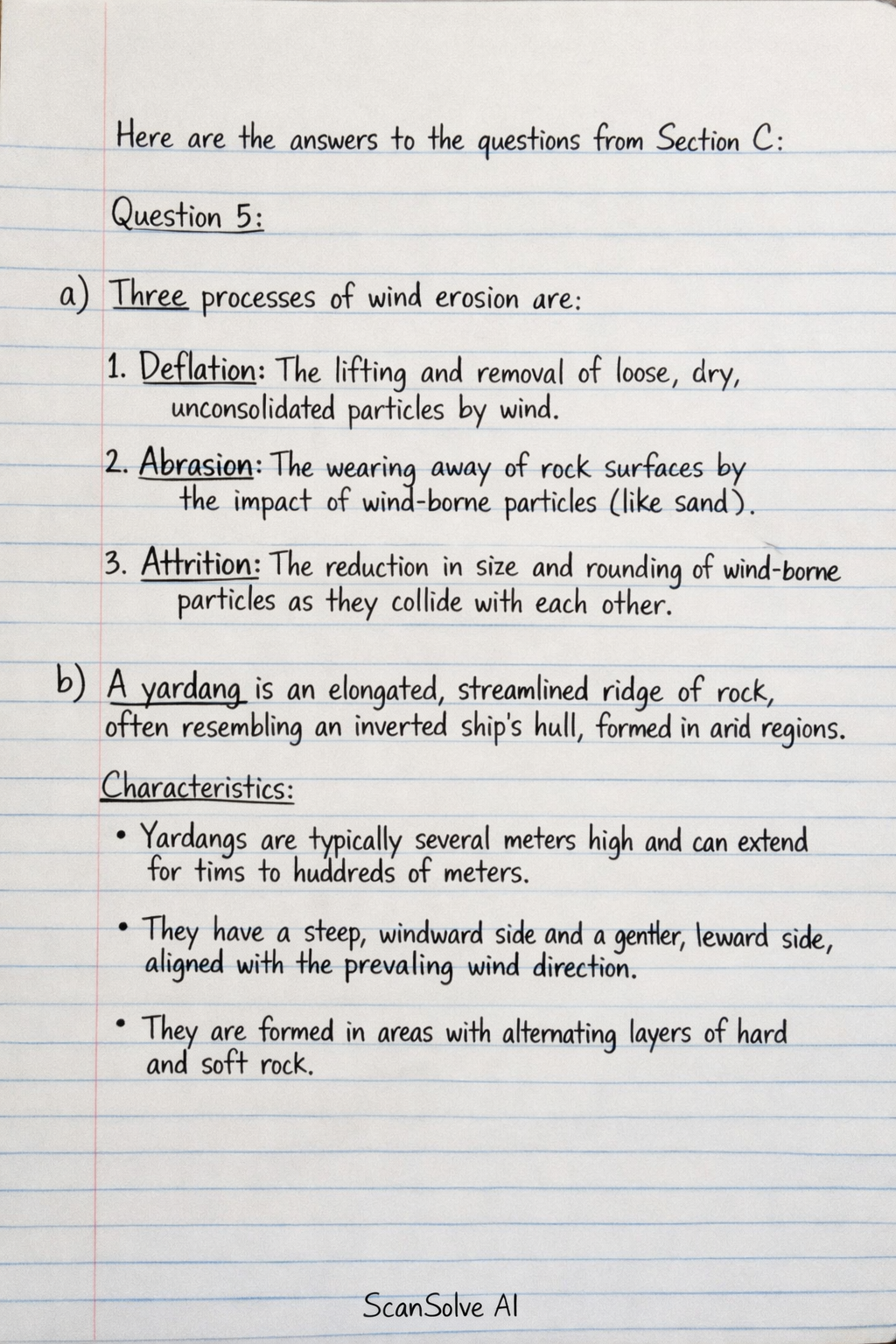
Here are the answers to the questions from Section C: Question 5: a) Three processes of wind erosion are: 1. Deflation: The lifting and removal of loose, dry, unconsolidated particles by wind. 2. Abrasion: The wearing away of rock surfaces by the impact of wind-borne particles (like sand). 3. Attrition: The reduction in size and rounding of wind-borne particles as they collide with each other. b) A yardang is an elongated, streamlined ridge of rock, often resembling an inverted ship's hull, formed in arid regions. Characteristics:* Yardangs are typically several meters high and can extend for tens to hundreds of meters. They have a steep, windward side and a gentler, leeward side, aligned with the prevailing wind direction. They are formed in areas with alternating layers of hard and soft rock. Mode of formation:* Yardangs form when wind, carrying abrasive sand particles, erodes softer rock layers or weaker zones more rapidly than harder, more resistant rock. The wind preferentially sculpts the landscape along lines of weakness, creating grooves and hollows. Over time, the more resistant rock stands out as elongated ridges, with their shape streamlined by the continuous abrasive action of the wind. (A diagram would typically show an elongated ridge with a steep side facing the wind and a gentler side on the leeward, indicating the direction of the prevailing wind.) Question 6: a) Two warm ocean currents associated with the Atlantic Ocean are: 1. Gulf Stream 2. North Atlantic Drift b) Five characteristics of the Benguela current are: 1. It is a cold ocean current. 2. It flows northward along the west coast of Southern Africa. 3. It originates from the Antarctic Circumpolar Current. 4. It causes significant upwelling of cold, nutrient-rich water. 5. It contributes to the aridity of the Namib Desert. c) Four benefits of the ocean to mankind are: 1. Food Source: Provides a significant source of food, including fish, shellfish, and seaweed, supporting global food security. 2. Transportation and Trade: Serves as a major route for international shipping, facilitating global trade and the movement of goods. 3. Climate Regulation: Plays a crucial role in regulating global climate by absorbing heat and carbon dioxide, and influencing weather patterns. 4. Mineral and Energy Resources: Contains valuable mineral resources (e.g., salt, manganese nodules) and is a source of fossil fuels (oil, natural gas) and renewable energy (tidal, wave power). Question 7: a) Three reasons for places north of the Arctic Circle experiencing 24 hours of continuous daylight on 21st June are: 1. Earth's Axial Tilt: The Earth's axis is tilted at approximately 23.5^ relative to its orbital plane. 2. Summer Solstice: On June 21st, the Northern Hemisphere is tilted most directly towards the Sun, marking the Summer Solstice. 3. Sun's Position: Due to this tilt, the Sun's rays extend beyond the North Pole, illuminating all areas north of the Arctic Circle continuously as the Earth rotates. b) Three effects of: (i) rotation of the Earth: 1. Alternation of Day and Night: Causes the daily cycle of day and night. 2. Coriolis Effect: Leads to the Coriolis effect, which deflects moving objects (like winds and ocean currents) to the right in the Northern Hemisphere and to the left in the Southern Hemisphere. 3. Apparent Movement of Celestial Bodies: Causes the apparent daily rising and setting of the Sun, Moon, and stars. (ii) revolution of the Earth: 1. Change of Seasons: Causes the annual cycle of seasons due to the varying angle of the Sun's rays throughout the year. 2. Varying Length of Day and Night: Leads to changes in the length of day and night at different times of the year in most parts of the world. 3. Different Constellations Visible: Causes different constellations to be visible in the night sky at different times of the year. Question 8: a) An environmental resource refers to any natural material or energy source found in the environment that is useful or valuable to humans. These resources can be renewable (e.g., sunlight, forests) or non-renewable (e.g., minerals, fossil fuels). b) Four advantages of vegetation to mankind are: 1. Oxygen Production: Vegetation, through photosynthesis, produces oxygen, which is essential for human respiration and the survival of most life forms. 2. Food Source: Plants provide a direct source of food (fruits, vegetables, grains) and indirectly support livestock that humans consume. 3. Raw Materials: Vegetation supplies various raw materials for industries, such as timber for construction, fibers for textiles, and medicinal compounds. 4. Soil Conservation: Plant roots bind soil particles, preventing soil erosion by wind and water, and improving soil fertility. c) Two problems created by the over-exploitation of mineral resources are: 1. Resource Depletion: Leads to the exhaustion of non-renewable mineral reserves, making them unavailable for future generations and potentially causing economic instability. 2. Environmental Degradation: Mining activities often result in habitat destruction, deforestation, soil erosion, water pollution (e.g., acid mine drainage), and air pollution, severely impacting ecosystems. Send me the next one 📸